
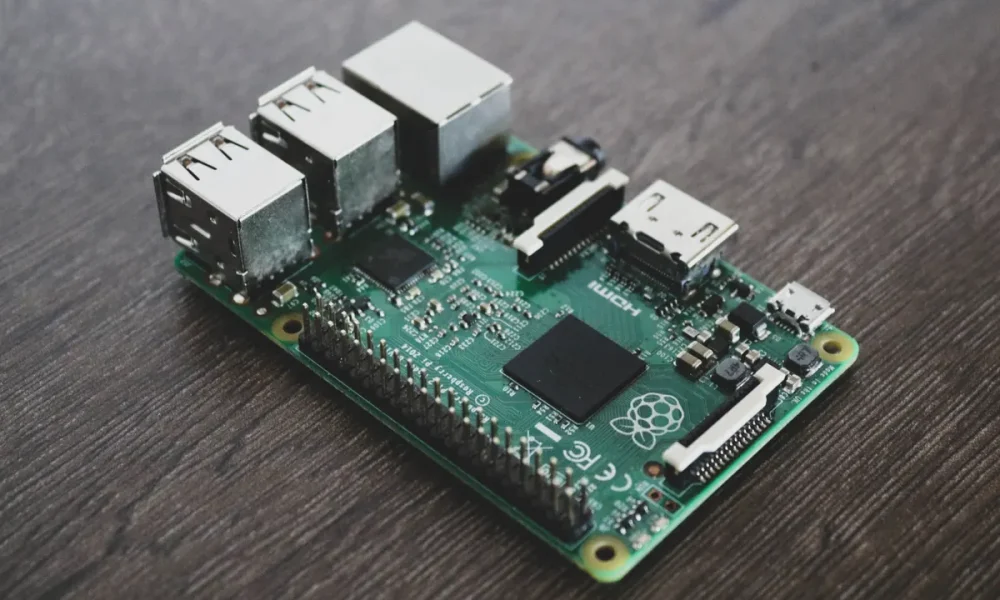
Raspberry Pi and Filtronic shares are drawing fresh attention from investors who watched Rolls-Royce deliver a 1,338% return since mid-2021 and are now scanning the market for the next multi-year compounder. Both companies sit in very different corners of the market, but each carries a credible long-term growth thesis, along with risks that deserve an honest look.
Raspberry Pi: actual numbers behind the AI hype
The share price has more than doubled year to date, which tends to invite scepticism. But the underlying numbers from the company’s FY 2025 results, published 31 March 2026, offer something firmer to work with. Revenue came in at $323.2m, up from $259.5m in FY 2024, representing 25% year-on-year growth. Gross profit reached $77.8m, with EBITDA growth of 25% described as ahead of expectations.
Profitability at the product level is also moving in the right direction. Accessory profit per board improved to $1.4 in FY 2025, ahead of the company’s own target of $1 per board. Gross profit from single-board computers and compute modules rose 28% to $66.3m, while accessories gross profit grew 28% to $10.9m.
The broader growth story leans heavily on edge AI. Raspberry Pi’s AI HAT+ 2 board enables customers to run large language models and vision language models locally on devices, bypassing cloud dependency. Semiconductor unit sales increased 47% to 8.4m in FY 2025, the first year they exceeded single-board computer and module units at 7.6m. The company’s Connect platform, which allows enterprises to link securely to IoT devices in the field, finished the year with approaching 400,000 connected devices, with over-the-air update functionality added in Q4.
Analysts expect revenue to approach $608m in the current year, with roughly 60% earnings-per-share growth, if momentum from the US and China (up 56% and 62% respectively in unit terms last year) holds. The forward price-to-earnings ratio sits at around 50, so the market is already pricing in much of that outcome. A memory chip shortage, expected to persist into 2027, is driving input costs higher and forcing Raspberry Pi to pass those costs on to customers, which could cap margin expansion and test that premium valuation.
The setup suggests a stock that rewards patience and punishes leverage. Arm Holdings-backed, growing strongly across smart home, aerospace and defence verticals, and with a credible edge AI angle, the long-term case holds. But at a 50x forward multiple, every quarterly result becomes a test of whether the growth rate justifies the price.
Filtronic and the SpaceX contract pipeline
Filtronic shares have risen around 2,300% over five years, which makes the 44% pullback over two months feel like a correction rather than a collapse. The question is whether the pullback is structural or cyclical. The contract record suggests the latter.
In August 2025, Filtronic secured its largest-ever order, a £47.3m ($62.5m) contract from SpaceX for its next-generation gallium nitride (GaN) E-band product, to be used in the Starlink high-speed internet service. First units are scheduled to ship in FY2027, with material revenues expected across FY2027 and FY2028. That contract followed a £32.5m purchase in June, a £16.8m win in February, and a £6.4m production order the previous August, building a picture of deepening commercial dependency from SpaceX’s side.
The original strategic partnership was signed on 24 April 2024, covering the supply of E-band Solid State Power Amplifier modules for Starlink ground stations. As the relationship has deepened, Filtronic issued 10,949,079 warrants to SpaceX at an exercise price of 92.8p, worth £10.2m if fully exercised, equivalent to 5% of share capital, with the potential for vesting up to 15% of share capital in total. According to Edison Group’s analysis, vesting terms were also amended so that full vesting now requires SpaceX to double the volume of products required, and vesting occurs on product delivery rather than on order placement — a structural alignment of incentives that limits dilution risk for existing shareholders unless revenue targets are genuinely met.
Customer concentration is the obvious counterargument. SpaceX accounts for the bulk of Filtronic’s revenue today, and any deterioration in that relationship would register immediately in the share price. The company is working to expand into defence to broaden its revenue base, but that diversification is still early stage. SpaceX’s published ambition to grow the Starlink constellation from around 10,000 satellites to more than 42,000 satellites represents a long runway for demand, but it also means Filtronic’s near-term fortunes remain tightly coupled to one customer’s capital programme.
The risk/reward calculus shifts after a near-50% drawdown. With the £47.3m GaN E-band contract locking in revenue visibility through FY2028, the next test is whether the defence diversification generates enough pipeline news to reduce the concentration discount the market is currently applying.


 Bitcoin
  Ethereum
  Tether
  BNB
BNB  USDC
USDC  XRP
XRP  Solana
  TRON
TRON  Lido Staked Ether
  Cardano
  Gram (prev. Toncoin)
  Avalanche