
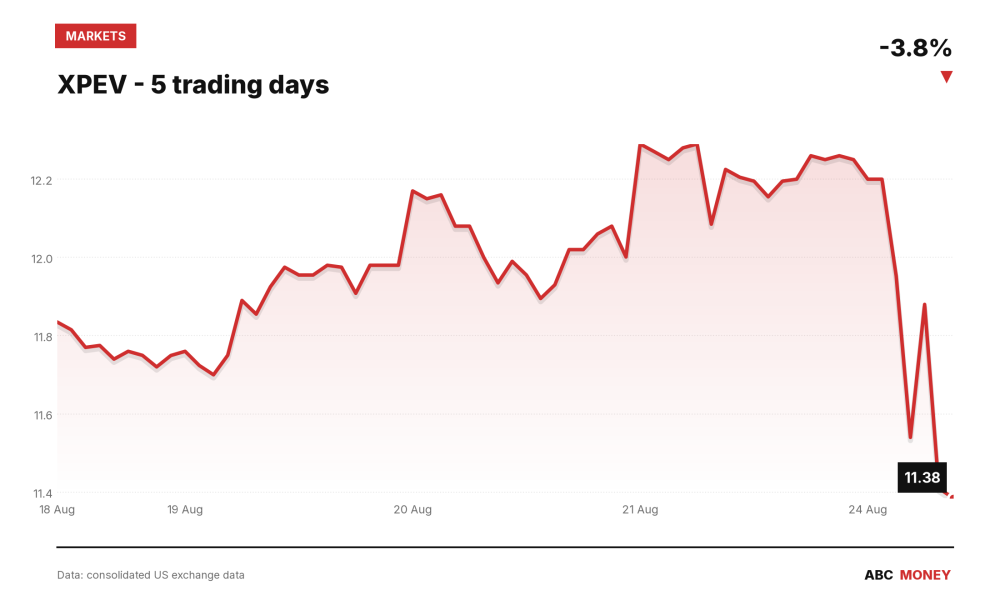
XPeng’s quarterly loss nearly tripled from a year earlier, and the market did not wait for the conference call to work out what that meant: shares in the Chinese electric-vehicle maker XPeng Inc. (NYSE: XPEV) fell 7.62% on 24 August 2026 to $11.316, extending a slide that has now taken the stock down 9.04% over the trailing 20 trading days, according to Benzinga.
The company reported a GAAP net loss of RMB1.34 billion (US$0.20 billion) for the second quarter of 2026, up from RMB0.48 billion a year earlier. That translated into a loss of US$0.21 per American depositary share, more than three times worse than the roughly US$0.06 loss analysts had pencilled in ahead of the report, according to TipRanks estimates and figures in XPeng’s own unaudited results.
A Quarterly Loss That Outran Revenue Growth
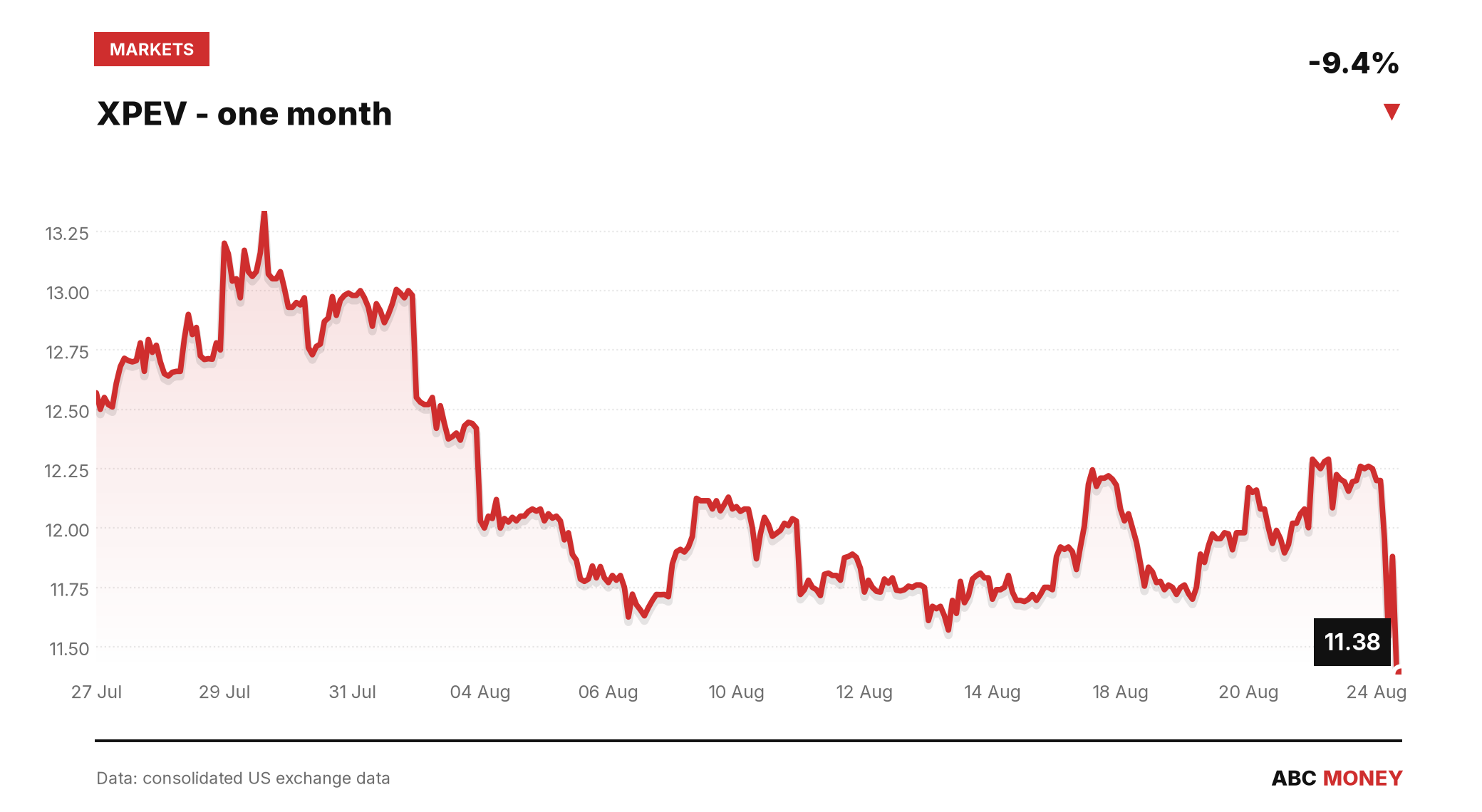
The scale of the miss, not just its direction, is what stands out. Revenue for the quarter came in at RMB19.74 billion (US$2.91 billion), up 8% from a year earlier and up a hefty 51.5% from the first quarter – a solid sequential improvement that still fell short of Wall Street’s revenue estimate, according to Nasdaq. Deliveries, meanwhile, barely moved: XPeng handed over 103,295 vehicles in the quarter, up just 0.1% on the same period last year, even as the group operated 740 sales stores across 257 cities as of 30 June. Put those together – flat unit sales, a solid revenue print, and a loss that blew past expectations – and the pressure looks like it is coming from margins and spending rather than a collapse in demand.
Where the Guidance Story Gets Murkier
Coverage of the results framed XPeng’s third-quarter outlook as coming in below Wall Street forecasts, and the headline figure invites that reading at first glance. The company guided to third-quarter revenue of RMB21.7 billion to RMB23.4 billion, roughly $3.2 billion to $3.45 billion at prevailing exchange rates. Taken at face value, that range implies sequential growth of 33% to 49% from the second quarter – an odd shape for a guidance “miss.” Whether the range genuinely undershoots what analysts had modelled is harder to pin down, since no single, widely cited Q3 revenue consensus figure for XPeng is readily available to test the claim against. The loss figure is unambiguous; the guidance framing deserves more scepticism than it has been given.
No Sign Short-Sellers Saw It Coming
One thing the positioning data rules out is a pre-earnings pile-in by traders betting on exactly this outcome. XPEV’s daily short-sale ratio – the proportion of trading volume made up of short sales, where traders borrow and sell shares hoping to buy them back cheaper – ran between roughly 0.39 and 0.66 in the fortnight before the results, according to FINRA data, with no discernible spike in the days immediately ahead of the report. That points to the earnings themselves, rather than pre-positioned bearish bets, as the trigger for Monday’s fall, which came on trading volume more than double the stock’s 20-day average.
The macro backdrop offered little cushion. The 10-year US Treasury yield stood at 4.69% in the run-up to the results, up from 4.65% previously, according to FRED data from the Federal Reserve Bank of St. Louis – a modest but real headwind for loss-making growth companies that depend on investor patience and access to cheap capital.
The Wider Picture
The results land in a week with its own unrelated noise around Chinese tech names: Alibaba Group Holding (NYSE: BABA) executives Joseph Tsai and Wu Yongming both filed disclosures with US securities regulators on the same day as XPeng’s earnings, though those filings concern Alibaba’s own equity and have no bearing on XPeng’s numbers. XPeng is frequently pitched as one of the sharper Chinese challengers to Tesla (NASDAQ: TSLA) in the electric-vehicle market, but Monday’s figures are a reminder of how much ground it still has to cover: delivery growth essentially stalled even as losses widened sharply, a combination that tends to worry investors more than a straightforward revenue miss on its own.
The next test comes with third-quarter results, when the market will find out whether that RMB21.7 billion to RMB23.4 billion revenue range materialises, and whether delivery volumes finally start moving again after a quarter in which they barely did.
This article is for information only and is not investment advice or a recommendation to buy or sell any asset. Markets move quickly; figures are correct as sourced at the time of writing. Always do your own research before making financial decisions.



 Bitcoin
  Ethereum
  Tether
  BNB
BNB  USDC
USDC  XRP
XRP  Solana
  TRON
TRON  Lido Staked Ether
  Cardano
  Gram (prev. Toncoin)
  Avalanche