
Wednesday’s JM Smucker Q1 earnings beat Wall Street’s forecasts across revenue, profit and cash flow, but the number that mattered most for shareholders had nothing to do with sales: J.M. Smucker (NYSE: SJM) has already cut its debt to roughly three times earnings, a target it once thought it wouldn’t reach until the end of next year.
Net sales for the quarter ended 31 July rose 5% year-on-year to $2.22bn, and Yahoo Finance reported adjusted earnings per share of $3.24, up 71% on the same period last year. That jump owes a lot to timing: management flagged an $0.84-per-share benefit from tariff refunds received during the quarter, part of a $0.60-per-share benefit it now expects for the full year, according to the earnings call transcript carried by MarketBeat. Strip that windfall out and the underlying beat is real but considerably less dramatic than the headline growth rate suggests.
A one-off boost, but a genuine profit swing
The GAAP numbers tell their own story. Smucker reported net income of $324.3m for the quarter, a sharp reversal from the $43.9m net loss – equivalent to a $0.41-per-share loss – it posted a year earlier, according to RTTNews. That prior-year comparator matches the figure in Smucker’s own 10-Q filed with the SEC in August 2025, which recorded a $43.9m loss and $0.41 diluted loss per share for the quarter ended 31 July 2025 – useful confirmation that this quarter’s swing is a genuine turnaround and not an accounting artefact.
Buoyed by the print, Smucker lifted its full-year adjusted EPS guidance to a range of $10.50 to $11.00, up from the $9.75 to $10.25 it had guided to previously, Yahoo Finance reported. Set against that, overall net sales guidance for fiscal 2027 still points to a 3% to 4% decline, reflecting lower pricing – including deflation in green coffee costs – and a softer volume and product mix, according to Smucker’s own investor relations release.
Debt repair arrives a year ahead of schedule
The more interesting thread, and the one likely to shape how investors treat the stock from here, is the balance sheet. Smucker’s leverage ratio – net debt divided by earnings before interest, tax, depreciation and amortisation – stood at 4.3x in the same quarter a year ago, up from 3.6x previously, and had only worked down to about 4.1x by the third quarter of fiscal 2026, according to transcripts compiled by Investing.com. Management’s stated target was to reach roughly 3x by the end of fiscal 2027. On this call, they said they’d already got there – a full year early.
The mechanics behind that are straightforward: Smucker repaid $720.0m of debt in fiscal 2026, more than it had originally planned, according to the company’s fourth-quarter release. With leverage now near target, management told the call it is weighing share buybacks while continuing to prioritise debt reduction – a shift in tone from a company that has spent the past two years almost entirely focused on paying down borrowings taken on for its Hostess Brands acquisition.
Uncrustables up, coffee down
Away from the balance sheet, the brand picture is mixed. Uncrustables, Smucker’s frozen sandwich line, is now forecast to grow at a high-single-digit rate for the year, helped by added production capacity and marketing spend – an upgrade from the mid-single-digit growth management had guided to as recently as its fiscal fourth-quarter call in June, per Yahoo Finance. Trade title Food Business News named Uncrustables and Café Bustelo as the company’s key organic growth engines for the year.
Coffee is heading the other way. Management expects coffee volumes to decline by low single digits across fiscal 2027 despite a recent uptick, citing commodity price swings and shifting category dynamics. Layered on top is mid-single-digit cost inflation, driven chiefly by freight and commodity costs, which is squeezing the cost of goods sold even as pricing actions and the tariff refund flatter the bottom line.
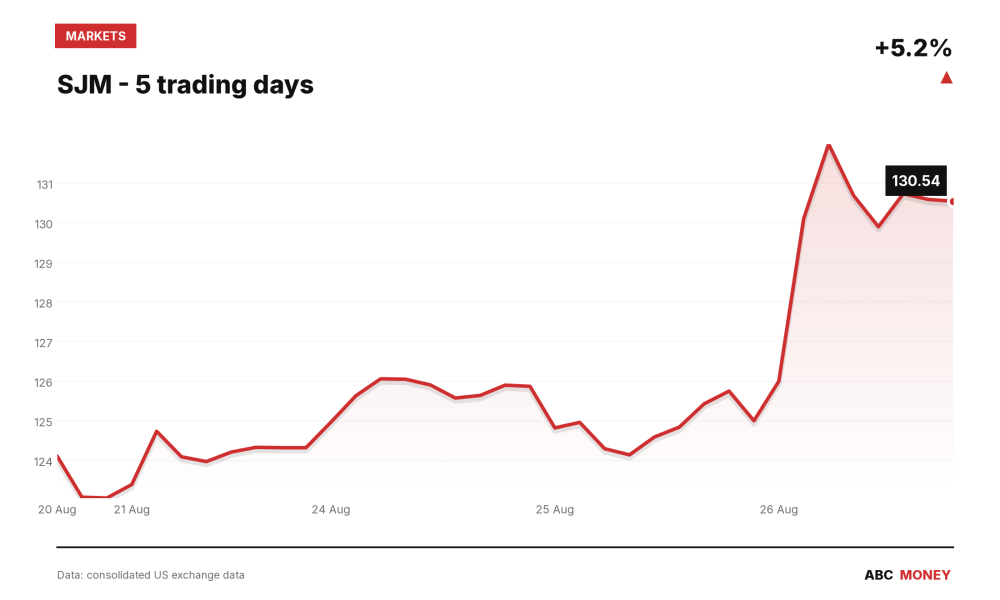
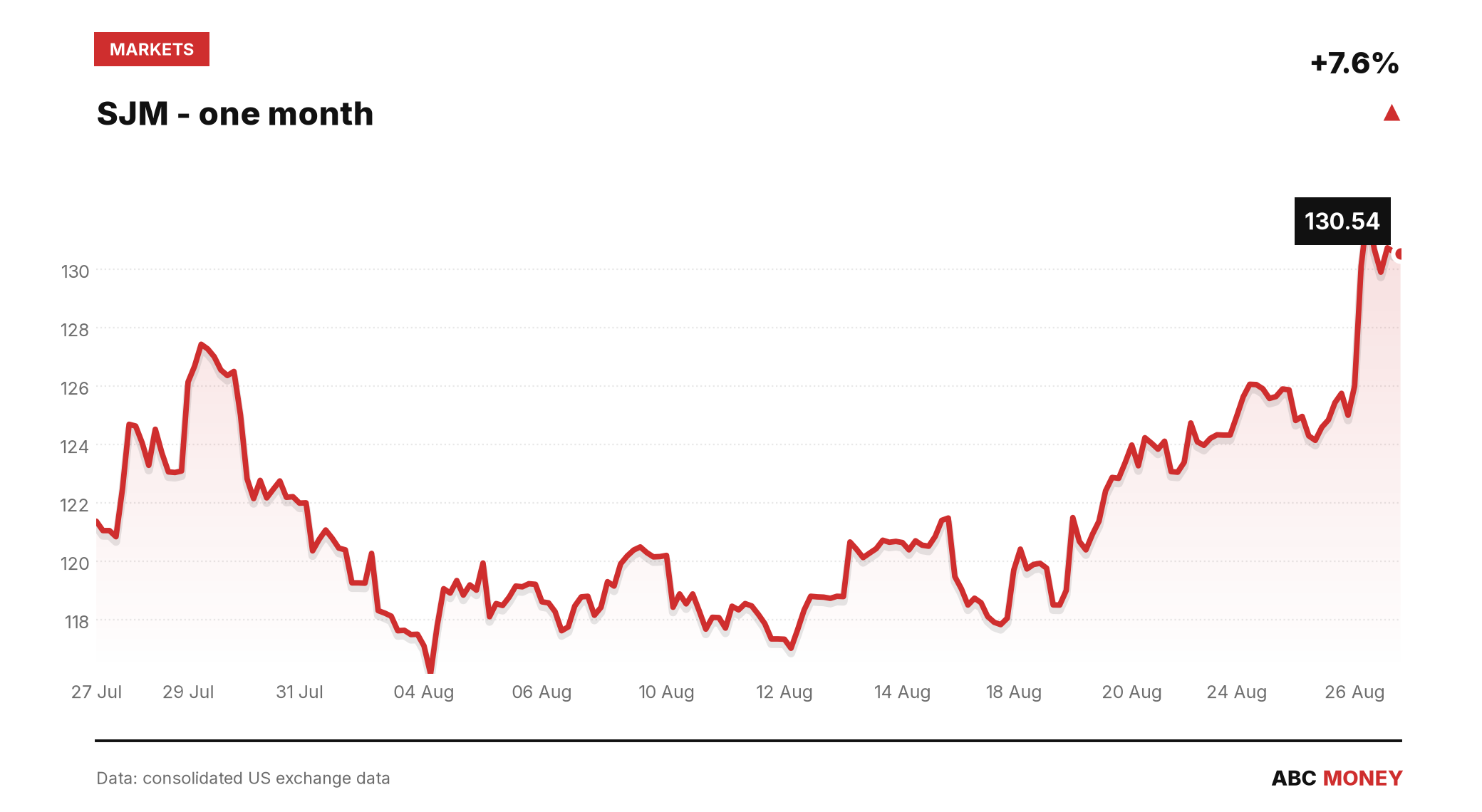
The market reaction suggests investors are focused on the debt story rather than the coffee soft patch. Shares closed at $130.58, up 3.63% on the day and 9.62% over the past 20 trading sessions, on volume 1.53 times the recent average, according to consolidated exchange data – a move that pushed the stock to a fresh 20-day high of $131.99. Analysts had been positioning for a strong print: UBS lifted its price target to $142 from $130 on 20 August, and J.P. Morgan raised its target to $139 from $125 a week earlier, according to Benzinga. Bearish positioning, meanwhile, looks thin: FINRA’s daily short-sale data shows short volume running at roughly half to two-thirds of total trading in SJM through the fortnight into results, leaving little sign of a crowded short trade for the rally to unwind.
What happens next depends on how quickly the buyback authorisation, if it comes, is put to work, and whether coffee volumes stabilise faster than the low-single-digit decline management is currently pencilling in for the rest of fiscal 2027.
This article is for information only and is not investment advice or a recommendation to buy or sell any asset. Markets move quickly; figures are correct as sourced at the time of writing. Always do your own research before making financial decisions.


 Bitcoin
  Ethereum
  Tether
  BNB
BNB  USDC
USDC  XRP
XRP  Solana
  TRON
TRON  Lido Staked Ether
  Cardano
  Gram (prev. Toncoin)
  Avalanche