Core & Main Q2 Earnings Beat, Shares Slide on Guidance
Core & Main Q2 earnings beat forecasts on sales, profit and EPS, yet shares slid as full-year guidance trailed Wall Street's estimate.
In this article 3 sections
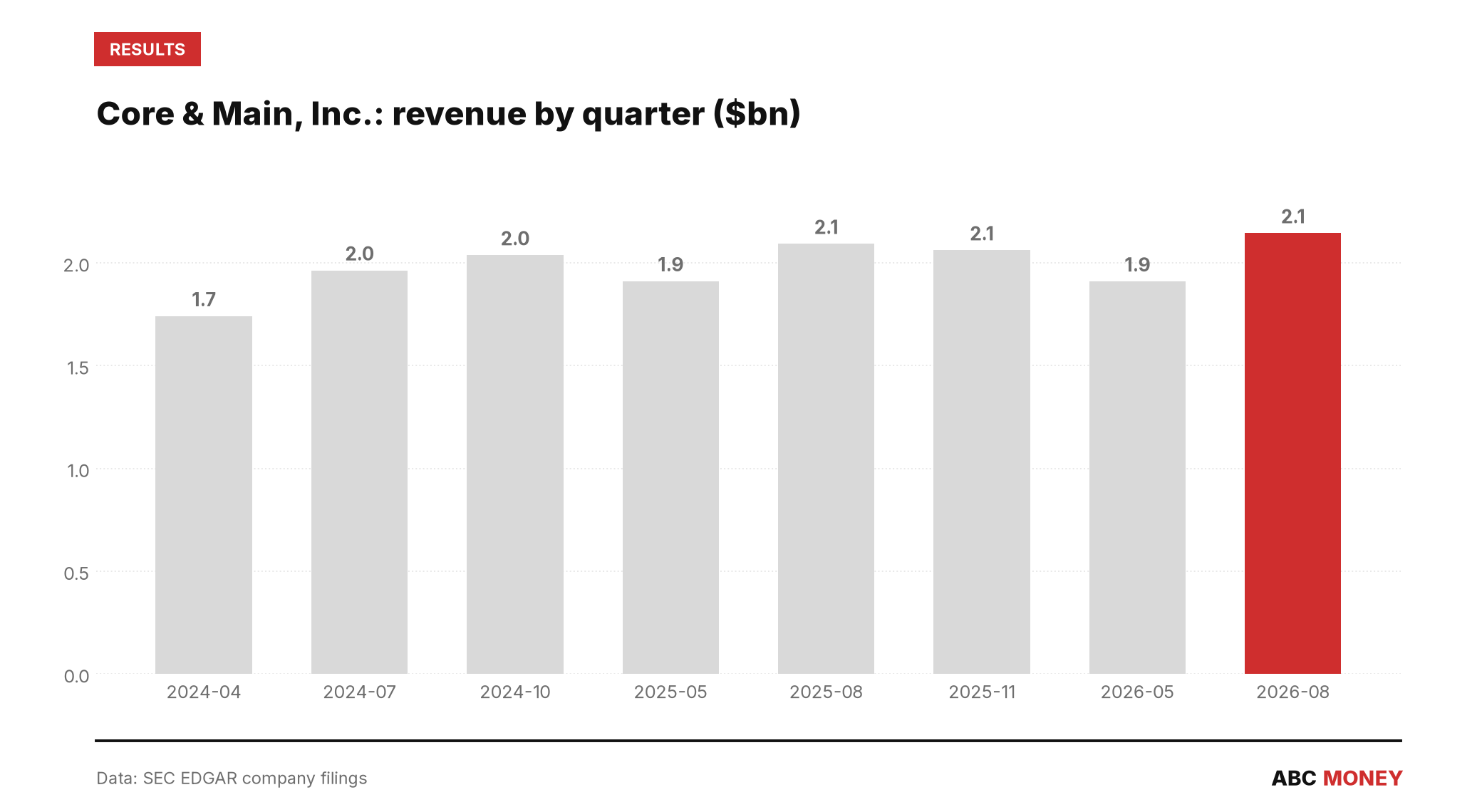
Core & Main (NYSE: CNM) turned in one of its stronger quarters in years on Wednesday, and its shares fell anyway. The water, wastewater and fire-protection distributor’s Q2 earnings call laid out net sales up 2.5% to $2.1bn, adjusted EBITDA up 3% to $274m, and a second straight quarter of record buybacks. As first reported by Benzinga, the results were framed as upbeat. The market’s verdict, delivered within hours, was rather less generous.
The disconnect is not really about the quarter that just ended. It is about the one still to come.
The headline numbers stack up
Core & Main’s second-quarter net sales, covering the 13 weeks to 2 August 2026, came in at $2,145m against $2,093m a year earlier – a 2.48% rise that rounds neatly to the reported 2.5%, according to the company’s 10-Q filed with the SEC. Net income rose 7.5% to $144m from $134m, and diluted earnings per share climbed 10% to $0.77 from $0.70, both figures confirmed in the same filing. Adjusted EBITDA – earnings before interest, tax, depreciation and amortisation, stripped of one-off items – reached $274m, up from $266m, for a margin of 12.8%, Yahoo Finance reported. None of that is a miss by any conventional reading.
Management also leaned hard into capital returns. Core & Main repurchased 3.7 million shares for roughly $169m during the quarter, its second consecutive record for open-market buybacks, according to a transcript of the call carried by Investing.com. Growth drivers cited on the call included treatment-plant projects, fire protection and data-centre-related work, the last of which management said had nearly doubled year-on-year. The company also closed its acquisition of Walker Industries, a Hawaii-based storm-drainage products business, extending its footprint beyond the mainland, Yahoo Finance noted.
Where the story turns
The problem sits in the outlook, not the print. Core & Main reaffirmed full-year guidance of $7.80bn to $7.90bn in net sales and $950m to $980m in adjusted EBITDA – numbers that sound steady until set against what Wall Street had pencilled in. Analysts had been looking for roughly $7.93bn in full-year revenue, meaning even the top of management’s range falls short of consensus, Yahoo Finance reported. That gap, small in percentage terms, was enough to reset expectations for the back half of the fiscal year.
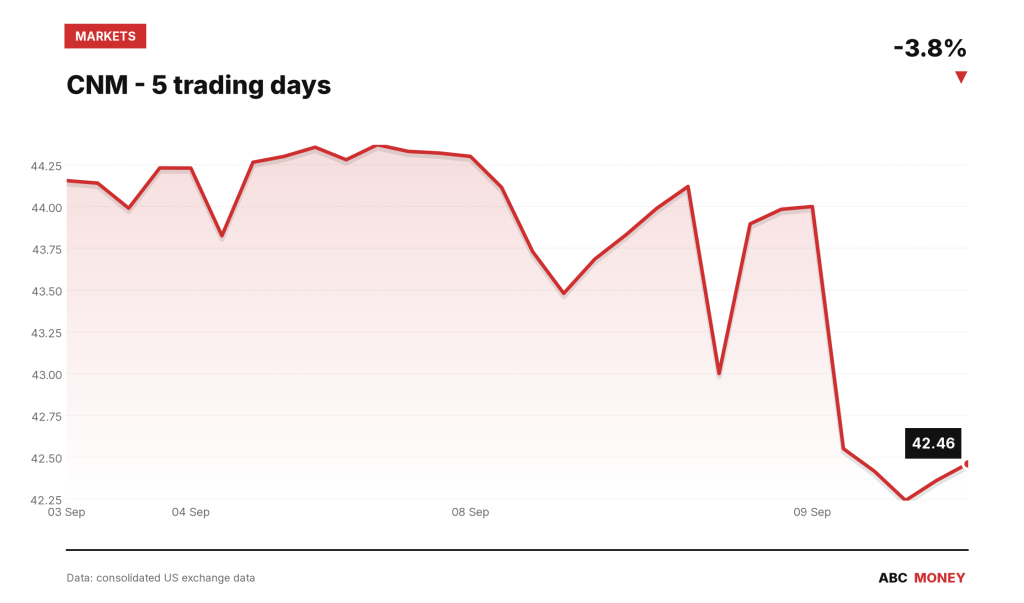
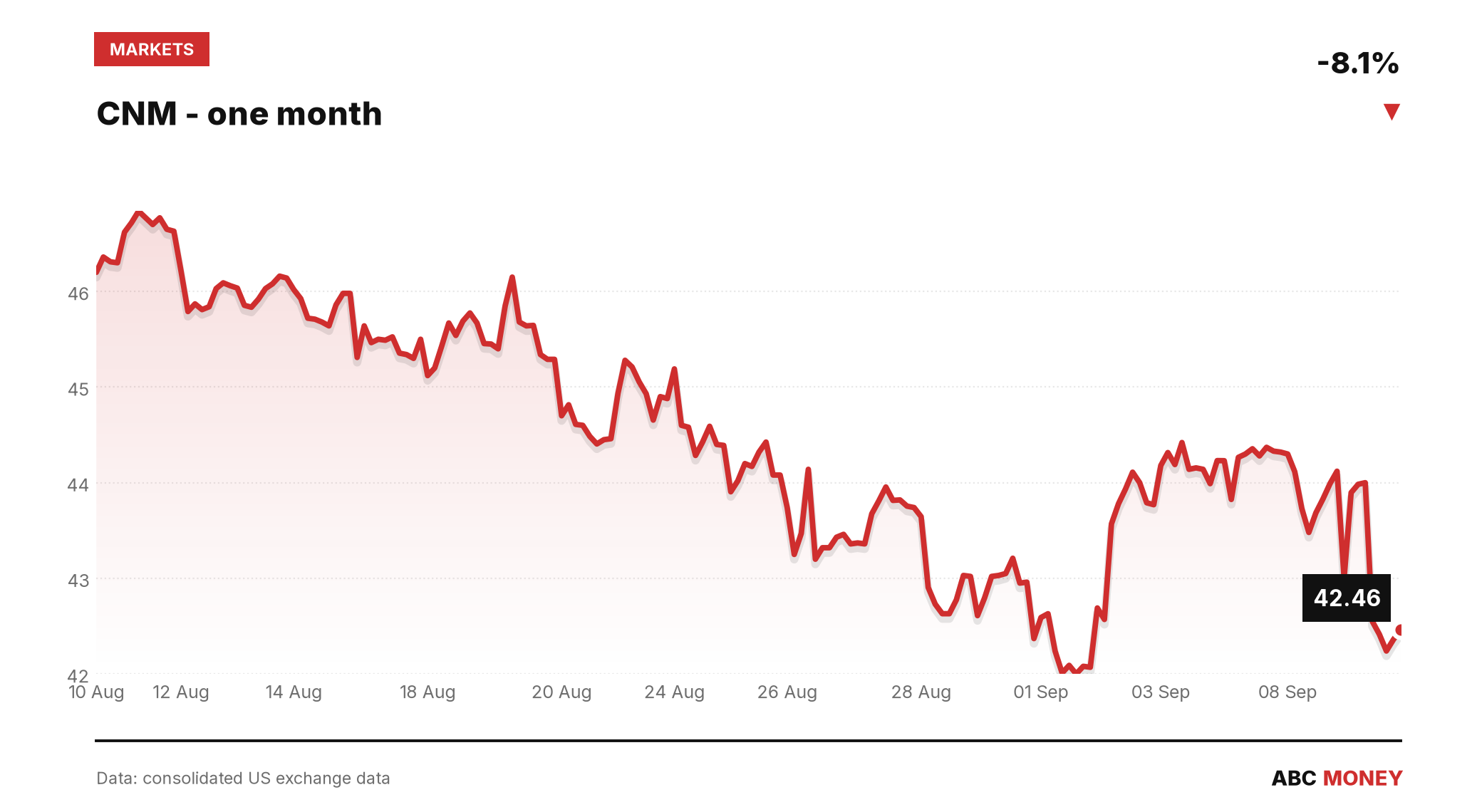
Shares fell sharply on the day, ChartMill put the decline at roughly 13.6%, attributing it to the soft full-year outlook rather than the quarter itself. By Wednesday afternoon the stock was changing hands at $42.46, down 6.98% over the preceding 20 trading days, with volume running about 1.3 times its 20-day average – a sign more sellers than usual were active, according to consolidated exchange data. The stock’s 20-day range had spanned $41.9999 to $45.645, putting the latest print near the bottom of that band.
It is worth being precise about what moved the shares. This was not a case of Core & Main missing its own quarter – every headline metric from sales to EPS to EBITDA came in ahead of the year-ago period. It was a case of full-year guidance landing below what the market had already priced in, a distinction that matters for anyone trying to read across from “beat” language on an earnings call to what actually happens to the stock.
No one saw it coming, at least not in the options and shorting data
There is little in the run-up to the print to suggest positioning had shifted in anticipation of a guidance disappointment. FINRA’s daily short-sale data shows the proportion of Core & Main’s trading volume attributable to short sales – bets that the stock would fall – bouncing between roughly 0.50 and 0.77 in the ten sessions before the call, with no clear build-up. That pattern is more consistent with a surprise than a well-flagged risk; the market moved after the numbers landed, not before.
Context from earlier in the fiscal year adds some nuance to the guidance debate. Through the first half of fiscal 2026, net sales rose just 1.3% to $4.06bn and adjusted EBITDA grew only 2% to $500m – a noticeably slower cadence than the standalone second-quarter figures imply, according to Modern Distribution Management. Seen against that backdrop, a guidance range that holds steady rather than raises looks less like conservatism and more like management squaring recent momentum with a slower first quarter.
What happens next likely hinges on whether the data-centre and treatment-plant demand management flagged on the call can accelerate enough in the second half to close the gap to consensus, and whether the buyback pace – already running at record levels for two straight quarters – continues to absorb shares even as the stock resets lower.
This article is for information only and is not investment advice or a recommendation to buy or sell any asset. Markets move quickly; figures are correct as sourced at the time of writing. Always do your own research before making financial decisions.