
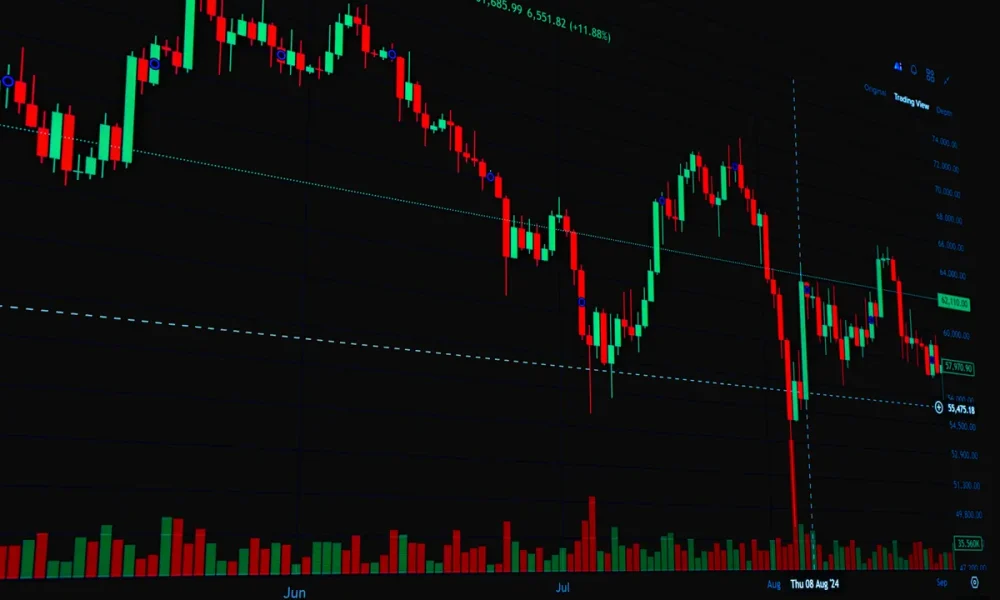
A momentum investing strategy is built on a deceptively simple premise: buy assets that are rising and sell those that are falling. As of 18 August, the MSCI World Momentum Index had returned 21% year-to-date, against 13% for the broader MSCI World Index, a gap wide enough to force even committed stock-pickers to reconsider their approach.
What momentum investing actually means
The core logic is that assets which have performed well over recent months tend to continue doing so in the near term. A basic implementation ranks stocks or funds by their returns over three, six, or twelve months and buys the top performers. More systematic practitioners layer on technical tools.
The relative strength index (RSI) measures the speed and magnitude of price changes, expressing the result as a number between 0 and 100. A reading of 50 or above indicates positive momentum, while a reading above 70 is generally taken as a sign the asset is overbought and vulnerable to a pullback. A reading below 30 suggests it may be oversold and due a recovery.
Some investors also watch moving averages. When a stock’s 50-day moving average rises above its 200-day moving average, that crossover is commonly read as a buy signal; the reverse signals a potential exit. ‘Some investors are probably doing it without even thinking about it, by buying a share or fund they notice is performing well,’ said Rob Morgan, chief investment analyst at Charles Stanley Direct.
The MSCI World Momentum Index had 351 constituents as of 30 June 2026, compared with 1,283 in the MSCI World Index, with the largest single position (Micron Technology) accounting for 7.37% of the momentum index versus 5.18% for the largest weight in the broader index. That concentration is partly what drives outperformance in rising markets, and partly what makes reversals so sharp.
The track record over recent years has been strong. In 2024, the MSCI World Momentum Index returned 30.56% in USD gross terms, against 19.19% for the MSCI World Index. In 2025 the gap narrowed: 21.75% versus 21.60%.
The risks that catch investors out
Momentum strategies require speed and discipline that most retail investors cannot sustain. Stocks cycle from positive momentum to overbought to oversold faster than a part-time investor tracking end-of-day prices can reliably act on. The strategy also concentrates into the most crowded trades by design, which amplifies losses when sentiment turns.
Terry Smith, chief executive and chief investment officer of Fundsmith, put the risk plainly in his July 2026 semi-annual letter, which he described as ‘unusually long’ with ‘more change’ than a typical update. Comparing the position of value investors to ‘trying to catch the proverbial falling knife,’ he warned: ‘All we are getting is cut fingers as their downward share price spiral is exacerbated by the index momentum enhancement effect.’ On the question of reversals, his assessment was stark: ‘In 2007–08, the S&P fell 57% in five months. Next time round, it would not surprise me if it accomplished this in five days.’
Angeline Ong, senior investment analyst at IG, made the same point from a different angle: ‘Popular momentum trades can also become crowded, which amplifies the snapback when they unwind’ — as happened with silver prices in early 2026.
Trading costs compound the challenge. Frequent buying and selling generates transaction costs and, in taxable accounts, capital gains tax. Over several years those frictions eat into the headline returns the strategy appears to deliver.
Building a momentum investing strategy: Smith’s pivot and what it signals
The more revealing story in Smith’s July letter is not the warning but the pivot. Fidelity’s analysis of the update noted that Smith said Fundsmith will take more account of momentum, both fundamental and in share price terms, and will be ‘much less willing to deploy the time-honoured technique of buying quality companies when they hit a glitch.’ Morningstar reported that Smith has pledged to incorporate earnings momentum and to be more active in exiting positions that are not working out.
In practice, Fundsmith began accumulating stakes in AppLovin, GE Vernova, Legrand, Mastercard, Netflix, Nextpower, Sage, The TJX Companies, TSMC, Uber, Veeva Systems, and Yum! Brands. It exited or started exiting Atlas Copco, Coloplast, EssilorLuxottica, Intuit, LVMH, Magnum Ice Cream, Mettler-Toledo, Nike, Novo Nordisk, Otis, Unilever, Wolters Kluwer, and Zoetis. The inclusion of TSMC drew particular attention: as Fidelity noted, it is not one of the largest holdings, but its presence signals a willingness to accept more cyclicality and price sensitivity than the classic Fundsmith template allowed.
Smith also argued in his January 2026 annual letter that passive index funds are themselves a momentum strategy, because they hold stocks in proportion to market capitalisation and therefore mechanically buy more of whatever is already rising.
Gaining exposure without doing it yourself
For investors who want a momentum investing strategy without the overhead, passive funds tracking the MSCI World Momentum Index are the most accessible route. The iShares Edge MSCI World Momentum Factor UCITS ETF, listed on the London Stock Exchange under tickers IWMO (USD) and IWFM (GBP), carries a total expense ratio of 0.25% and held net assets of $4.11bn at the time of its most recent factsheet. Xtrackers MSCI World Momentum UCITS ETF (XDEM) and the L&G Developed World Momentum Factor Index Fund offer comparable passive exposure.
Active funds with a momentum tilt are rarer by design. Morgan highlights the Artemis US Extended Alpha Fund as one that incorporates momentum elements alongside contrarian positioning; JPMorgan European Growth & Income (JEGI) and Aberdeen UK Smaller Companies Growth Trust (AUSC) both assess momentum alongside quality and value criteria.
The next test for the factor is straightforward: whether the leadership cohort in the momentum index holds up as rate expectations shift through the second half of 2026. History suggests the unwind, when it comes, arrives faster than the build-up.


 Bitcoin
  Ethereum
  Tether
  BNB
BNB  USDC
USDC  XRP
XRP  Solana
  TRON
TRON  Lido Staked Ether
  Cardano
  Gram (prev. Toncoin)
  Avalanche