
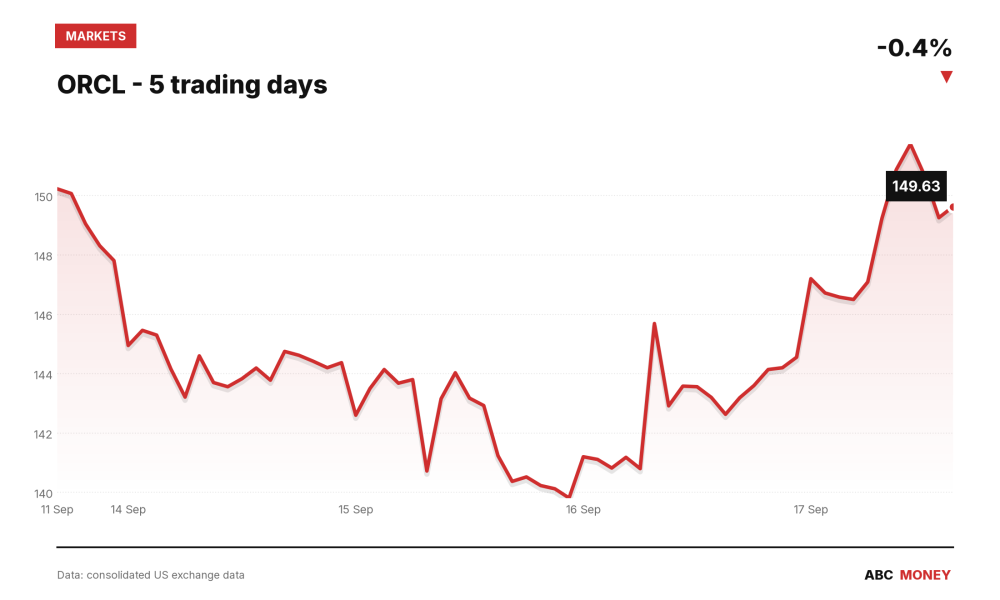
Oracle Corp (NYSE: ORCL) shares rose on OpenAI funding buzz on Thursday, extending a recovery that has been anything but a straight line since early summer. The trigger was widely reported the same way: news that OpenAI was in early talks with investors about a funding round that could value the ChatGPT maker at more than $1.2 trillion, a figure first reported by Bloomberg on 15 September and echoed by PYMNTS citing the Financial Times.
What outlets could not agree on was how far Oracle actually moved. The Motley Fool, Yahoo Finance and Nasdaq all ran versions of the same wire copy putting the gain at 6%. Benzinga called it “roughly 5%”. Invezz said 4%. Three numbers, one trading session. A snapshot of the consolidated tape at 18:00 UTC that day put Oracle’s 24-hour change at a more modest 1.92%, with shares last at $149.32 – well short of every headlined figure. The likeliest explanation is timing rather than error: intraday moves can run hotter earlier in the session and fade by the close, so a story filed off a bigger midday pop can look inflated against a later print. Either way, readers chasing an exact percentage from that morning’s headlines were better served treating the number as directional rather than precise.
Why the OpenAI story actually matters for Oracle
The mechanism behind the move is real enough. Oracle committed to a $300 billion computing-capacity deal with OpenAI last year, a bet that has periodically spooked investors worried the company was over-extending its balance sheet to build data centres for a single, still-private customer. A funding round anywhere near $1.2 trillion – up sharply from the roughly $852 billion valuation OpenAI carried in its previous raise, which brought in $122 billion, according to PYMNTS – would suggest OpenAI has plenty of capital lined up to keep paying its infrastructure bills. That reduces, at the margin, the risk that Oracle’s biggest AI wager turns into a stranded asset.
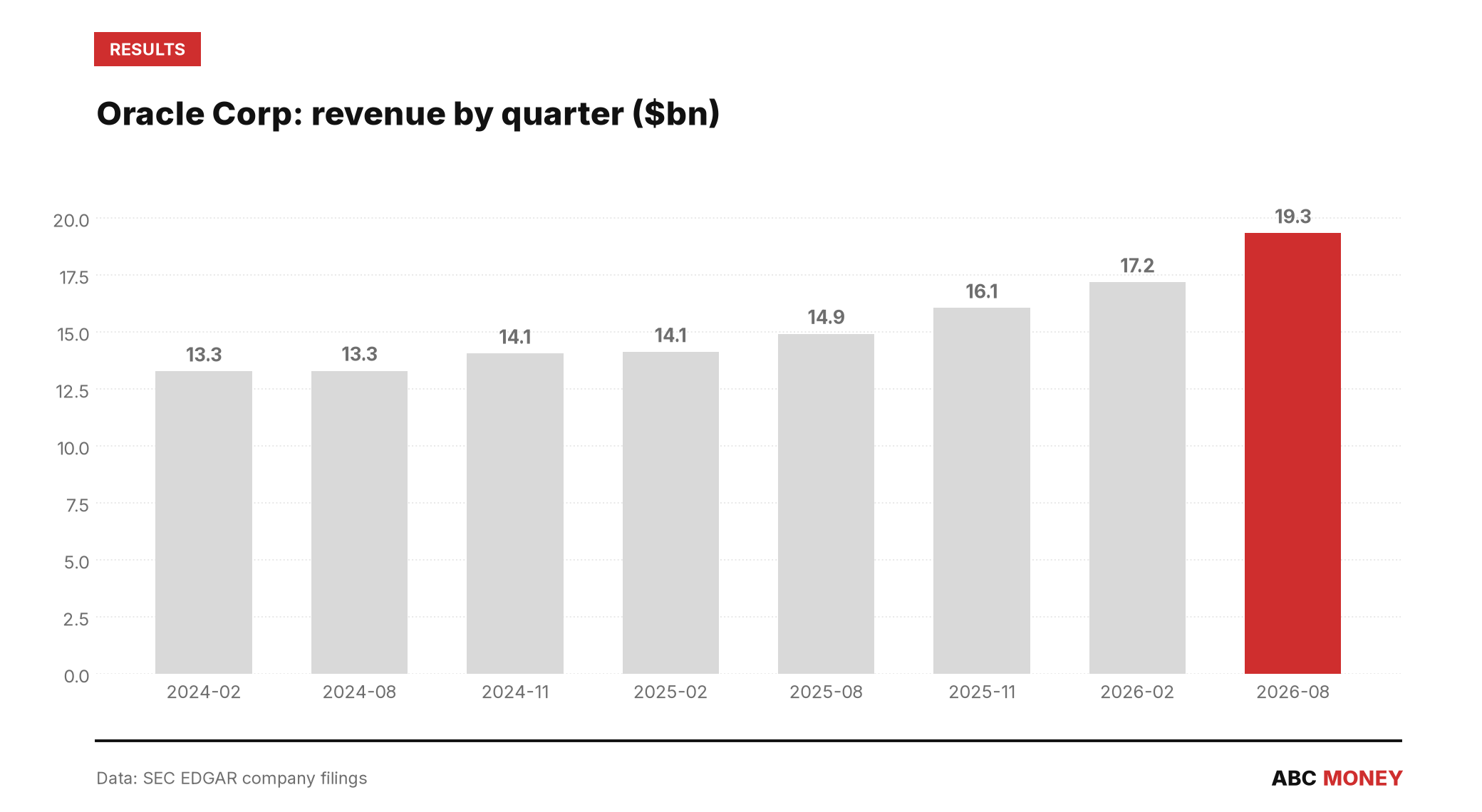
It also lands against a backdrop of genuinely strong numbers from Oracle itself. The company’s fiscal first-quarter revenue, filed with the SEC on 11 September, came in at $19.345 billion, a record and a step up from $17.19 billion the prior quarter and $16.058 billion the one before that. That sequential climb is the substance behind the “record revenue” narrative that has anchored Oracle’s rebound story since early September.
A stock that has swung, not simply risen
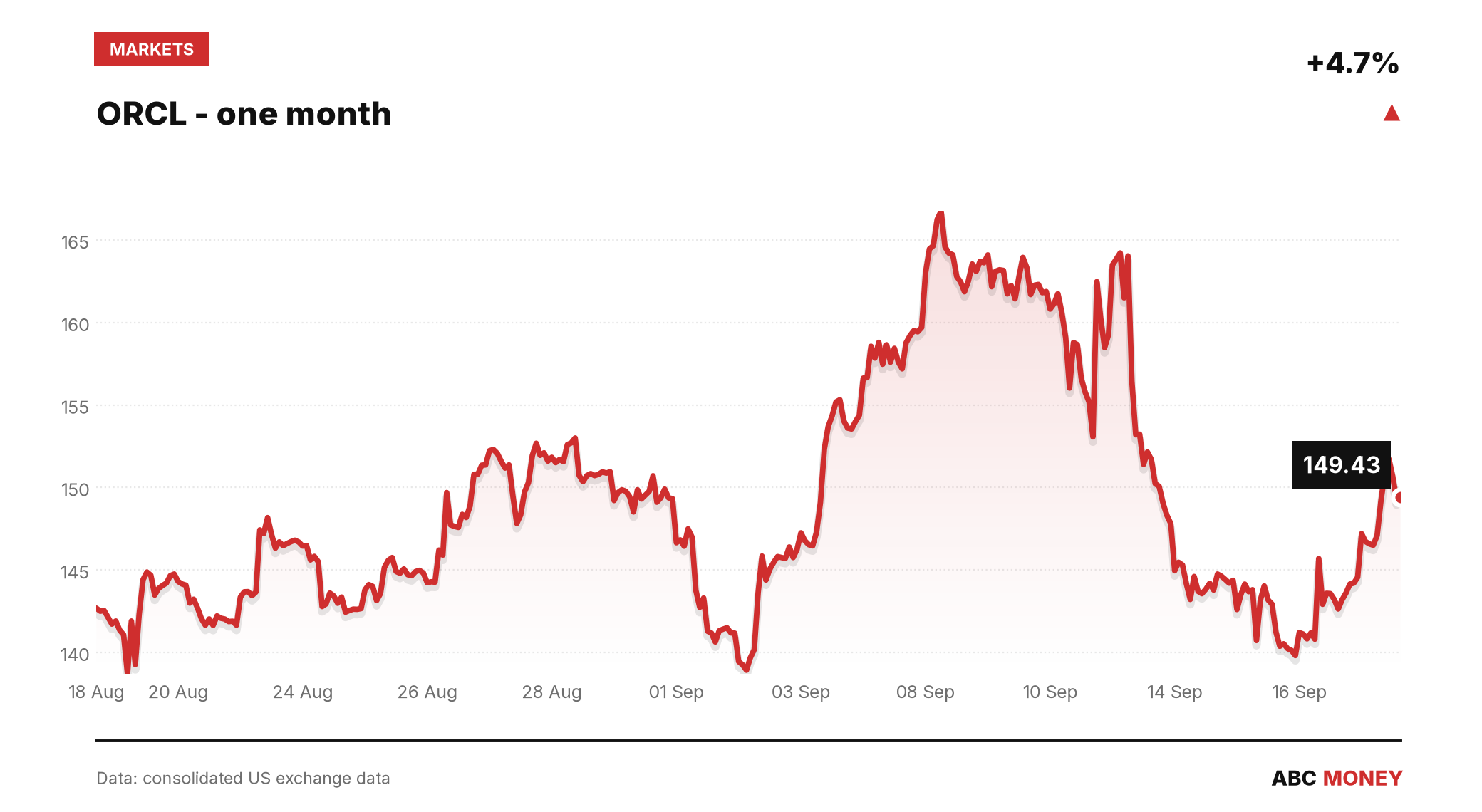
Context matters here because Oracle’s chart has been unusually jumpy. Shares traded around $172 in mid-June before tumbling to roughly $115 by late July, a fall of about 32% in a little over a month. The August-into-September recovery, built on that fiscal first-quarter print, carried the stock back up before it reversed again to around $140 by mid-September. Thursday’s gain, whatever its true size, sits inside a 20-day trading range of $138.92 to $166.76 – a band wide enough that a single day’s move can look dramatic in isolation while barely denting the broader pattern.
Positioning was already shifting before the news broke
One detail that predates the OpenAI headlines: short-selling activity in Oracle had been easing. FINRA’s daily short-sale data shows the share of Oracle’s trading volume tied to short sales – bets that the stock would fall – fell from 0.455 on 8 September to 0.318 by 16 September, the session before the rally. That is not proof of anything on its own, but a fading short-side presence into a positive catalyst tends to remove one source of resistance to a share-price move, however large that move eventually printed.
The broader market backdrop was steady rather than supportive or hostile. The 10-year US Treasury yield sat at 5.00% in mid-September, with the 10-year/2-year spread at 0.27 percentage points – hardly the kind of rates shock that tends to hit richly valued technology names hardest.
Separately that week, reporting also linked Oracle to a classified artificial-intelligence contract with the US Department of Defense and comments from OpenAI’s finance chief describing the business as “exceeding expectations” – both circulating alongside the funding story and plausibly blurring into the same “OpenAI buzz” that headline writers reached for. Untangling which driver did how much of the work on any single day is close to impossible from the outside; what is verifiable is the scale of the underlying prize. If OpenAI’s next funding round lands anywhere near the $1.2 trillion figure under discussion, the question for Oracle holders shifts from whether its AI customer can pay its bills to how much of that capital ends up flowing through Oracle’s own order book – a detail likely to surface in the company’s next quarterly filing rather than in any single day’s ticker move.
This article is for information only and is not investment advice or a recommendation to buy or sell any asset. Markets move quickly; figures are correct as sourced at the time of writing. Always do your own research before making financial decisions.


 Bitcoin
  Ethereum
  Tether
  BNB
BNB  USDC
USDC  XRP
XRP  Solana
  TRON
TRON  Lido Staked Ether
  Cardano
  Gram (prev. Toncoin)
  Avalanche