
The Clarity Act failure in the US Senate has done in a single procedural vote what years of industry lobbying could not: it has handed the job of writing America’s crypto rulebook to unelected regulators rather than elected lawmakers. The Senate’s cloture motion on the bill, formally H.R. 3633, fell 49-50 on 15 September 2026 – eleven votes short of the 60 needed to move forward – as National Law Review reported, dealing what CNBC called a major blow to the industry’s push for a formal market-structure framework.
The bill was meant to settle a question that has dogged digital assets for a decade: which regulator, the Securities and Exchange Commission or the Commodity Futures Trading Commission, actually has jurisdiction over which tokens, and on what terms exchanges can list them. Its collapse means that question stays open, decided case-by-case rather than by statute – as the Wall Street Journal first reported in laying out the industry’s pivot toward federal agencies.
The Clarity Act failure hits share prices
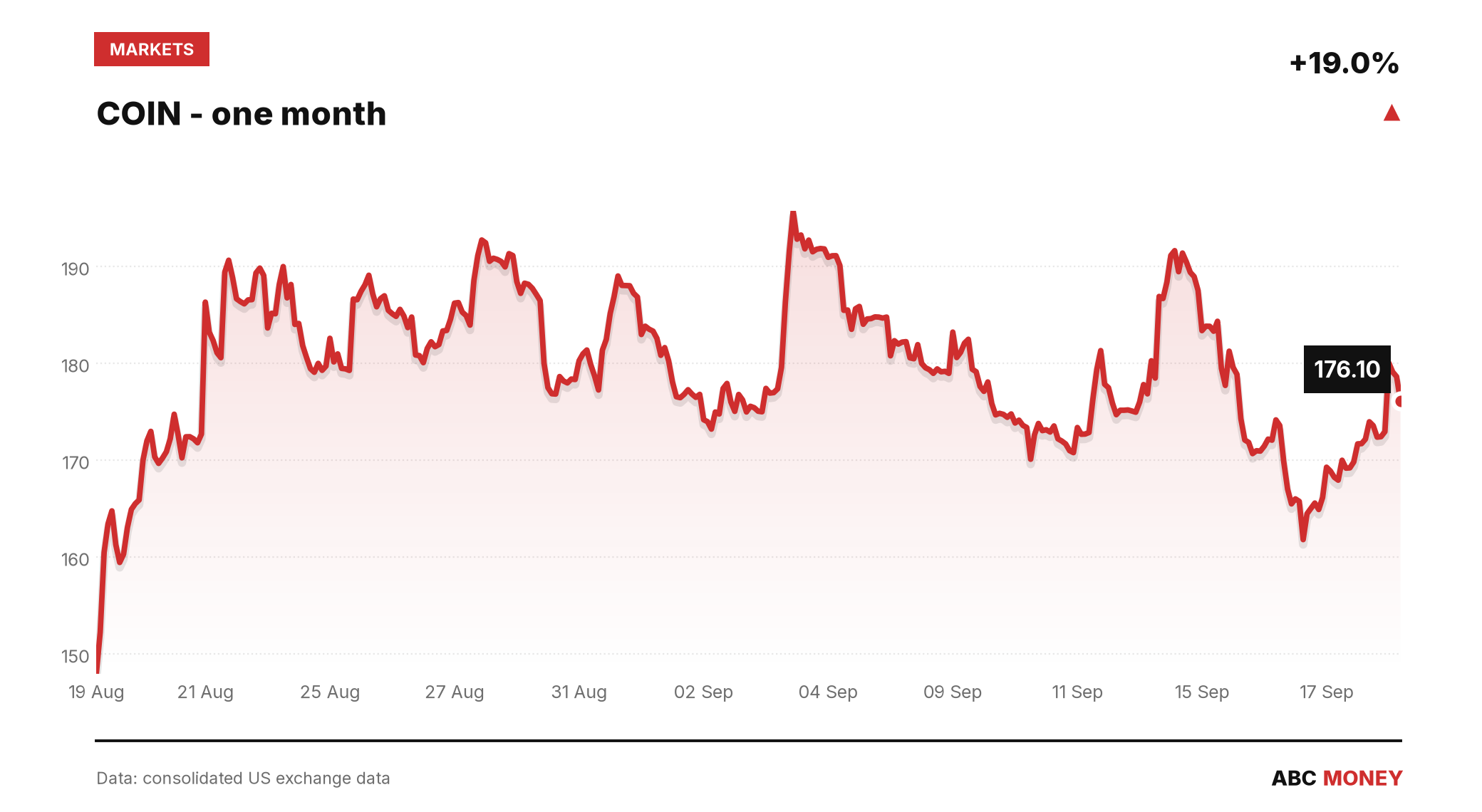
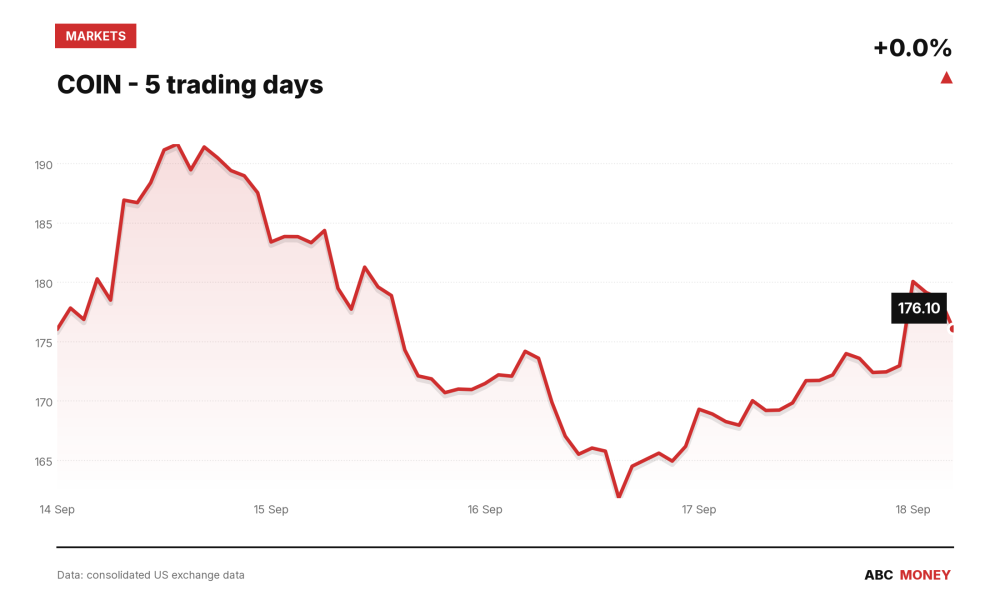
Markets reacted fast. Coinbase (NASDAQ: COIN) shares fell around 9% on the day of the failed vote, according to KuCoin News, while Circle Internet Financial (NYSE: CRCL) dropped somewhere between 8% and roughly 11.6% over the same window. Bitcoin slid to around $75,900-$76,000, its weakest level since early August. By 18 September, Coinbase had clawed back some ground: shares last traded at $176.00, up 1.39% on the day but still down 6.27% over the preceding twenty trading days, having ranged between $161.82 and $195.74 in that stretch. Trading volume that day ran at roughly a third of the twenty-day average, suggesting the sharpest selling had already passed rather than building.
Positioning data hints the market was already leaning bearish before the vote failed. FINRA’s daily short-sale ratio for Coinbase – the share of reported volume attributable to short sales, where investors borrow and sell stock betting the price will fall – climbed from 0.481 on 3 September to 0.615 by 17 September, a steady build in downside bets through the fortnight leading into the cloture vote.
The scale of the reversal is captured neatly by prediction markets: Polymarket had priced the Clarity Act’s odds of becoming law in 2026 at 82% back in February, according to FinanceFeeds. By the time the cloture vote failed, that probability had collapsed to roughly 7%. The bill’s undoing, per the same reporting, centred on a Democratic demand for an enforceable ban on officials profiting personally from crypto – a sticking point sharpened by President Trump’s disclosure of more than $1.4bn in crypto-related income for 2025. The House had already passed its own version of the bill by a wide bipartisan margin, 294-134, back in July 2025, which makes the Senate’s failure the first serious legislative setback the measure has suffered.
Rulemaking without the rule of law
With Congress stalled at least until the November midterms, attention has shifted to SEC Chairman Paul Atkins and CFTC Chairman Michael Selig, both of whom have told Forbes they remain committed to delivering regulatory certainty through rulemaking, with activity expected to intensify over the next six months. The Hill reports the industry is now looking squarely to Trump-appointed regulators to fill the gap statute was meant to close.
That is a narrower kind of certainty than the bill would have delivered. Regulatory guidance issued by an agency chair can be rewritten by the next one; a law passed by Congress cannot be undone by a change of personnel at 100 F Street. The industry spent heavily lobbying for the latter and has, for now, been handed the former.
Coinbase’s own numbers complicate the story
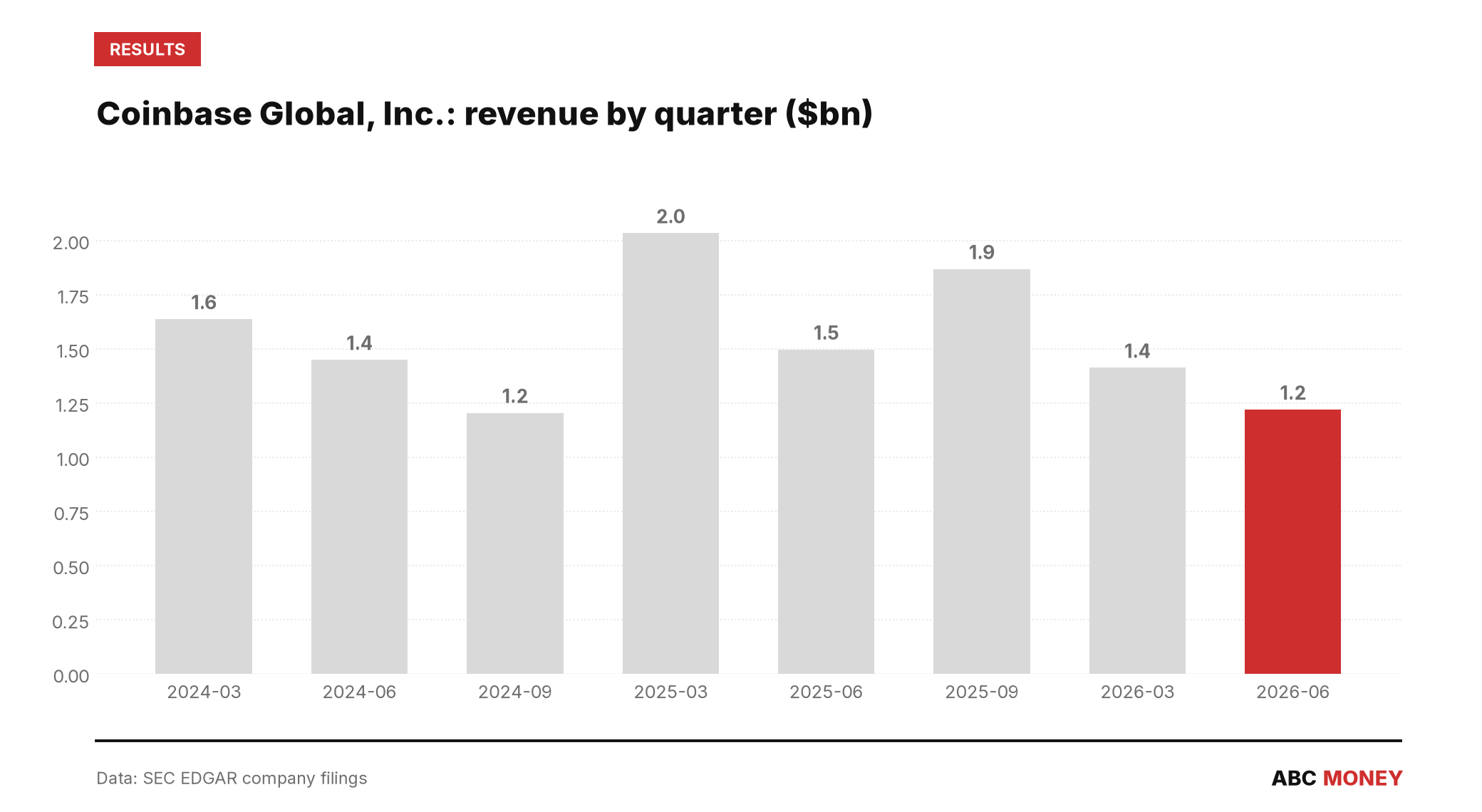
The policy drama lands on an exchange whose finances have already turned. Coinbase posted net losses of $394.1m in the first quarter of 2026 and $359.5m in the second, according to its quarterly filings with the SEC – a sharp reversal from the $1.43bn profit it reported in the second quarter of 2025 and the string of profitable quarters before that. Revenue has followed a similar arc, falling from $1.87bn in the third quarter of 2025 to $1.41bn and then $1.22bn in the first two quarters of this year. Diluted losses per share ran to $1.49 and $1.36 in those same two 2026 quarters, against diluted earnings of $5.14 a year earlier.
None of that turn is caused by the Clarity Act’s failure – the losses predate the vote by months – but it does mean Coinbase is absorbing a fresh policy setback from a weaker starting position than the one it enjoyed through most of last year.
The next marker for the market is less a date than a pattern: whether SEC and CFTC rulemaking over the coming months produces guidance detailed enough to substitute for statute, or whether exchanges spend the run-up to the midterms operating, as they have for years, under rules improvised one enforcement action at a time.
This article is for information only and is not investment advice or a recommendation to buy or sell any asset. Markets move quickly; figures are correct as sourced at the time of writing. Always do your own research before making financial decisions.



 Bitcoin
  Ethereum
  Tether
  BNB
BNB  USDC
USDC  XRP
XRP  Solana
  TRON
TRON  Lido Staked Ether
  Cardano
  Gram (prev. Toncoin)
  Avalanche