
Alibaba Group Holding (NYSE: BABA) used its Apsara Conference in Hangzhou on 22 September 2026 to unveil the Zhenwu V900, a new AI accelerator chip its cloud unit is billing as three times more powerful than its own predecessor. That much is well documented. What’s less solid is the framing, repeated across plenty of headlines that day, that the V900 has somehow leapfrogged Nvidia (NASDAQ: NVDA) in a head-to-head test. It hasn’t – because no such test has been run.
The chip, built by Alibaba’s semiconductor arm T-Head, was announced alongside 216GB of memory and inter-chip bandwidth of 1,200GB per second, and Alibaba says it can be strung together into training clusters of up to 500,000 units, according to TechNode. Mass production is pencilled in for the first quarter of 2027.
Three times faster than what, exactly?
The “3x” figure that anchored most of Tuesday’s coverage is a generational comparison against Alibaba’s own M890 chip, launched in May 2026 – not a benchmark against any Nvidia silicon. That distinction matters, because the same triple-performance claim was made for the M890 against its own predecessor, the Zhenwu 810E, four months earlier, per TechXplore. This looks less like a single knockout blow and more like a marketing cadence Alibaba has settled into: roughly every few months, a new chip, roughly the same multiple.
Bloomberg reported Alibaba positioning the V900 as an accelerator designed “to compete with Nvidia Corp.”, which is a fair characterisation of intent. But intent isn’t performance data. Independent benchmarking against Nvidia’s current lineup doesn’t exist yet, and Nvidia remains by far the dominant supplier of AI accelerators in China regardless – shipping an estimated 2.2 million cards there in 2025, good for roughly 55% of the market, according to DailyCoin. Whatever the V900 turns out to do in production, it’s launching into a market Nvidia still runs.
Existing customer base, and a bigger data centre pledge
Alibaba says its existing Zhenwu chips are already deployed with more than 650 customers spanning automotive, finance, energy and manufacturing. The V900 launch was paired with a considerably larger ambition: Alibaba’s chief executive, Eddie Wu, told the conference that “by 2032, the global data center capacity operated by Alibaba Cloud will surpass 20GW”, a target reported via Alibaba’s own newswire release. That figure is the bigger story arguably than the chip itself – it implies a multi-year capital commitment to infrastructure that dwarfs any single processor announcement, and it’s the number analysts are likelier to hold Alibaba to over time.
The broader context is US export controls, which have cut Chinese technology firms off from Nvidia’s top-tier chips and pushed domestic self-sufficiency efforts into overdrive. Huawei’s Ascend line announced its own new AI infrastructure the same week, per Qz – a reminder that the V900 is one entrant in a crowded, state-encouraged race rather than a solitary challenger to Nvidia’s throne.
What the shares actually did
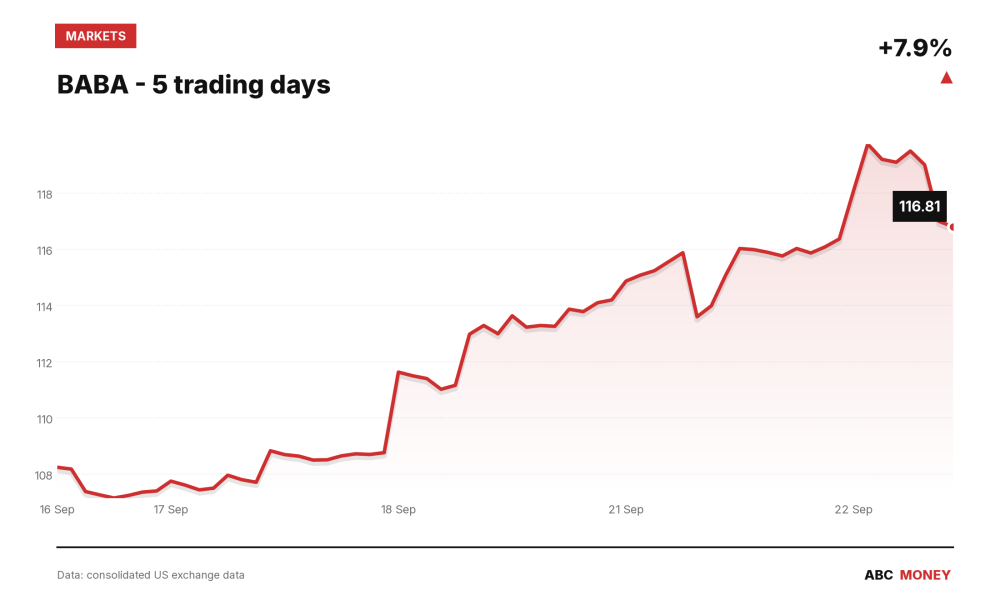
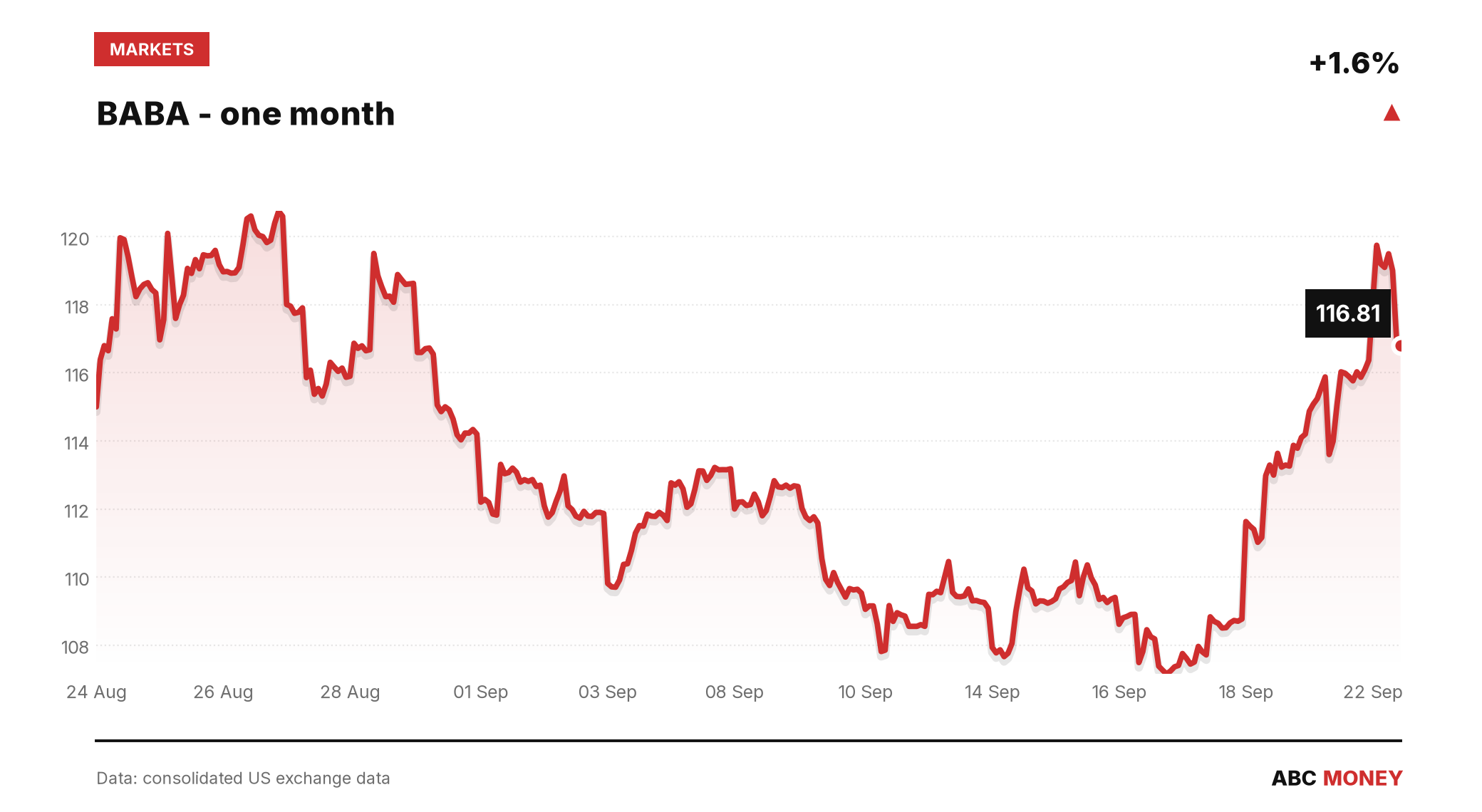
Alibaba’s Hong Kong-listed stock closed roughly 2% higher on the day, and the US-listed shares gained more than 3% in premarket trading, according to Yahoo Finance and CNBC. That early pop faded as the session wore on: by 15:00 UTC, BABA traded at $116.81, down 1.08% over the prior 24 hours, with volume running more than double the 20-day average – a sign of heavy two-way trading rather than a one-directional rush, and a reminder that a premarket headline gain doesn’t always survive contact with a full trading day.
There’s no sign of a short-covering rally, either. Daily short-sale ratios tracked by FINRA sat in a fairly steady 0.44 to 0.56 range through the fortnight before the announcement, with no discernible spike tied to the chip news – short-sellers, in other words, weren’t scrambling to close positions on the back of it.
None of this makes the V900 a non-event. Cutting the gap from a generational chip launch to mass production down to roughly four months, as Alibaba appears to be doing with the M890-to-V900 cycle, is a genuine pace of iteration. But the chip Alibaba is really racing is its own last one, inside a domestic market that US export controls have made captive rather than contested. Whether the V900 can do anything meaningful against Nvidia’s hardware is a question nobody has yet been able to answer with actual numbers – and until an independent benchmark exists, that comparison remains Alibaba’s to assert, not the market’s to confirm.
Production is scheduled to begin in the first quarter of 2027, which is the date worth circling if an answer is going to arrive at all.
This article is for information only and is not investment advice or a recommendation to buy or sell any asset. Markets move quickly; figures are correct as sourced at the time of writing. Always do your own research before making financial decisions.



 Bitcoin
  Ethereum
  Tether
  BNB
BNB  USDC
USDC  XRP
XRP  Solana
  TRON
TRON  Lido Staked Ether
  Cardano
  Gram (prev. Toncoin)
  Avalanche