
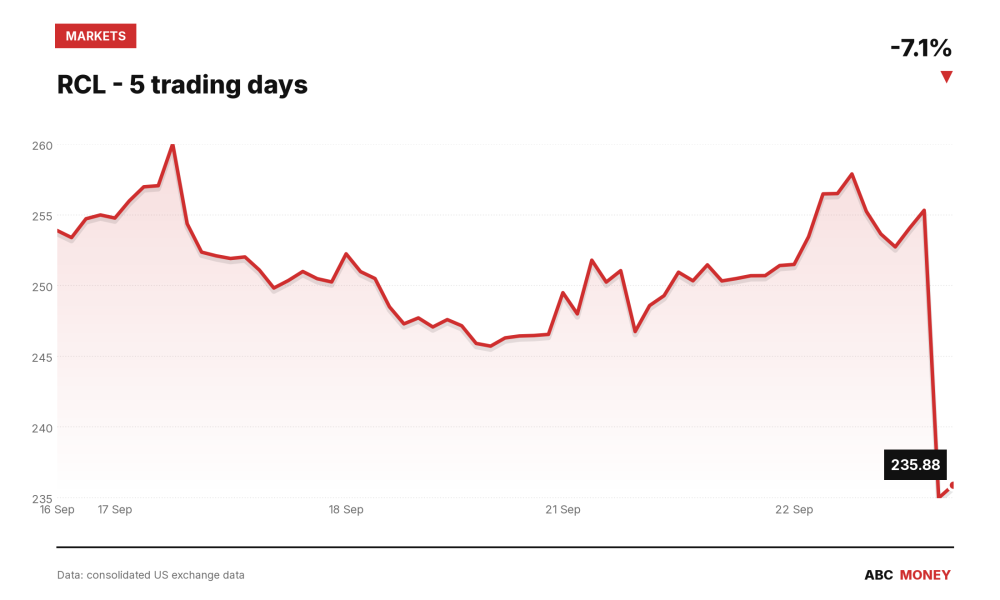
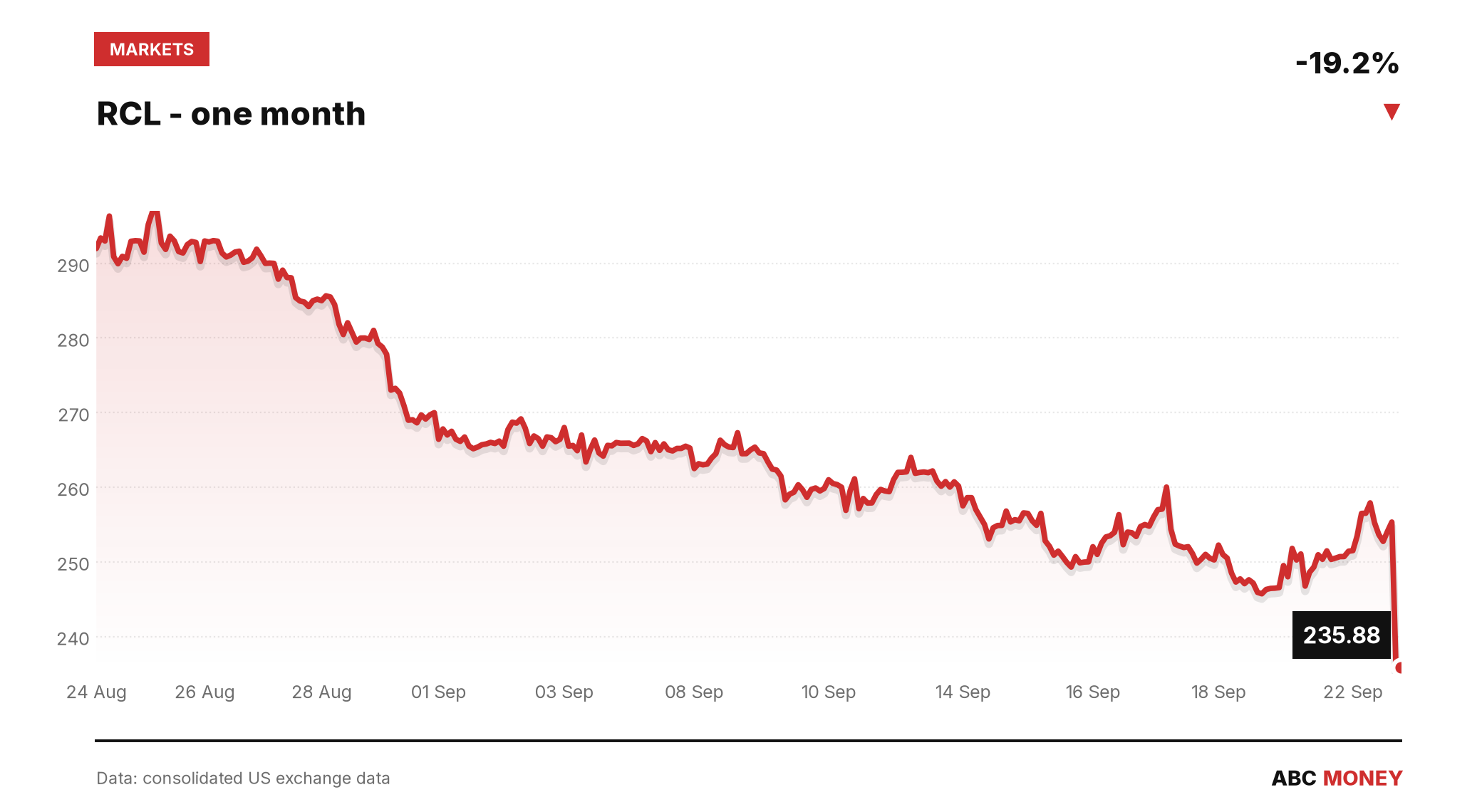
Shares in Royal Caribbean (NYSE: RCL) fell sharply on 22 September after the Financial Times reported that the cruise operator is nearing a deal for Sandals Resorts International that would value the Jamaica-based hotel group at more than $6bn. The stock closed down 8.24% on the day, on volume more than five times its 20-day average, and traded as low as $234.98 – within touching distance of a 52-week low.
That is a big reaction for a company whose core business – selling cabins on ships – has nothing directly to do with beachfront all-inclusive resorts. The market’s verdict looks less like excitement about a growth story and more like unease about what such a deal would cost, and how it would be financed.
What the Royal Caribbean Sandals deal actually says
The trouble for anyone trying to pin down the details is that the reporting itself doesn’t agree on the shape of the transaction. The FT’s figure – a Sandals valuation north of $6bn – was picked up by Benzinga and other wire syndication the same afternoon, but the underlying structure varies by outlet. CNBC reported a specific structure: a $3bn deal for a 50% equity stake in Sandals. Other outlets running the FT’s own account describe it instead as a “majority stake” acquisition, without specifying a percentage or price. Those two framings are not obviously reconcilable, and neither Royal Caribbean nor Sandals has issued a statement confirming either version.
Nothing has reached the US Securities and Exchange Commission’s public record either. A check of Royal Caribbean’s EDGAR filing history turns up no 8-K – the form companies use to disclose material events such as signed acquisitions – referencing Sandals. That is not unusual for a deal still described as “near” rather than done, but it means the size, structure and financing of any transaction remain, for now, a matter of competing press accounts rather than a document investors can read for themselves.
What is not in dispute is that Sandals is a substantial business: a family-controlled operator of adults-only, all-inclusive Caribbean resorts currently chaired by Adam Stewart. A deal valuing it above $6bn would, by most outlets’ accounts, be Royal Caribbean’s largest-ever investment and a genuine pivot – from a company that puts guests on ships to one that also puts them up on land.
Why the market sold rather than cheered
Diversification stories usually get a warmer reception than this. Commentary accompanying the sell-off pointed to two linked worries: the price tag, and how Royal Caribbean would pay for it. The company has already been active in debt markets this year, including a $1.25bn senior notes offering, and investors parsing a multibillion-dollar, land-based acquisition are evidently doing the arithmetic on what more borrowing would do to the balance sheet.
That arithmetic is getting less forgiving. The 10-year US Treasury yield, a benchmark for corporate borrowing costs, stood at 5.01% as of 18 September, up from 4.94% at the prior reading, according to Federal Reserve data. A large debt-funded deal struck against that backdrop costs more to service than the same deal would have a year or two ago, which helps explain why the market’s first instinct was to mark the stock down rather than up.
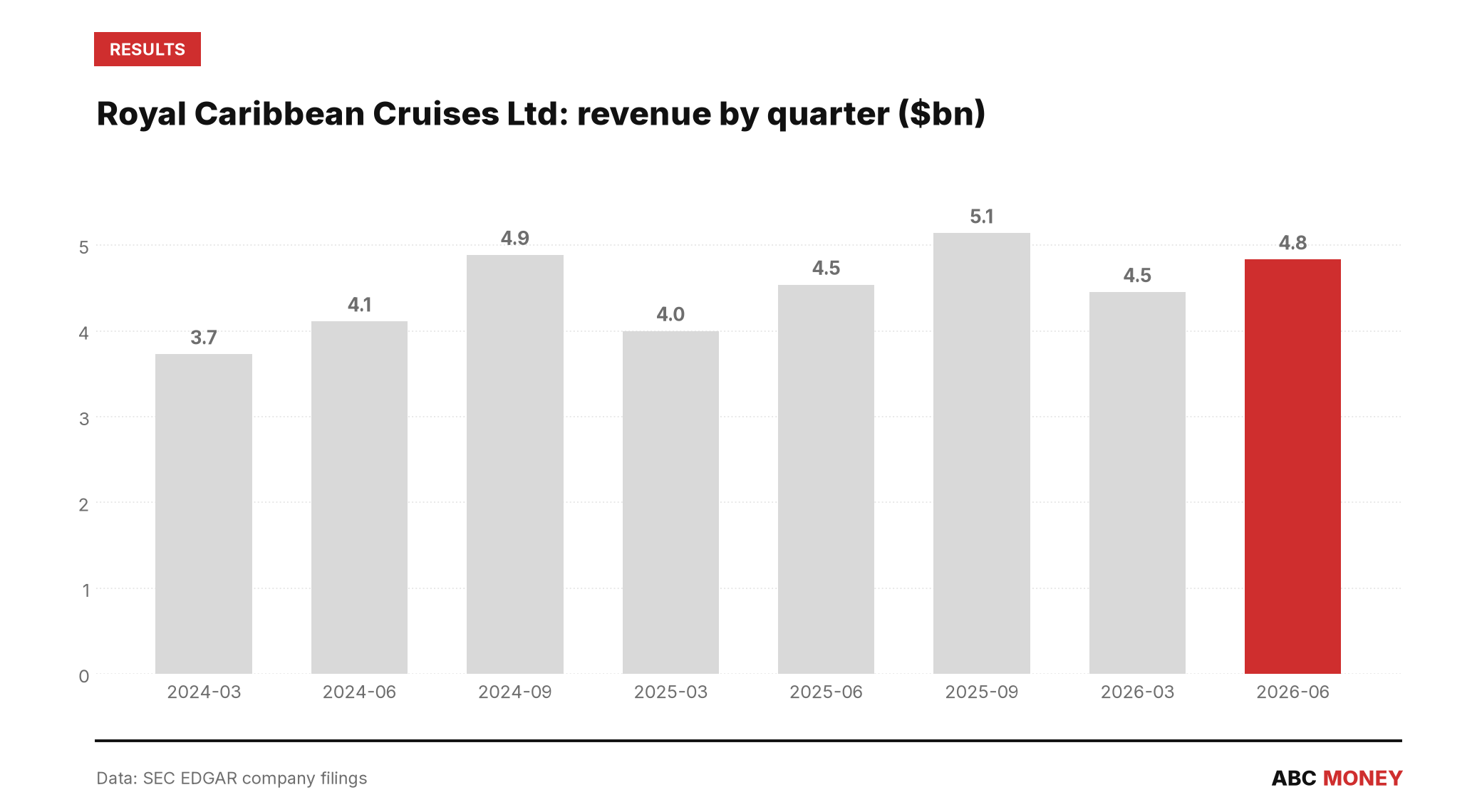
Royal Caribbean’s own numbers show why investors have something to protect. The company reported net income of $1.128bn for the second quarter of 2026, on revenue of $4.83bn, continuing a run of quarterly profits that has strengthened steadily since 2024. A transaction that stretches the balance sheet risks that momentum, at least in the eyes of shareholders who sold first and asked questions later.
Positioning around the report
Short-selling activity – trades betting the shares would fall – had already been drifting higher into the report. FINRA’s daily short-sale data show RCL’s short-volume ratio, the proportion of daily trading volume attributable to short sales, at 0.43 on 21 September, up from a range of roughly 0.28 to 0.40 over the prior fortnight. That is a modest build rather than an extreme spike, but it suggests at least some traders were positioned for turbulence before the news broke rather than only reacting afterwards.
The immediate question for investors is not really whether a deal happens – the reporting is consistent that talks are advanced – but on what terms. Whether Royal Caribbean is buying half of Sandals for roughly $3bn, as CNBC’s sourcing has it, or a larger majority stake at a higher outlay, will matter enormously for how much debt the company needs to take on and how quickly any deal could add to earnings. Until a signed agreement or an SEC filing settles that point, the stock is likely to keep trading on headlines rather than on numbers it can verify.
This article is for information only and is not investment advice or a recommendation to buy or sell any asset. Markets move quickly; figures are correct as sourced at the time of writing. Always do your own research before making financial decisions.



 Bitcoin
  Ethereum
  Tether
  BNB
BNB  USDC
USDC  XRP
XRP  Solana
  TRON
TRON  Lido Staked Ether
  Cardano
  Gram (prev. Toncoin)
  Avalanche