
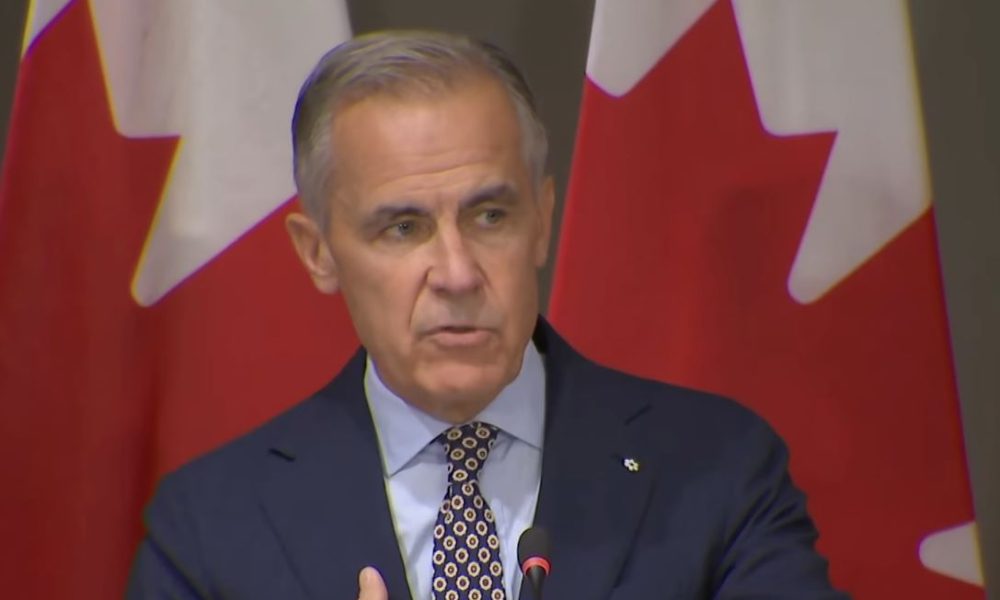
The Royal York Hotel in Toronto is an example of a structure that conveys seriousness without being overly dramatic. High ceilings, dark wood panels, and a lobby that seems to have been intended for discussions about big sums of money. Therefore, it seemed fitting that Prime Minister Mark Carney would give the keynote speech at Canada’s inaugural investment summit last week. Investors from almost 30 nations were present in the room, managing assets totaling about $100 trillion. Few Canadian prime ministers have asked people to open their wallets while standing in front of such an audience.
Throughout his career, Carney has been working toward this kind of moment. He had spent decades in rooms with the same individuals he was pitching to as a former governor of the Bank of Canada and the Bank of England. He is familiar with their language, their worries, and the particular queries they pose prior to investing money in a new market. Most politicians just don’t have that familiarity, and observing him conduct a summit like this gives the impression that he is aware of how unique his position is.
Nearly $500 billion in new investment commitments to Canada were the summit’s most notable outcome. That amount included everything from significant infrastructure financing commitments from Canada’s largest banks to reallocations of pension funds. Over a five-year period, TD Bank committed $150 billion in financing. More than $100 billion was promised by Scotiabank. A $50 billion Maple Fund aimed at critical infrastructure was jointly launched by CPP Investments and Brookfield. Bell Canada and the Saskatchewan government announced a $52.5 billion AI infrastructure hub on the fringes of the summit, which is said to be the province’s biggest capital investment ever.
Those figures merit careful consideration, so it’s worth taking a moment to examine them. Additionally, the government has been promoting the idea that, with $93 billion in FDI recorded in 2025, foreign direct investment in Canada is at its highest level in 20 years.
In nominal terms, that number is correct. However, economists have pointed out that the 2007 peak of $125.5 billion becomes about $188.8 billion in today’s dollars after accounting for inflation, more than doubling the total from the previous year. Carney may be relying on the most positive interpretation of the data because he is an economist by training. The framing needs a closer examination than it has been receiving, even though the larger investment story is still genuine and significant.
The ongoing trade dispute between Canada and the United States serves as the backdrop for all of this. Canada’s economic strategy was largely dependent on its relationship with its neighbor to the south for many years. Up until it didn’t, that arrangement functioned fairly well. Ottawa is now making some urgent efforts to diversify after the conflict with the Trump administration revealed how concentrated that reliance had become. In many respects, the summit served as Canada’s most visible announcement that it is actively seeking new allies.
A purposeful tool of that pitch was the prospectus given to delegates. It covered eight categories (conventional energy, clean energy, minerals and metals, ports, digital infrastructure, advanced manufacturing, and transportation) in its 66-page list of 167 possible investment projects. The predominance of energy and resource projects provides insight into Canada’s perceived areas of greatest competitive advantage. Just sixty-three projects involving metals and minerals. 31 suggestions for clean energy. Most observers were surprised by how detailed and varied the document was.
International investors appear to be genuinely intrigued, if not genuinely interested. Jonathan Gray, the president of Blackstone, referred to Canada as “a sleeping giant, economically”—either a compliment or a tactful way of stating that the nation has long fallen short of its potential. Most likely both. Before the summit, PensionDanmark, a Danish labor market fund that manages about $63 billion, had $1 billion in Canadian assets. It is now reportedly thinking about increasing its equity allocations. In July, foreign investment in Canadian stocks reached $7.2 billion, the highest level of the year. Compared to their American counterparts, Canadian stocks are trading at a significant discount—less than 16 times forward earnings as opposed to roughly 19 times for the S&P 500. That disparity is apparent to institutional investors who are value-oriented.
There are valid concerns regarding execution. A single summit doesn’t address Canada’s long-standing problems with permitting deadlines and regulatory complexity. Business associations have been cautious, pointing out that in order to draw in capital, the conditions that initially deterred investment must be improved. Left-leaning critics dubbed it a “Privatization Summit,” claiming that decisions pertaining to public infrastructure were made behind closed doors. Depending on who you asked, the government’s announcement that it would look for private operators for Canada’s four biggest airports while keeping ownership of the land fell somewhere between bold and controversial.
However, last week there was a change in Toronto. The degree of participation, the names in the room, and the particularity of some of the commitments are difficult to ignore. It will take years to determine whether Carney can turn momentum into long-lasting economic change. The pitch is working, at least for the time being, which is more than could have been said about Canada’s investment story not too long ago.


 Bitcoin
  Ethereum
  Tether
  BNB
BNB  USDC
USDC  XRP
XRP  Solana
  TRON
TRON  Lido Staked Ether
  Cardano
  Gram (prev. Toncoin)
  Avalanche