
Hewlett Packard Enterprise (NYSE: HPE) has landed its first AMD Helios order, a $1.2 billion deal to kit out cloud provider Vultr with AMD-powered AI racks – and used the win to justify a considerably rosier multi-year growth story for its networking business. The announcement, made on 30 September 2026, names Vultr – which HPE describes as the world’s largest privately held cloud infrastructure company – as the launch customer for the new AMD Helios AI Rack platform.
What Vultr is actually buying
The order covers deployment of AMD Helios AI Rack systems across Vultr’s US data centre locations. Each rack packs 72 AMD Instinct MI455X GPUs alongside AMD EPYC “Venice” CPUs, AMD Pensando Vulcano AI networking cards and AMD’s ROCm software stack, wired together with six HPE Juniper Networking QFX5252 scale-up Ethernet switch trays, according to Investing.com. That networking layer is the tell: HPE’s own release leans on “purpose-built HPE Networking scale-up switching and software” as the differentiator, and Vultr is no stranger to the kit – the two companies have worked together on Juniper Networks equipment for roughly three years, predating HPE’s 2025 acquisition of Juniper.
The growth targets moved further than the deal size
The Vultr order landed alongside a networking investor day, and it’s the guidance revision that matters more than the headline contract. HPE lifted its long-term networking segment revenue growth forecast to a high-teens percentage compound annual rate through fiscal 2029, up from a prior 5%-7% range that had run through fiscal 2028, Reuters reported. The nearer-term fiscal 2027 forecast was raised too, to a high-teens-to-low-20s% range from 14%-17% previously. In other words, management is using a single named customer win as the proof point for reshaping growth assumptions across the entire networking division – a much bigger bet than one order, however large.
How the shares reacted
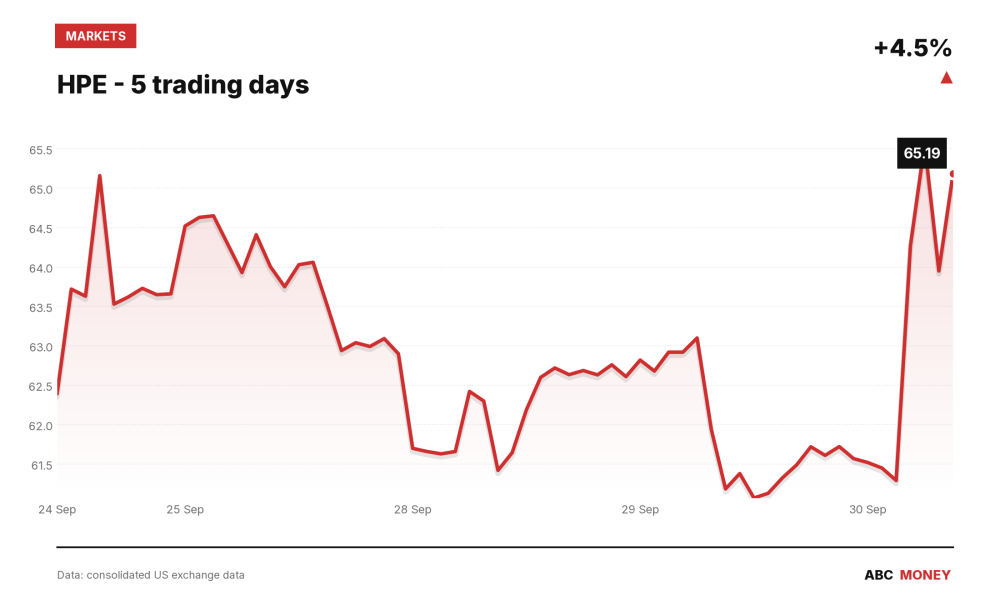
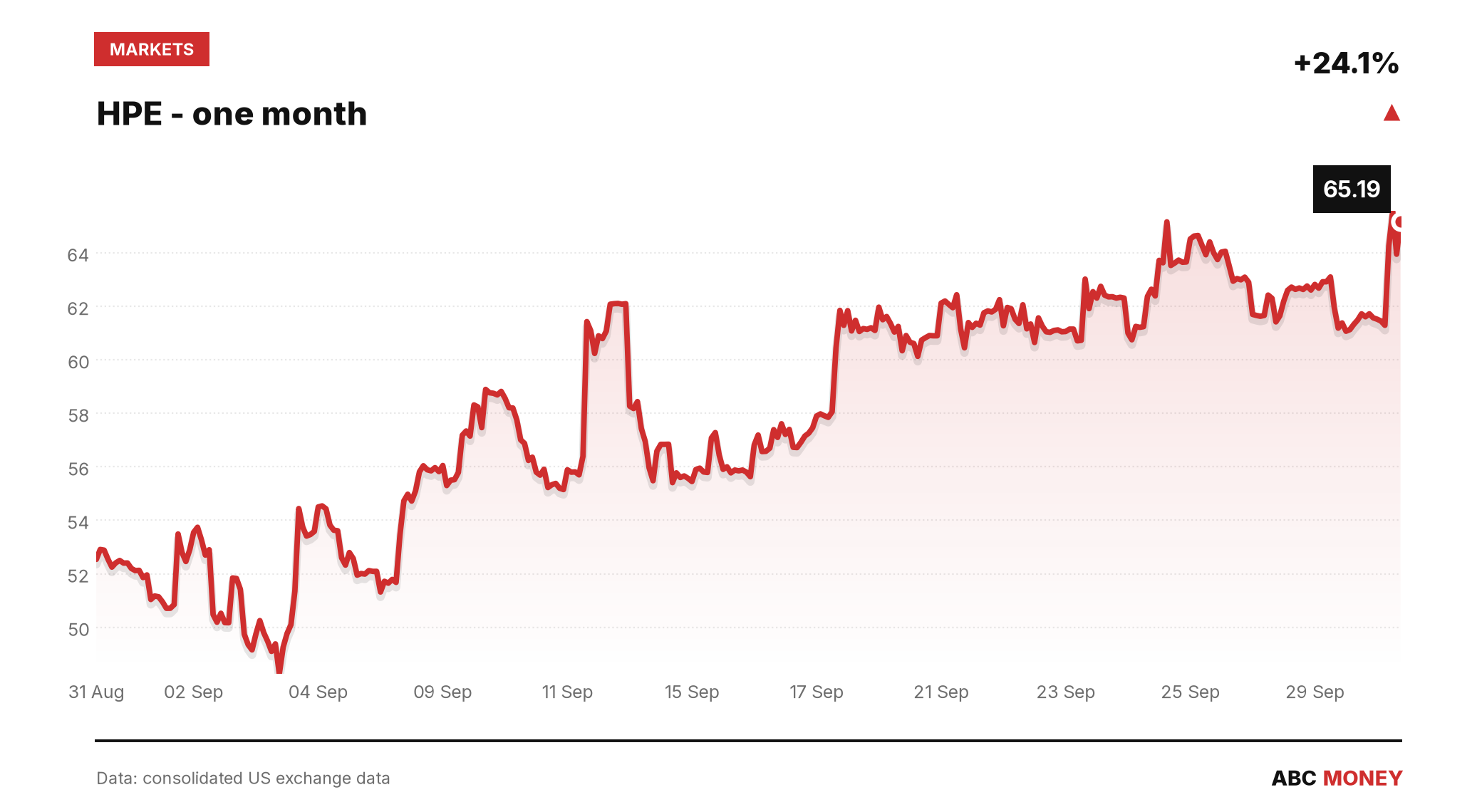
The market took the update seriously. By 14:00 UTC on the announcement day, HPE shares were changing hands at $64.97, up 5.52% on the session and within touching distance of a 20-day high of $65.56, having climbed almost 14% over the preceding month. Turnover ran about 11% above the 20-day average.
There’s a positioning wrinkle worth flagging. Daily short-sale data from FINRA – which tracks how much trading volume comes from short sellers betting the stock will fall – showed HPE’s short-volume ratio easing steadily in the days before the news, from 0.591 on 24 September to 0.367 on 29 September, the session immediately before the announcement. A falling ratio can reflect short sellers buying back borrowed shares (unwinding bearish bets) rather than fresh buyers piling in, and it’s not possible to pin that shift directly on advance knowledge of the Vultr deal from the FINRA data alone. Still, a market that had been getting less bearish into results day is a useful data point for anyone parsing the size of the pop.
The numbers behind the narrative
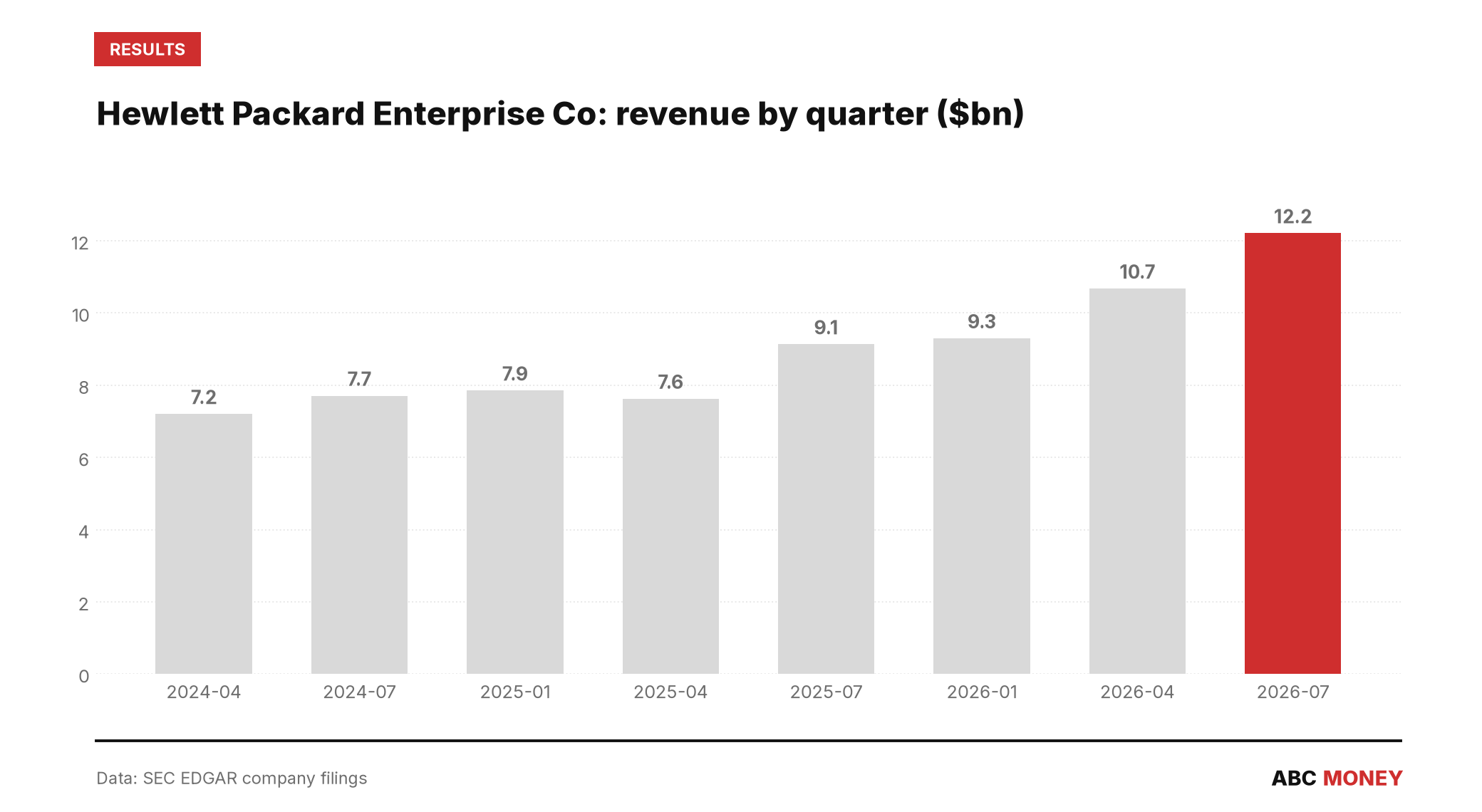
HPE’s underlying financials help explain why investors are willing to buy into an upgraded growth story rather than treat it as marketing. Quarterly revenue, drawn from the company’s own SEC filings, has risen from $7.204 billion in the quarter ended April 2024 to $12.213 billion in the quarter ended July 2026 – a run that includes the Juniper acquisition closing and its networking business being folded in. That integration wasn’t painless: HPE posted a net loss of $1.05 billion in the quarter ended April 2025, before swinging to net income of $1.54 billion in the most recent quarter. That volatility looks tied to acquisition-related costs rather than anything to do with the Vultr order itself, but it is the backdrop against which the new networking targets have to be judged – this is a company that has just absorbed a large deal and is now asking the market to believe the combined business can compound at rates roughly two to three times its previous forecast.
For AMD, the deal is one more data point that Helios – its answer to Nvidia’s integrated rack-scale AI systems – is finding real customers beyond the chipmaker’s own marketing slides, even if the Vultr contract is modest next to the hyperscale orders that dominate headlines elsewhere in the sector. For HPE, the next test is whether the high-teens networking growth target survives contact with quarterly results, starting with how the company frames networking segment revenue when it next reports.
This article is for information only and is not investment advice or a recommendation to buy or sell any asset. Markets move quickly; figures are correct as sourced at the time of writing. Always do your own research before making financial decisions.


 Bitcoin
  Ethereum
  Tether
  BNB
BNB  USDC
USDC  XRP
XRP  Solana
  TRON
TRON  Lido Staked Ether
  Cardano
  Gram (prev. Toncoin)
  Avalanche