
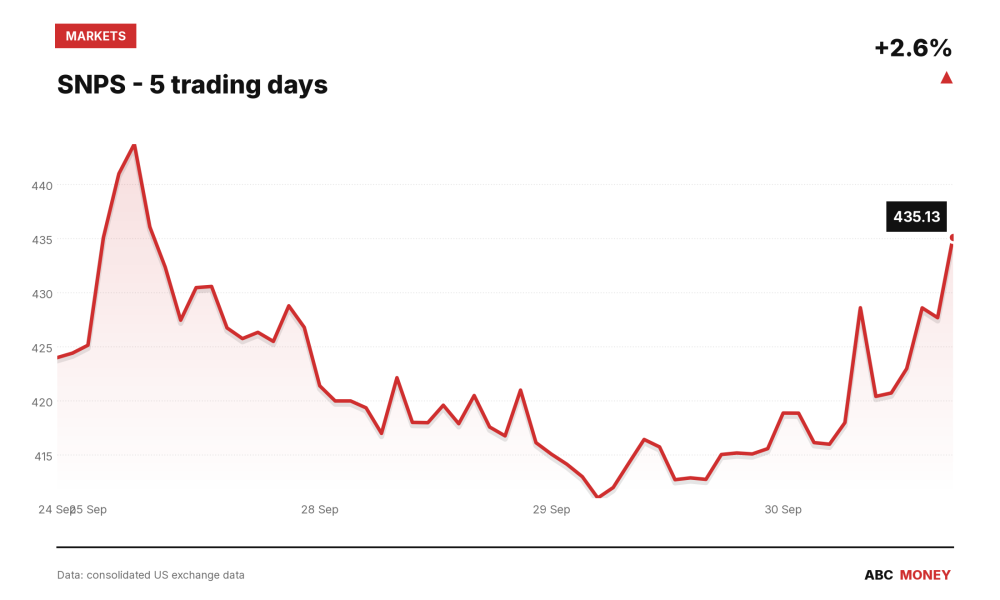
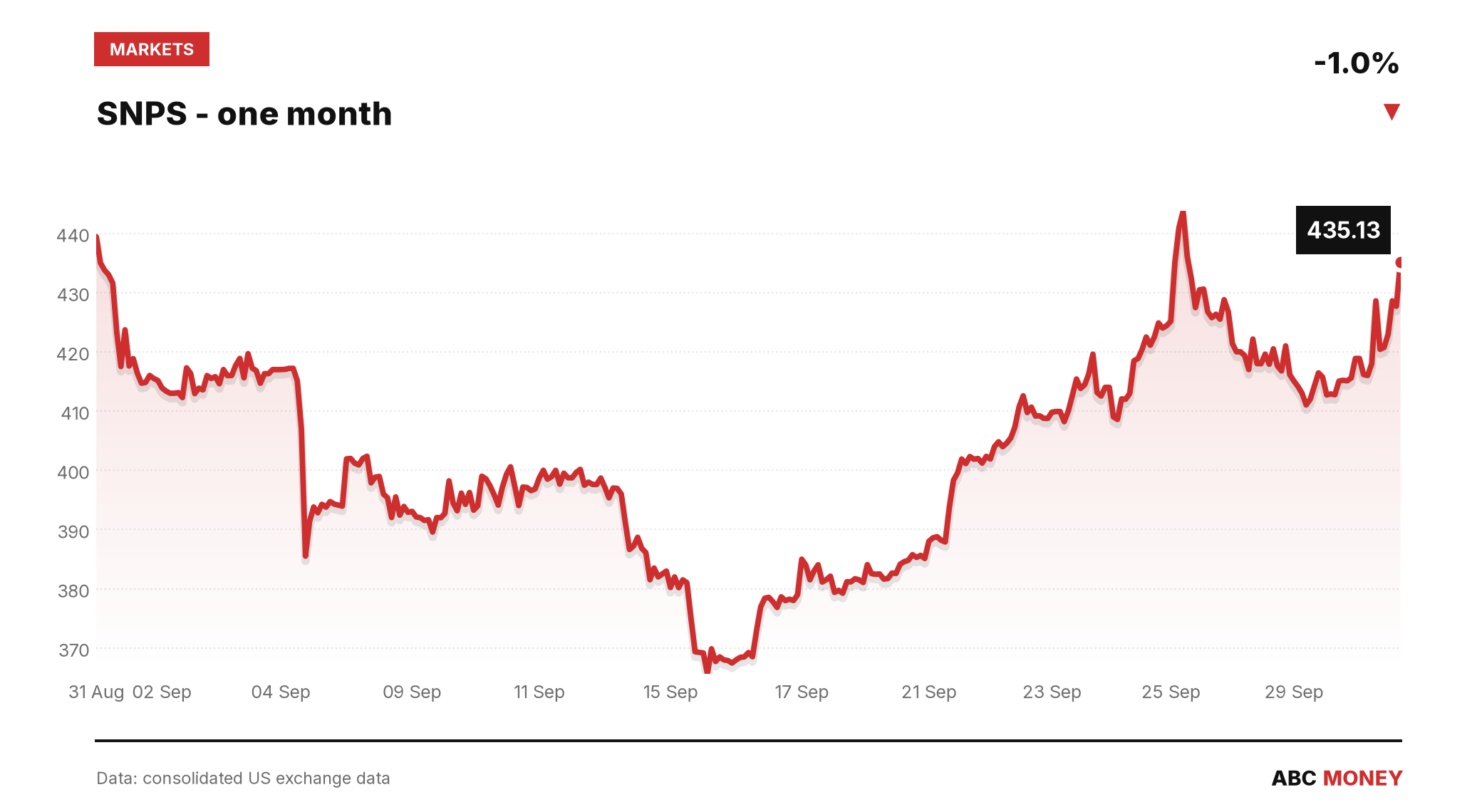
Synopsys (NASDAQ: SNPS) and OpenAI announced a multi-year partnership on 30 September to build “GPT-Synopsys,” a specialised AI model for chip design that pairs OpenAI’s frontier models with Synopsys’ electronic design automation (EDA) software – the tooling engineers use to lay out and verify semiconductor circuits. The GPT-Synopsys chip design deal sent Synopsys shares up 4.19% on the day to $435.50, part of a 9.94% climb over the prior 20 trading sessions, on volume roughly 3.14 times the stock’s recent average, according to the companies’ joint announcement.
The tie-up was corroborated independently by Reuters, which confirmed the two firms had struck a deal to jointly develop an AI model for chip design work. The core claim checks out: this is a real, signed partnership, not a rumour inflating a thinly traded stock.
What the two sides actually agreed
Per the release, Synopsys and OpenAI will act as “preferred partners” under a multi-year agreement to develop and deliver GPT-Synopsys, described as bringing together “OpenAI’s frontier AI with Synopsys’ trusted EDA tools and chip design expertise.” OpenAI will licence Synopsys’ EDA software as part of building and operating the model, and the companies say they will collaborate closely on research and development plus joint go-to-market efforts under what both sides call a shared revenue framework. Benzinga’s reporting on the announcement flagged the same structure – revenue sharing plus software licensing – while noting explicitly that financial terms were not disclosed.
That last point matters more than it might first appear. Revenue-sharing arrangements can mean almost anything, from a token royalty on a niche product to a material slice of a company’s top line. Without a number attached, the announcement tells investors the shape of the deal but not its size.
The numbers nobody has yet
No 8-K – the filing US-listed companies use to disclose material events to the Securities and Exchange Commission – had appeared for this announcement at the time of writing. That is not unusual for a same-day press release; companies typically have four business days to file, and undisclosed terms are often exactly that: terms the companies haven’t chosen to disclose yet, rather than terms being concealed. But it does mean the deal’s economic magnitude is, for now, unverifiable against anything Synopsys has told regulators.
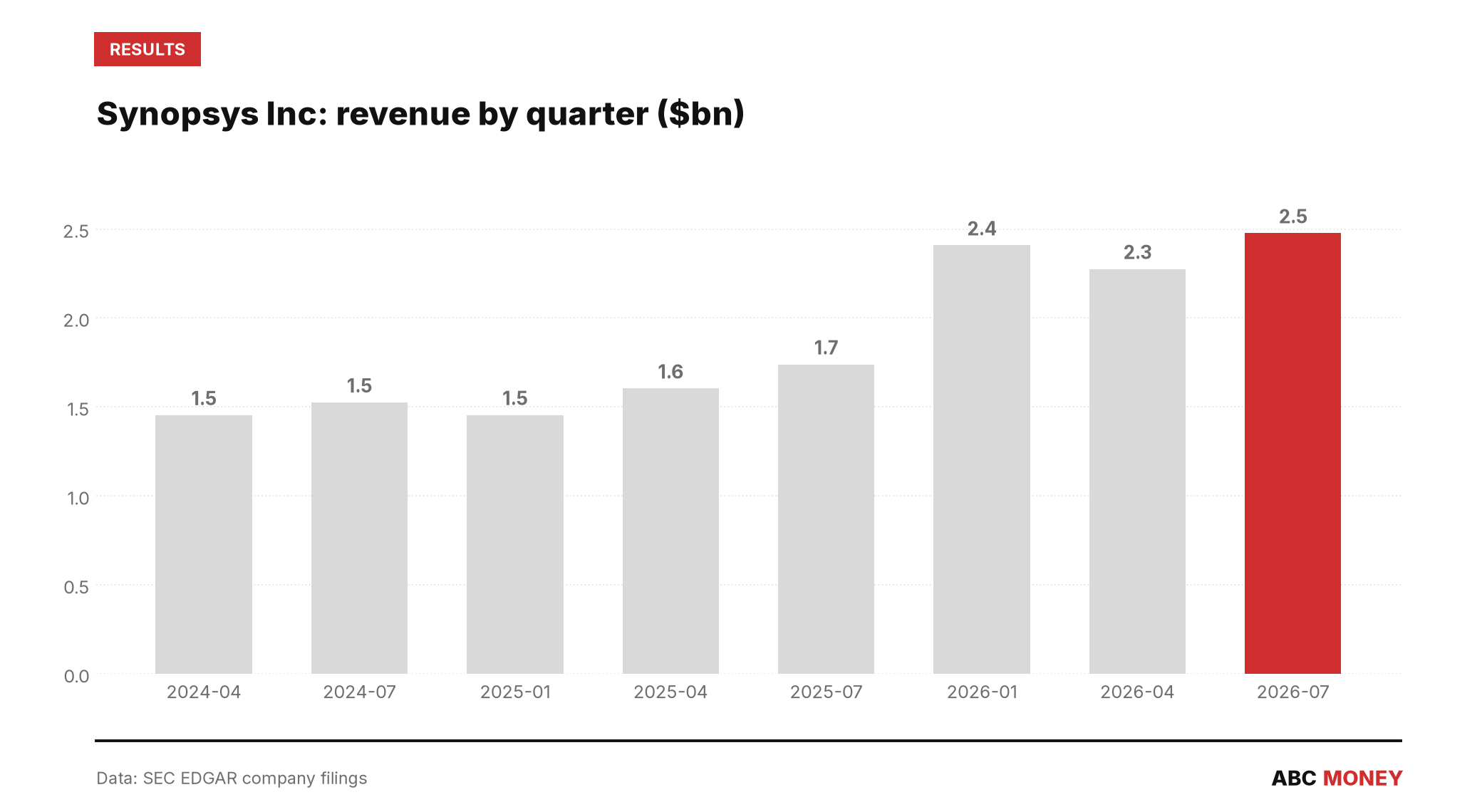
What is verifiable is the scale of the business the deal sits inside. Synopsys reported quarterly revenue of $2.48bn for the quarter ended 31 July 2026, with net income of $545.8m for the same period – a sharp rebound from the $17.1m and $65m net income figures logged in the two preceding quarters, both of which had been depressed by one-off items disclosed in earlier filings. Set against that base, even a generously sized AI licensing arrangement would need to be unusually large to move Synopsys’ overall numbers on its own in the near term. The market’s 20-day, 9.94% run-up suggests investors are pricing in something more than incremental licence revenue – they are betting on GPT-Synopsys as a strategic foothold in agentic AI for chip design, a market EDA vendors are racing to claim before hyperscalers build the capability in-house.
Positioning ahead of the news
One way to check whether a rally like this was already anticipated is to look at short interest – the proportion of daily trading volume attributable to short sellers betting the stock will fall. FINRA’s daily short-sale data shows Synopsys’ short volume ratio bouncing between roughly 0.32 and 0.53 in the fortnight before the announcement, with no sharp dip that would suggest a wave of short-covering drove the price move. That is consistent with genuine new buying on the news rather than short sellers scrambling to close positions – a distinction that matters for how durable the rally might prove, since covering rallies tend to fade faster than rallies built on fresh conviction.
The move also landed against a rising-rate backdrop: the 10-year US Treasury yield stood at 5.24% on 28 September, up from 5.17% the prior reading, according to Federal Reserve data. Higher long-term yields typically pressure growth-stock valuations, which makes Synopsys’ rally on AI-specific news look like a case of investors treating this deal as a genuine re-rating catalyst rather than a rate-driven trade.
What comes next
Commentary from outlets including TradingView has framed the tie-up as an early but strategically significant move, aligning Synopsys with a frontier AI lab at a moment when EDA vendors are jockeying for position with both AI labs and hyperscalers – Synopsys has separately been linked to AI collaborations with Amazon around the same period. The company’s next scheduled quarterly filing will be the first real test of whether GPT-Synopsys shows up as a line item investors can measure, rather than a framework they can only take on trust.
This article is for information only and is not investment advice or a recommendation to buy or sell any asset. Markets move quickly; figures are correct as sourced at the time of writing. Always do your own research before making financial decisions.

 Bitcoin
  Ethereum
  Tether
  BNB
BNB  USDC
USDC  XRP
XRP  Solana
  TRON
TRON  Lido Staked Ether
  Cardano
  Gram (prev. Toncoin)
  Avalanche