
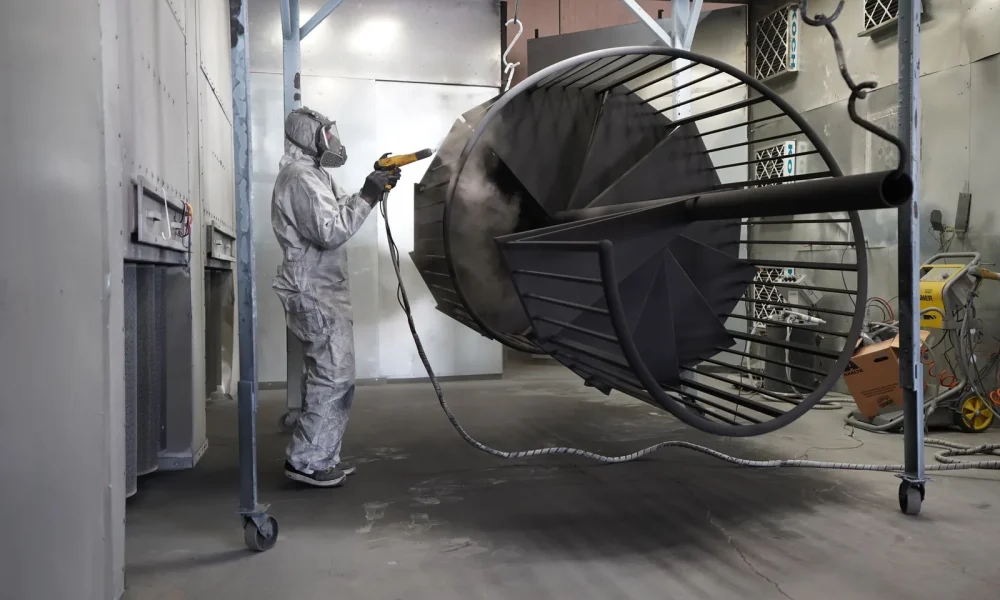
For many small and mid-sized UK manufacturers, finishing is the bottleneck nobody budgets for. Parts are cut, welded and machined in-house, then sent out to a subcontractor for painting, where they join someone else’s queue. Deciding whether to bring that work back under the same roof comes down to a spreadsheet, and the numbers are more nuanced than a supplier’s quote suggests.
Industrial spray booths range from compact dry filter units for a small workshop to fully enclosed, heated rooms for large fabrications, and the capital outlay scales accordingly. Before comparing prices, though, it’s worth being clear about what the current arrangement actually costs.
What outsourcing really costs
The subcontractor’s per-part price is the obvious figure, but it’s rarely the whole one. Transport to and from the finisher, packaging, handling damage and the admin of tracking batches all add up. So does lead time. Parts sitting at an external painter for a week or two are work in progress with cash tied up in them, and long turnaround times can cost orders from customers who need delivery quickly.
Quality is harder to price but just as real. Rework on parts that come back with runs, poor adhesion or the wrong shade eats into margin, and disputes over responsibility take management time. Any honest comparison should try to put a figure on these hidden costs, even if it’s an estimate.
The capital side
The booth itself is only one line in the budget. Installation, ducting, electrical and gas connections, compressed air supply, spray equipment and any building alterations can add significantly to the headline price. Some sites need upgraded power or a new extraction route through the roof, and those works are best scoped before a purchase is committed.
Tax treatment can soften the impact considerably. The Annual Investment Allowance lets businesses deduct the full cost of qualifying plant and machinery, up to £1 million a year, from taxable profits. Companies buying new equipment may also be able to claim full expensing. The rules have specific conditions, so it’s sensible to confirm eligibility with an accountant before assuming the relief applies.
Asset finance and hire purchase are common routes for spreading the cost, with the equipment itself acting as security. That can protect working capital, but the total cost of borrowing should be included in any payback calculation rather than left out.
Running costs that are easy to underestimate
Energy is typically the largest ongoing expense, and most of it goes on heating the replacement air that a booth pulls in and exhausts. Heat recovery systems, variable speed fans and good insulation cost more upfront but can cut running costs noticeably, which matters more now that energy prices are less predictable than they were a decade ago.
Filters, paint, thinners and waste disposal are recurring costs. Compliance adds more. Extraction equipment used to control exposure to hazardous substances must be thoroughly examined and tested at least every 14 months, and staff spraying certain paints may need air-fed breathing equipment and health surveillance. Labour and training round out the picture, since a booth is only as good as the person using it.
Where the payback comes from
The strongest cases for in-house finishing tend to rest on speed and control rather than a simple saving per part. Shorter lead times can release working capital and support premium pricing for faster delivery. Direct control over quality usually reduces rework. Some manufacturers also find spare capacity they can sell to other local firms, turning a cost centre into a modest revenue stream.
There’s a scheduling benefit too. When finishing sits in the same building, production planning no longer has to work around a subcontractor’s collection days and capacity. Urgent orders can be prioritised, and small batches that an external finisher might decline or charge a premium for become practical.
The risks worth modelling
Utilisation is the biggest variable. A booth that runs most days pays back far faster than one used a couple of times a week, and fixed costs such as finance repayments, testing and insurance continue whether it’s busy or idle. Businesses with lumpy or seasonal order books need to test the numbers against a quiet year, not just a good one.
Skills are another consideration. Experienced sprayers are in demand, and losing a key operator can leave expensive equipment underused. Regulatory change, such as tighter limits on solvent emissions, could also require further investment later.
Building a sensible model
A useful approach is to calculate the break-even volume: the number of parts per year at which in-house finishing costs the same as outsourcing once capital, running and compliance costs are included. From there, sensitivity testing on energy prices, volumes and labour costs shows how robust the case really is.
Treated as a strategic investment rather than a like-for-like swap, a finishing line can strengthen a manufacturer’s position considerably. The decision just deserves the same scrutiny as any other significant capital commitment, with the hidden costs of the status quo given as much weight as the price of the alternative.
Contributed content: this article was written by a third-party contributor and does not necessarily reflect the views of ABC Money. Editorial and Advertising Policy


 Bitcoin
  Ethereum
  Tether
  BNB
BNB  USDC
USDC  XRP
XRP  Solana
  TRON
TRON  Lido Staked Ether
  Cardano
  Gram (prev. Toncoin)
  Avalanche