Bitcoin
  Ethereum
  Tether
  BNB
BNB  USDC
USDC  XRP
XRP  Solana
  TRON
TRON  Lido Staked Ether
  Cardano
  Gram (prev. Toncoin)
  Avalanche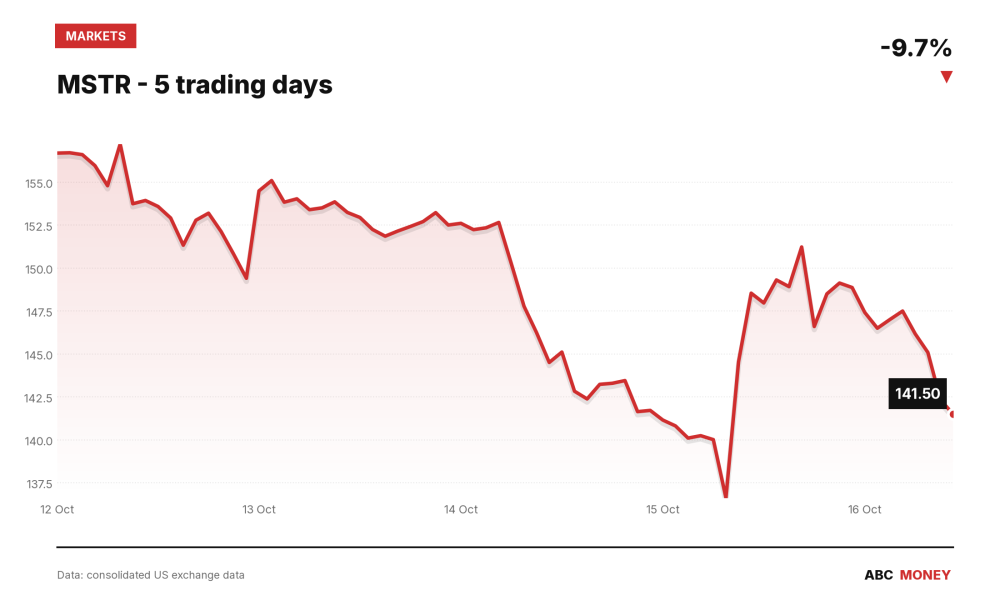
Strategy (NASDAQ: MSTR) shares dropped sharply on 16 October after MSCI confirmed the kind of MSCI index exclusion risk the bitcoin treasury company thought it had dodged back in January. The stock traded at $141.34 as of 15:00 UTC, down 4.12% on the day and 10.52% over the preceding 20 trading sessions, as Benzinga reported.
The trigger is a tightened eligibility framework for MSCI’s Global Investable Market Indexes, which already exclude investment funds and business development companies and will now apply a similar test to “non-operating” corporate issuers — a label aimed squarely at firms that hold large balance-sheet positions in bitcoin rather than running conventional businesses. The change takes effect after the close of trading on 30 November 2026, via MSCI’s November index review.
A reprieve that didn’t last
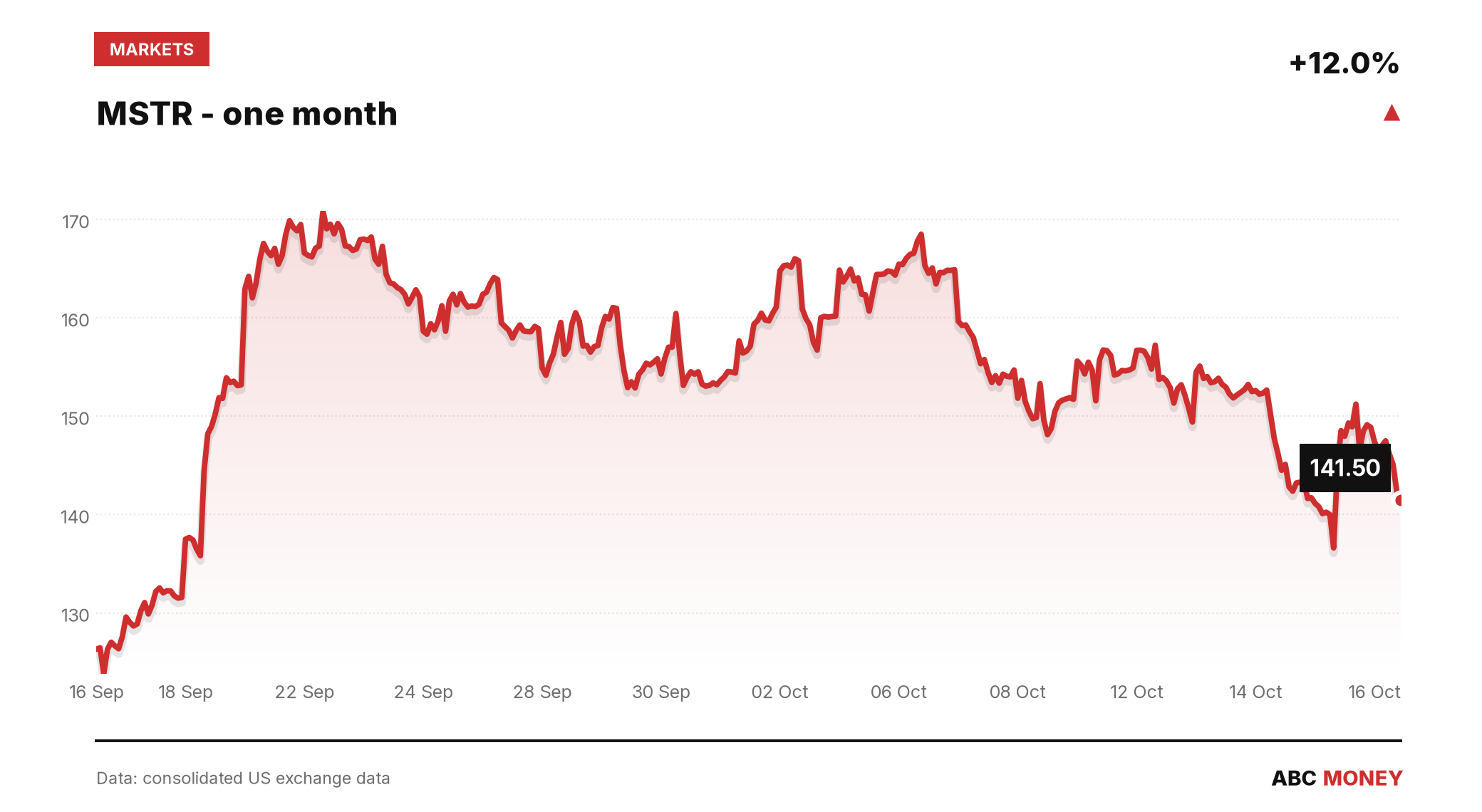
This is the second time in under a year MSCI has moved the goalposts on crypto treasury companies, and the whiplash is part of what makes the story land. In January 2026, MSCI opted not to exclude bitcoin treasury firms under an earlier version of the proposal, a decision that sent MSTR shares up as much as 7% at the time, according to Bitcoin Magazine. Eight months on, the index provider has effectively reinstated the threat through a differently worded test — one that Strategy itself says repackages the same digital-asset concentration concerns MSCI had previously shelved.
MSCI’s methodology works in two stages. Companies are first screened for whether they hold “substantial” operating assets. Those that fail are then run through five financial-ratio tests, and are excluded if four or more of the five flag. MSCI is also scrapping the interim workarounds it had used for digital-asset-heavy firms — including curbs on secondary share offerings and freezes on index weighting increases — in favour of this single pass/fail test, according to reporting cited by Invezz.
Strategy on the preliminary list, final word due 11 November
Strategy appears on MSCI’s preliminary potential-removal list alongside Metaplanet (MTPLF) and several smaller digital-asset holders, with the definitive constituent list due on 11 November 2026 — nearly three weeks ahead of the actual effective date. That gap matters: exclusion is a live risk, not yet a formal decision, and Strategy is actively contesting its classification.
The company’s public rebuttal, posted on its own investor-relations page, argues that funds tracking MSCI’s benchmark indexes hold only 3.1% of its basic shares outstanding, and that “non-operating company” has no settled meaning under US or international accounting standards. In other words, Strategy’s case is twofold: the direct selling pressure from passive index-tracking funds forced to sell would be modest, and the underlying test is, in its view, poorly defined.
What the numbers actually show
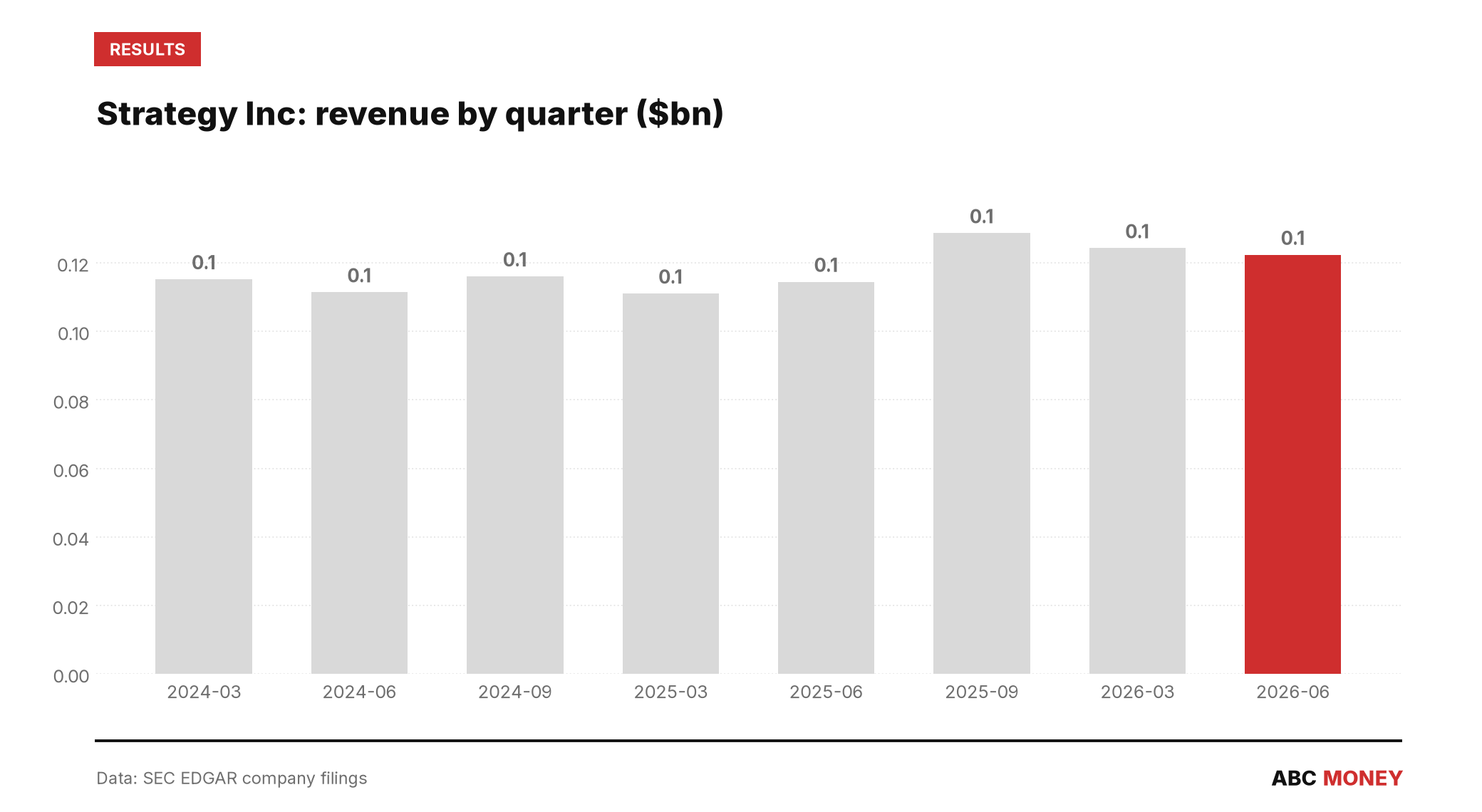
Strip away the index mechanics and Strategy’s operating business is tiny relative to the swings in its reported profit. Quarterly revenue has sat in a narrow band — $124.3m in the first quarter of 2026 and $122.4m in the second, filings show. Net income, by contrast, lurched from a $12.54bn loss in the first quarter to an $8.22bn loss in the second, driven by fair-value accounting on the company’s bitcoin holdings rather than anything happening in its software operations, according to Strategy’s 10-Q filings with the SEC. That volatility — a company whose earnings are essentially a bitcoin price chart wearing a corporate wrapper — is precisely the pattern MSCI’s new test is designed to catch.
There is no sign yet that the selling is being driven by bearish traders positioning for a formal exclusion rather than index funds reacting to the rule itself. MSTR’s daily short-sale volume ratio — the share of trading volume that comes from short sales, where traders borrow and sell stock betting on a price fall — has held in a 0.39 to 0.51 range through mid-October, with no spike around the MSCI announcement, according to FINRA data. That points to a repricing by holders reassessing index exposure rather than a wave of fresh bearish bets.
What happens next
Two dates now bracket the story. MSCI is expected to publish its definitive list of affected constituents on 11 November, which should clarify whether Strategy and Metaplanet make the final cut or secure another reprieve. If they don’t, the exclusion takes effect after the close on 30 November, forcing index-tracking funds to unwind their positions by that date. Until then, Strategy’s own disclosure that MSCI-linked passive money accounts for just 3.1% of its share count will be the central number in its defence — and the one investors watching the stock’s next move are likely to keep testing against the headlines.
This article is for information only and is not investment advice or a recommendation to buy or sell any asset. Markets move quickly; figures are correct as sourced at the time of writing. Always do your own research before making financial decisions.