Bitcoin
 Ethereum
 Tether
 BNB
 USDC
 XRP
 Solana
 TRON
 Lido Staked Ether
 Cardano
 Gram (prev. Toncoin)
 Avalanche
CrowdStrike (NASDAQ: CRWD) and Nvidia (NASDAQ: NVDA) have widened their alliance on AI agent security, announcing a plan to push protection beyond software and into the chips that run AI workloads. The companies said at Nvidia’s GTC 2026 conference that CrowdStrike’s Falcon Guardian – its AI Detection and Response (AIDR) product, which watches how autonomous AI agents behave and intervenes when something looks wrong – will integrate with Nvidia’s newly unveiled OpenShell Reference Architecture, a secure runtime for AI agents, the companies said in a joint statement.
The two also plan to integrate Falcon Guardian with Nvidia Sentry, a hardware-level enforcement layer designed to run on Nvidia’s BlueField-4 data-processing units (DPUs – specialised chips that offload networking and security tasks from the main processor). That step would let CrowdStrike’s detection logic act not just at the operating-system or application layer, where most endpoint security lives today, but inside the infrastructure the AI agent is actually running on.
From guardrails to in-silicon enforcement
“AI agents have already created a new attack surface, and guardrails alone won’t stop an adversary,” said Daniel Bernard, CrowdStrike’s chief business officer, in the release. Nvidia’s Justin Boitano, vice president of enterprise, framed the rationale similarly: “Securing agents in production requires protection from the runtime to the underlying infrastructure.” Both quotes point to the same worry driving the deal – that AI agents acting autonomously inside corporate systems need defences that follow them all the way down to the hardware, not just software-level monitoring that can be bypassed or blinded.
This isn’t a cold start. The two companies first embedded Falcon AIDR into Nvidia’s OpenShell runtime under a “Secure-by-Design AI Blueprint” unveiled on 16 March 2026, and CrowdStrike only launched Falcon Guardian itself weeks before this latest announcement, at its own Fal.Con conference on 1 September 2026. The GTC news is best read as the third leg of a build-out, extending a software-layer product toward infrastructure-level reach rather than introducing a wholly new strategy.
Shares still well off their recent high
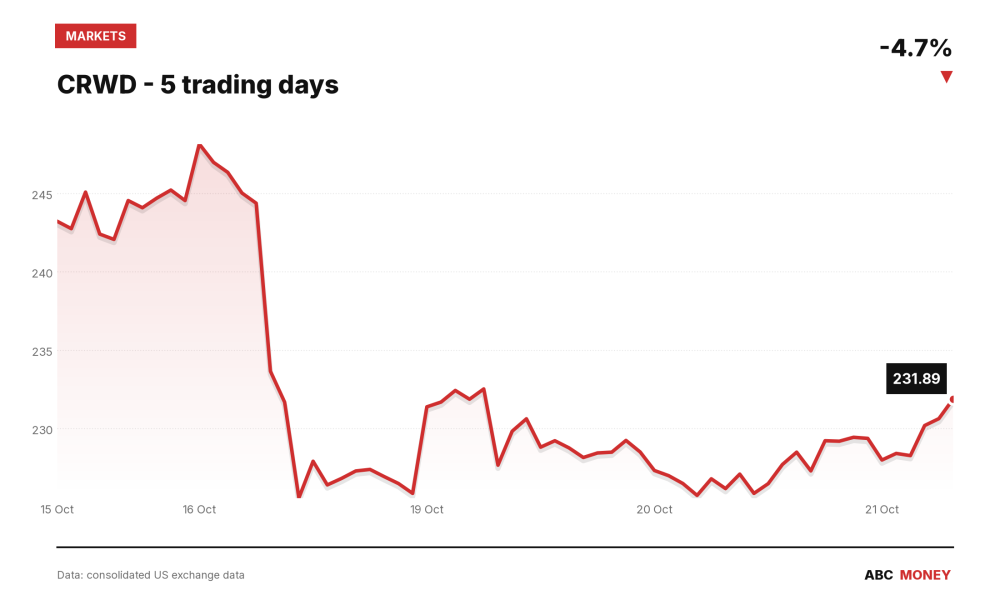
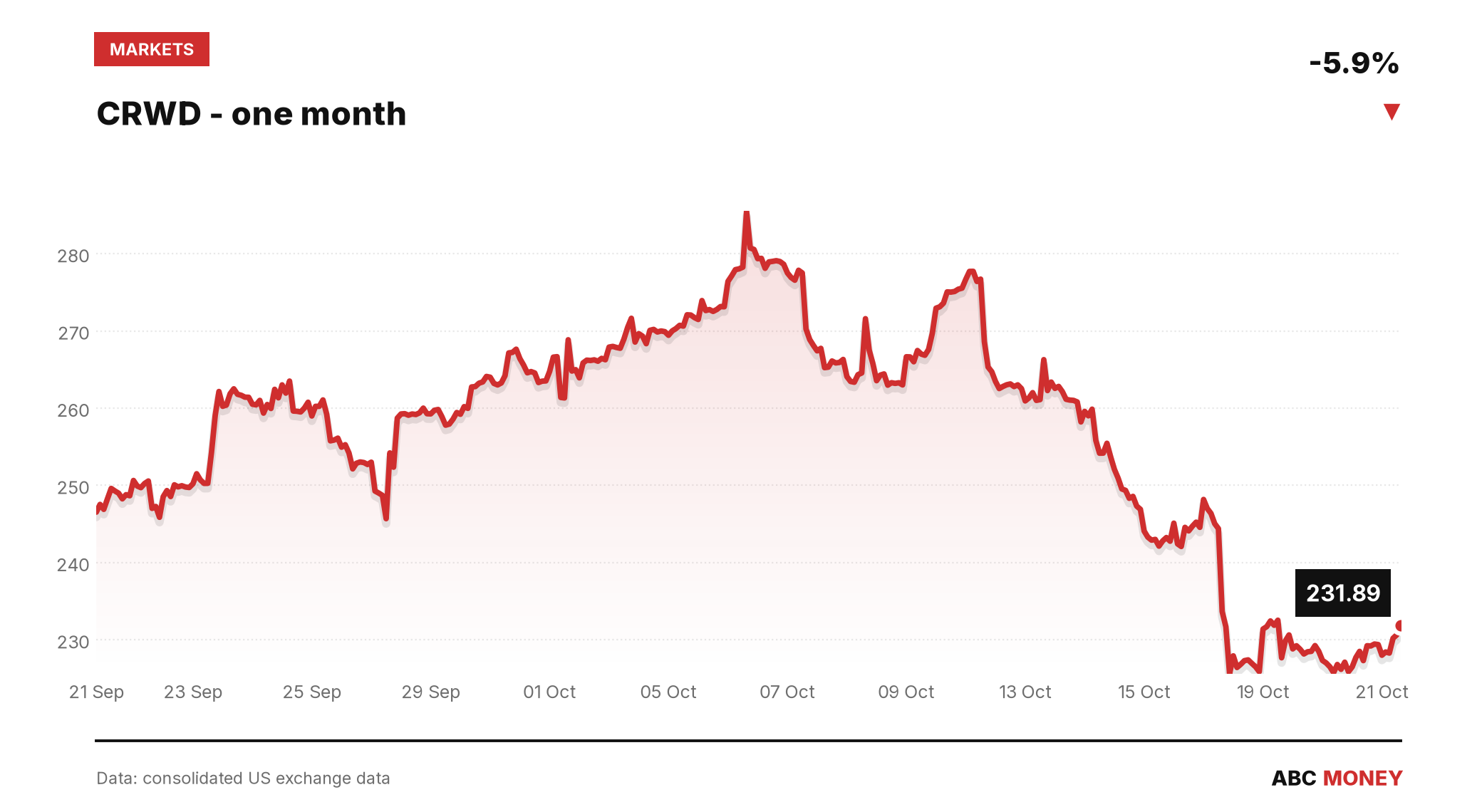
The market reaction has been muted rather than euphoric. CRWD traded at $232.325 as of 1pm UTC on 21 October, up 1.25% on the prior session, but the stock remains down 13.06% over the trailing 20 trading days, a stretch that included a 20-day high of $285.5065, according to consolidated US exchange data. Some of that pullback predates the Nvidia news: shares had already come under pressure in mid-October after reports that Perplexity was giving away a competing AI security “sandbox” tool, unsettling cybersecurity peers broadly.
Rising bond yields have not helped richly valued software names either. The 10-year US Treasury yield stood at 5.15% on 19 October, up from 5.09% the prior reading, according to data from the Federal Reserve Bank of St Louis. Higher long-term yields tend to weigh more heavily on growth stocks whose earnings are priced in further into the future, and CrowdStrike – trading at a premium even after its pullback – sits squarely in that camp.
Profitability returning, insiders selling on schedule
The partnership news lands as CrowdStrike’s underlying financials have turned a corner. After a run of GAAP net losses through fiscal 2026, the company reported net income of $27.77m, or $0.11 a diluted share, in its fiscal first quarter of 2027 covering February to April 2026, followed by a smaller profit of $5.31m, or $0.01 a diluted share, in the quarter to July, according to filings with the SEC. That marks a shift from the losses of between roughly $34m and $110m a quarter that the company posted through most of fiscal 2026.
Separately, CrowdStrike insiders filed routine disclosures around the announcement: chief executive George Kurtz filed a Form 4 on 20 October, and chief legal officer Johanna Flower filed a Form 4 and an amended Form 4/A on 19 and 20 October. Nothing in the filings suggests these were anything other than scheduled disposals of the kind executives file regularly under pre-arranged trading plans; there is no sign of unusual timing tied to the Nvidia news.
For CrowdStrike, the pitch to enterprise customers is straightforward: as companies deploy more autonomous AI agents inside their infrastructure, the attack surface moves with them, and a security vendor that only watches the software layer risks missing threats that live closer to the metal. Whether that argument translates into faster revenue growth will likely show up first in CrowdStrike’s next quarterly filing, when analysts will be watching for early signs of AIDR and Falcon Guardian adoption rates alongside the company’s broader net-new annual recurring revenue trends.
This article is for information only and is not investment advice or a recommendation to buy or sell any asset. Markets move quickly; figures are correct as sourced at the time of writing. Always do your own research before making financial decisions.