Bitcoin
 Ethereum
 Tether
 BNB
 USDC
 XRP
 Solana
 TRON
 Lido Staked Ether
 Cardano
 Gram (prev. Toncoin)
 Avalanche
Thermo Fisher Scientific (NYSE: TMO) delivered the kind of Thermo Fisher Q3 earnings print that analysts like to call “clean” – revenue up 9% to $12.14bn, both profit measures ahead of forecasts, and full-year guidance raised. Look a little closer, though, and roughly $0.15 of the adjusted earnings beat and about $60m of adjusted operating income came from a one-off tariff refund rather than the underlying business simply running better, according to management’s own comments on the earnings call.
The headline numbers are solid regardless. Revenue for the quarter ended 26 September 2026 rose 9% year-on-year to $12.14bn, up from $11.122bn in the same period last year, according to the company’s earnings filing. GAAP diluted earnings per share climbed 9% to $4.64, from $4.27 a year earlier. Adjusted earnings per share – the company’s preferred, non-GAAP measure that strips out items like amortisation and restructuring charges – rose 15% to $6.68.
Both figures beat what Wall Street was pencilling in. Adjusted EPS of $6.68 topped the consensus estimate of $6.40, a beat of about 4.4%, while revenue of $12.14bn came in 1.6% above the $11.95bn analysts had forecast, according to a transcript carried by Investing.com.
Where the margin gain actually came from
The more interesting number sits in the margin line. GAAP operating margin rose to 18.6% from 17.4% a year ago, while the adjusted operating margin – the figure management leans on most heavily in its own commentary – improved to 24.5% from 23.3%. That kind of jump in a single quarter for a company this size is unusual, and part of the explanation is mundane rather than structural: Thermo Fisher recovered tariff costs during the quarter that added a net $0.15 to adjusted EPS, management told analysts on the call. Strip that out and the underlying improvement is real but considerably less dramatic than the headline implies – a distinction worth keeping in mind before extrapolating this quarter’s margin trajectory into 2027.
The quarter also marked the completion of Thermo Fisher’s previously announced divestiture of its microbiology business, part of a broader capital-deployment programme the company has been running for several quarters, as reported by Yahoo Finance. Portfolio pruning of this kind tends to flatter margins mechanically, by removing a lower-margin unit from the mix, which is a separate effect from the tariff refund but points the same direction.
Guidance raised, again
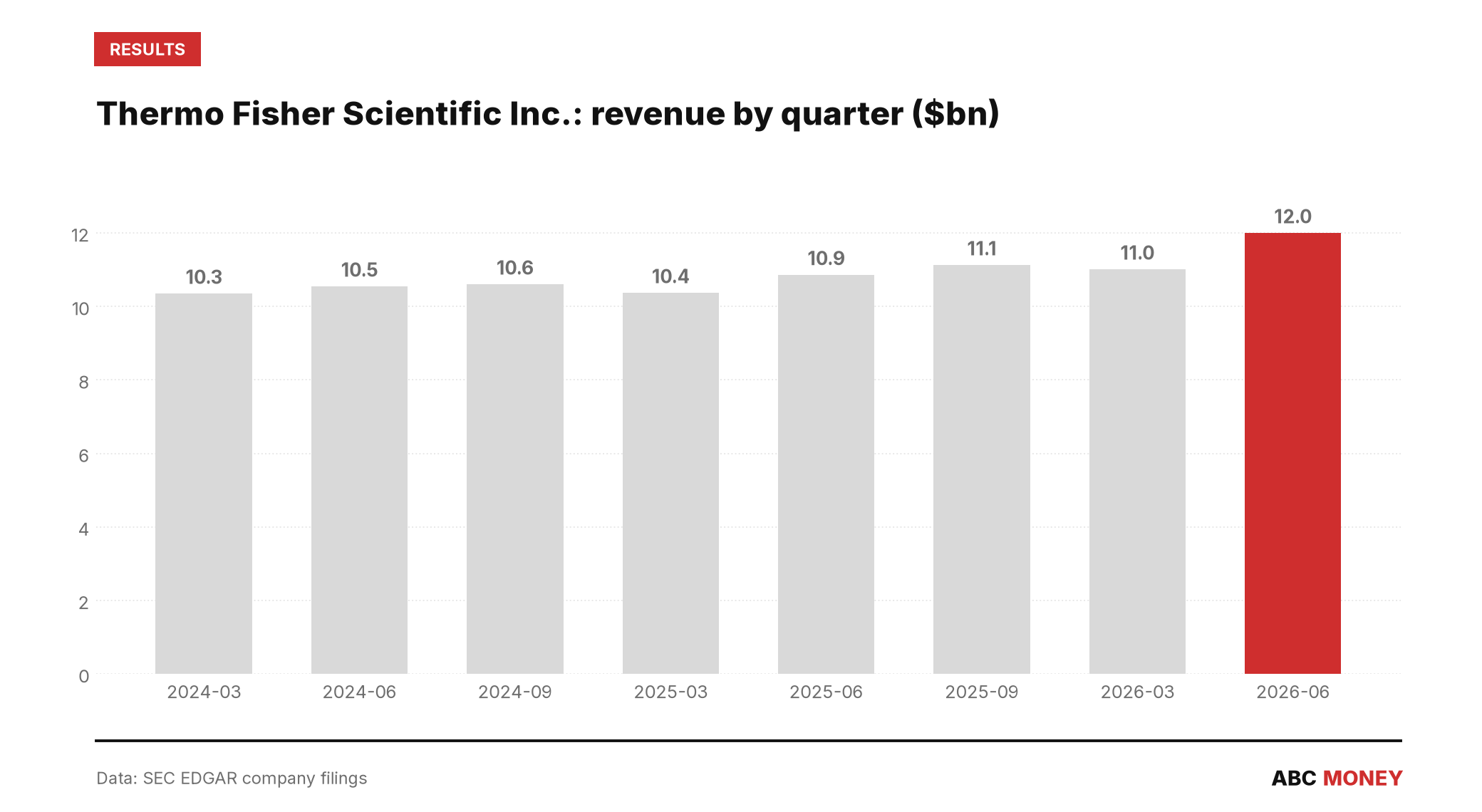
Thermo Fisher lifted its full-year 2026 outlook alongside the results, now guiding to revenue of $47.7bn-$48.2bn and adjusted EPS of $25.13-$25.43, according to the call transcript. That marks the second consecutive quarter of upward revisions, following a string of beats that has taken quarterly revenue from $10.345bn in the first quarter of 2024 to $11.994bn in the second quarter of this year, per the company’s own quarterly filings. The trend has been one of steady, if unspectacular, top-line compounding punctuated by occasional quarters – like this one – where a specific item does a disproportionate share of the earnings-beat work.
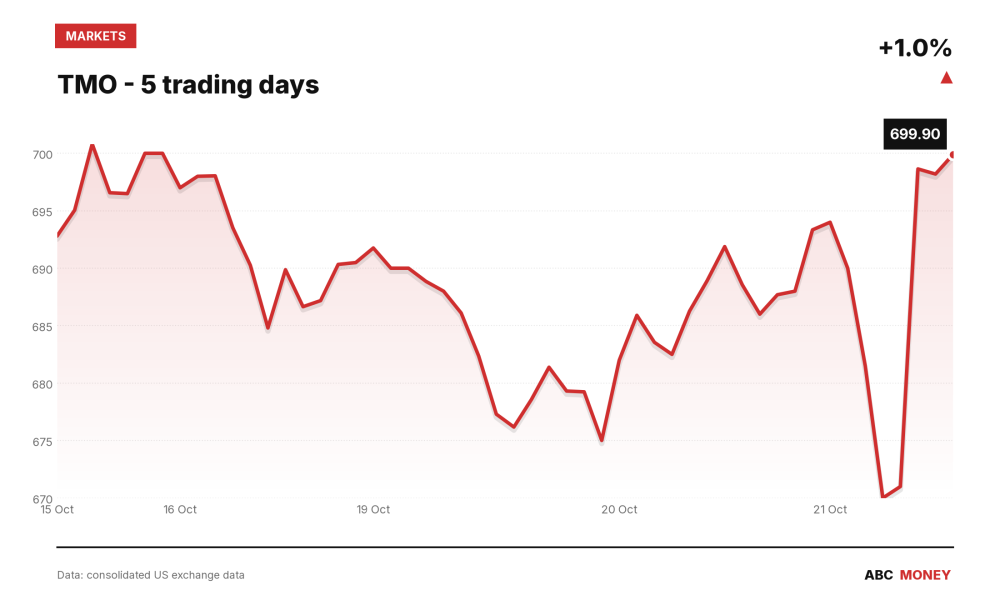
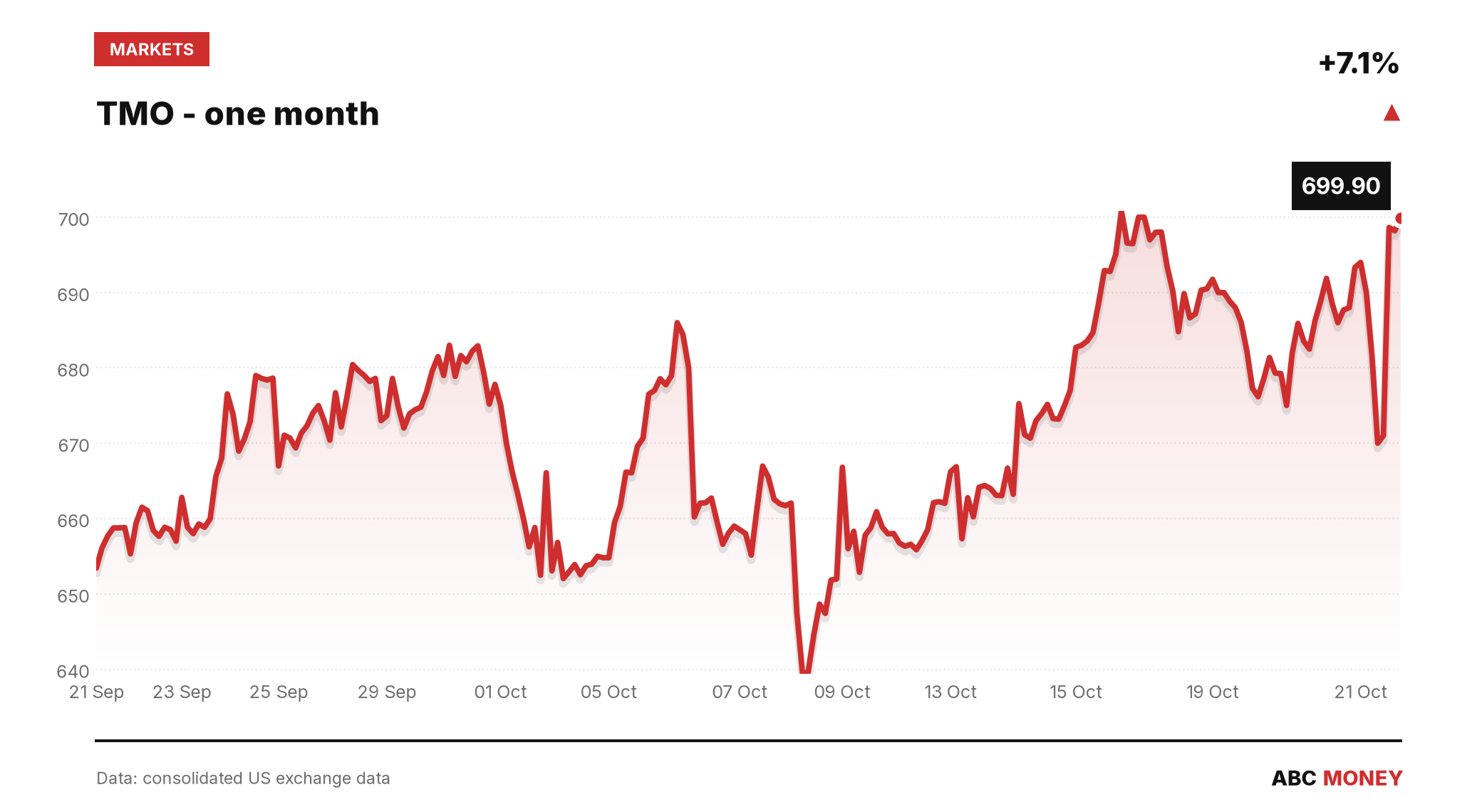
The shares traded at $701.00 as of 3pm UK time on 21 October, up 1.01% on the day and 2.75% over the preceding 20 trading sessions, having touched a 20-day high at that same level, according to consolidated exchange data. Volume on the day ran at around 90% of the 20-day average, suggesting the move was driven by conviction buying rather than a broad rush for the exits or into the stock.
Positioning was already thin before the print
Bearish bets against the stock had been thinning out in the days running into the results. FINRA’s daily short-sale ratio for TMO – the proportion of a day’s trading volume that comes from short sales, where a lower number implies less fresh bearish activity – fell to 0.267 on 20 October from 0.411 the previous session, the lowest reading across the preceding ten trading days, based on FINRA data. That pattern is consistent with short-sellers paring back exposure ahead of a result that, on the headline figures at least, gave them little to work with.
None of this changes the broad picture: Thermo Fisher has beaten expectations on both lines and raised its outlook for the year. The more useful exercise for anyone modelling the stock forward is separating the durable part of the margin story – scale, mix, the microbiology disposal – from the part that simply will not repeat next quarter. Thermo Fisher’s next scheduled update, the fourth-quarter and full-year 2026 results, will be the first real test of whether the margin gains hold once the tariff refund rolls out of the comparison.
This article is for information only and is not investment advice or a recommendation to buy or sell any asset. Markets move quickly; figures are correct as sourced at the time of writing. Always do your own research before making financial decisions.