Bitcoin
 Ethereum
 Tether
 BNB
 USDC
 XRP
 Solana
 TRON
 Lido Staked Ether
 Cardano
 Gram (prev. Toncoin)
 Avalanche
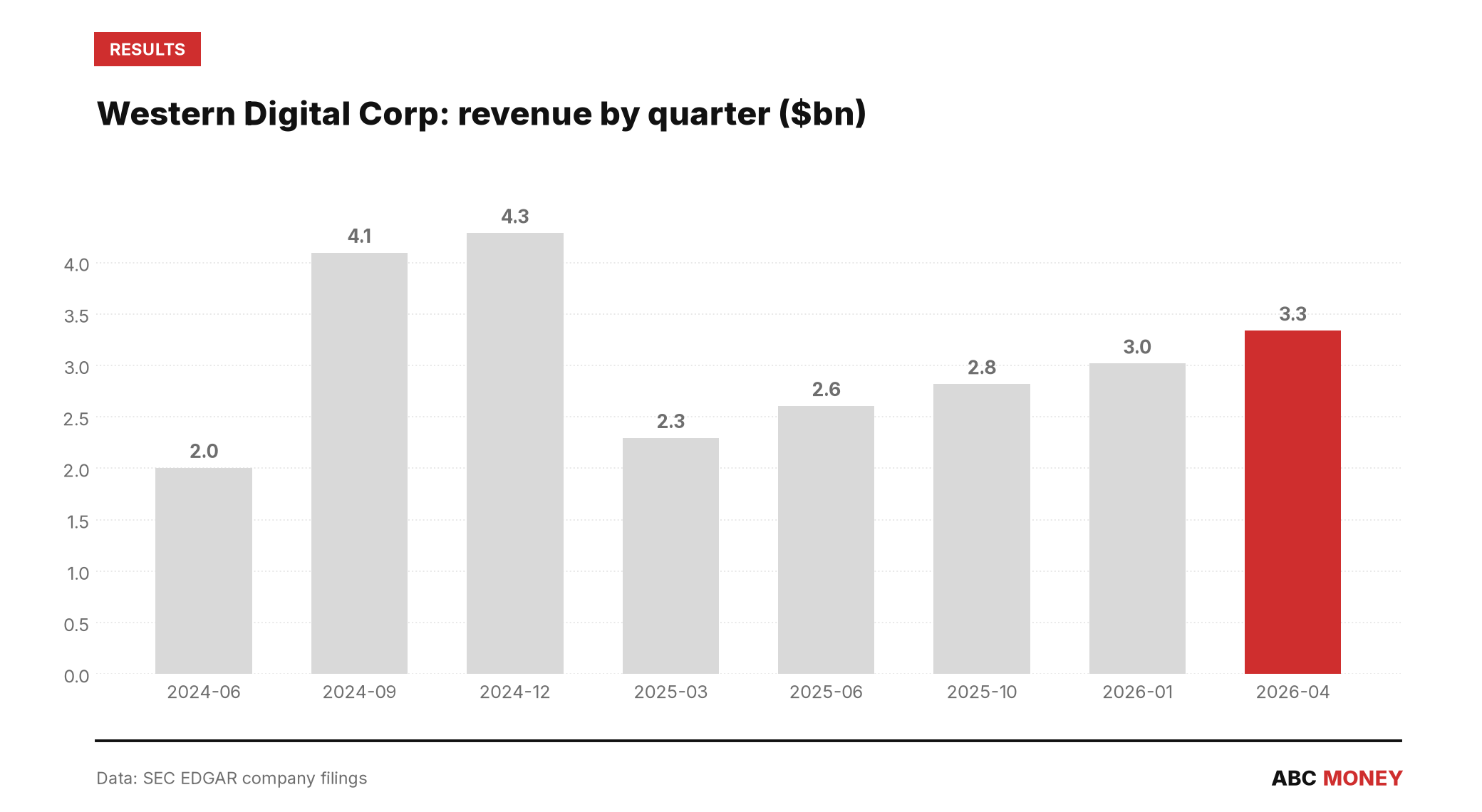
Western Digital’s earnings beat for the fiscal first quarter of 2027 was emphatic: revenue of $4.38 billion against a $4.14 billion consensus, and adjusted earnings per share of $4.64 versus the $4.11 analysts had pencilled in, according to the figures in Western Digital’s own results release. GAAP diluted earnings per share came in at $4.63, with the one-cent gap to the adjusted figure reflecting the usual stripping-out of one-off items. Both numbers cleared the bar GuruFocus had pegged at $4.11 a share, and the beat extends a run of quarters in which the hard-disk maker has outrun what Wall Street expected of it.
Western Digital (NASDAQ: WDC) didn’t stop at the headline numbers. Guidance for fiscal Q2 2027 calls for revenue centred on $5.10 billion and adjusted earnings per share of $5.60 to $6.00, a forecast TheStreet reported as a $5.0 billion-to-$5.2 billion revenue range built around $5.80 a share, plus or minus 20 cents. That would mark another leg up from an already outsized quarter, and the board backed its confidence with cash: a 17% dividend increase to $0.175 a share, payable on 17 December 2026, as disclosed in the company’s release.
Cloud storage carries the quarter
The engine behind the numbers is nearline storage for data centres – the high-capacity hard drives cloud operators buy by the rack to keep pace with AI workloads. Cloud revenue reached $3.9 billion, 88% of the total quarter and up 54% year-on-year, driven in part by the early ramp of Western Digital’s newer EPMR recording platform, according to commentary from the earnings call reported by Benzinga. Margins moved with it: non-GAAP gross margin hit 58.1%, up roughly 1,420 basis points (a basis point is one-hundredth of a percentage point) from 43.9% a year earlier, per BigGo Finance‘s read of the release. That is the kind of margin expansion that normally gets a stock re-rated higher, not sold off.
Why the Western Digital earnings beat didn’t hold the share price
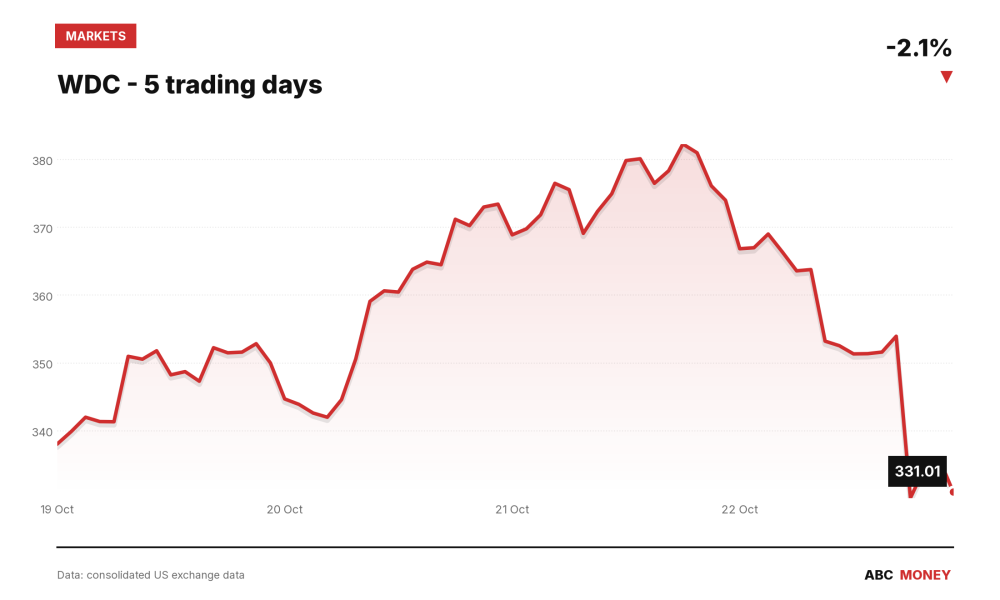
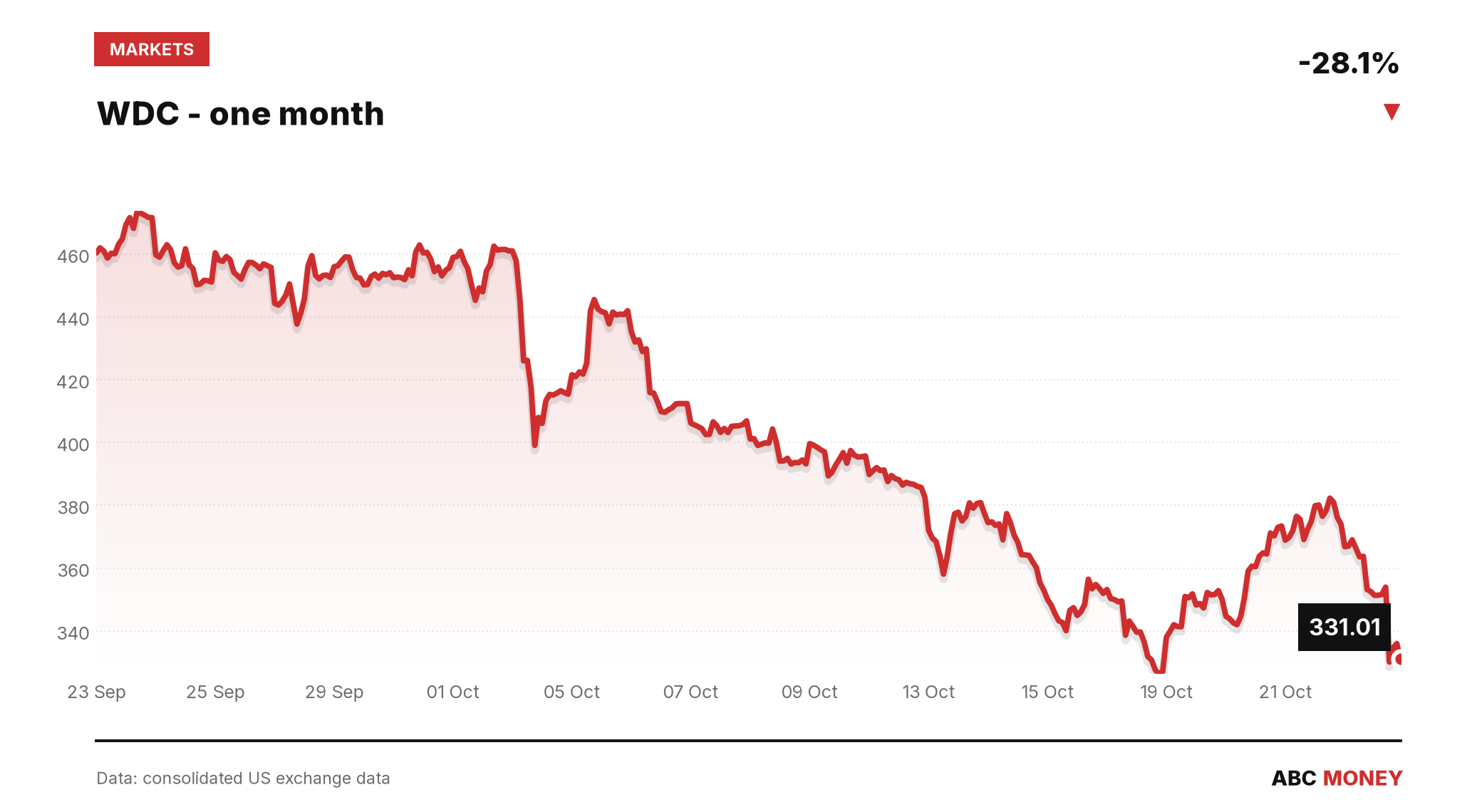
It didn’t work out that way. The shares closed the regular session down 6.43% at $354.19, then fell a further 4.85% in after-hours trading to $337.01, as Investing.com reported it, with investors apparently more interested in management’s comments on rising input costs and higher planned capital spending than in the headline beat itself. That reaction fits a pattern: Western Digital stock fell after each of its prior three earnings reports too – 13.0% in August 2026 and 10.1% in January 2026 – even as the underlying results improved, according to Opening Bell Daily News. A stock that keeps selling off on good news tends to say more about how richly it was priced going in than about the quarter itself, and with AI-linked storage names having run hard this year, Western Digital looks to have been caught in a broader repricing rather than punished for anything specific to its own numbers.
Positioning data lends some support to that reading. FINRA’s daily short-sale volume figures show the share of trading tied to short sales (bets that the price will fall) running between roughly 0.24 and 0.47 of total volume in the ten sessions before the results, with 0.465 the day before the release easing to 0.385 on the day itself – not the signature of a crowded short squeeze unwinding, but consistent with a market already nervous about valuation before the numbers landed.
The scale of the underlying earnings recovery is worth sitting with. Public filings show Western Digital’s net income climbing from $1.18 billion in the fiscal quarter a year earlier to $1.84 billion the quarter after that, and to $3.21 billion in the most recent quarter for which a full filing exists – the fiscal 2026 third quarter, reported in a 10-Q filed with the SEC in May 2026, with diluted earnings per share of $8.20 against $3.07 a year prior. That filing predates the quarter just reported, but it frames the trajectory the market had already priced in before Wednesday’s numbers arrived – and why a beat on top of a beat wasn’t, on its own, enough to hold the stock up.
What happens next for the shares likely depends less on this quarter’s numbers than on whether management’s guidance for rising costs and capital spending proves temporary or structural – a question investors will get their next real update on when Western Digital reports its fiscal second-quarter results.
This article is for information only and is not investment advice or a recommendation to buy or sell any asset. Markets move quickly; figures are correct as sourced at the time of writing. Always do your own research before making financial decisions.