Bitcoin
 Ethereum
 Tether
 BNB
 USDC
 XRP
 Solana
 TRON
 Lido Staked Ether
 Cardano
 Gram (prev. Toncoin)
 Avalanche
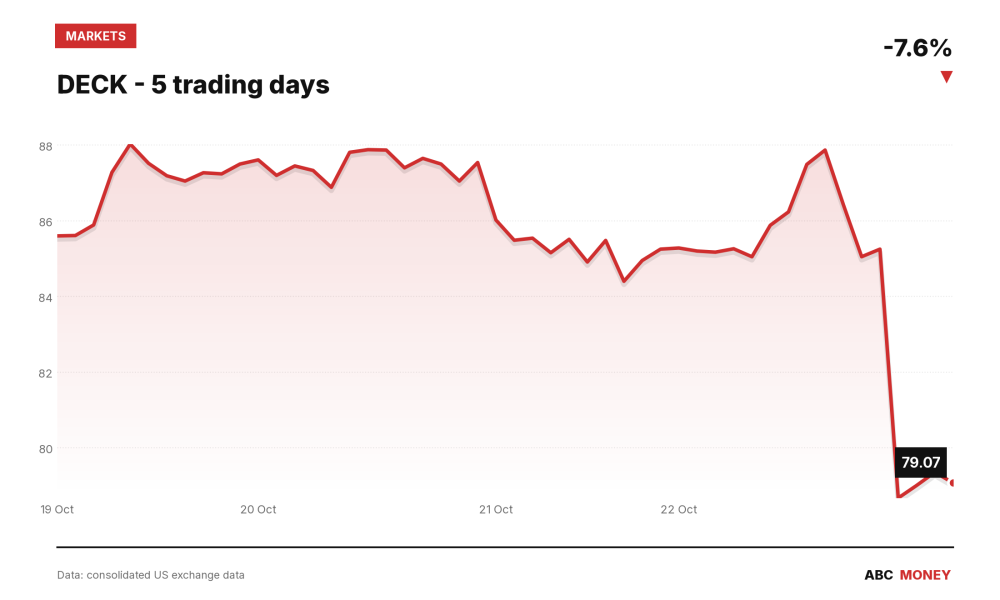
Deckers Outdoor (DECK) cut its fiscal 2027 guidance on 22 October, even as the owner of UGG and HOKA delivered a quarter that beat earnings forecasts by a wide margin. The market’s verdict was unambiguous: shares fell as much as 8.6%-8.7% in the immediate aftermath of the release, according to Investing.com, before the decline deepened to 10.01% by the close, leaving the stock at $79.07 on volume 3.77 times its 20-day average.
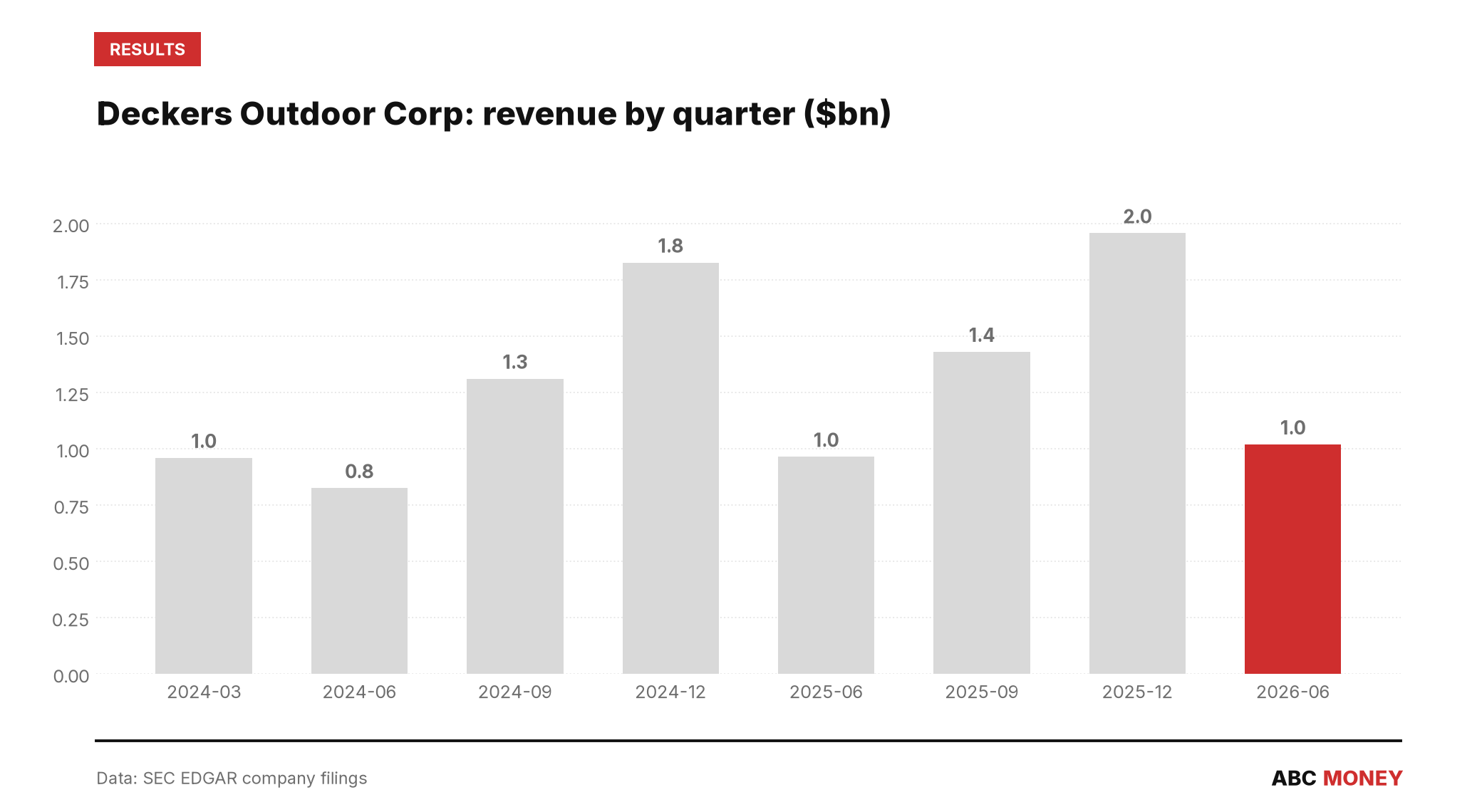
The headline numbers told two different stories. Second-quarter net sales of $1.48 billion rose 3.5% from $1.43 billion a year earlier but missed the $1.51 billion that analysts had pencilled in, according to the company’s 8-K filing. Diluted earnings per share of $2.31, up from $1.82 a year earlier, comfortably beat the $1.79 consensus tracked by GuruFocus – though $0.28 of that figure came from net refunds tied to the IEEPA tariff regime rather than underlying trading.
Why the fiscal 2027 guidance revision spooked investors
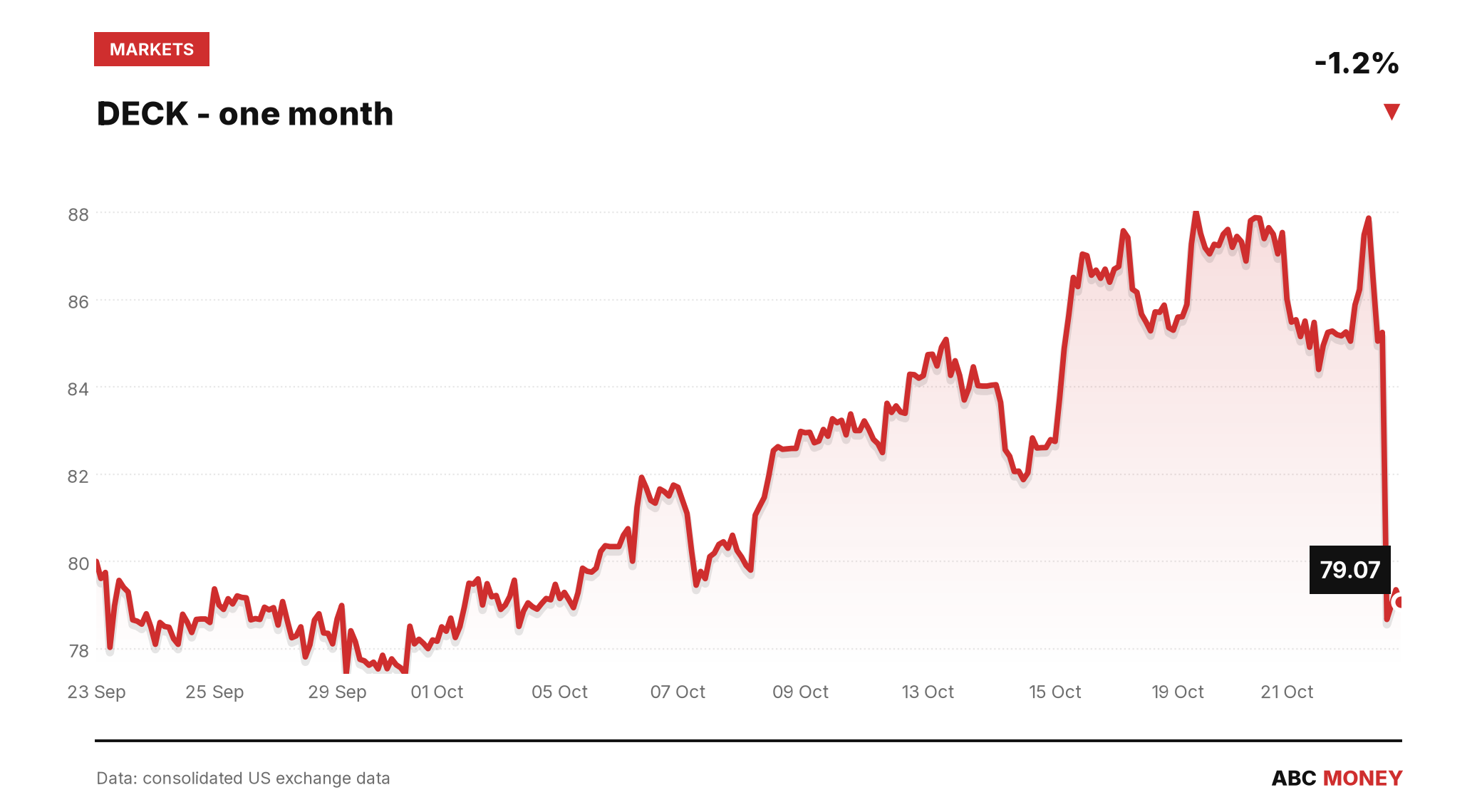
It was the outlook, not the quarter just gone, that did the damage. Deckers lowered its fiscal 2027 net sales guidance to a range of $5.70 billion to $5.73 billion, down from the $5.86 billion to $5.91 billion it had pencilled in previously, according to WWD. At the same time, the company raised its full-year diluted EPS guidance to $7.80-$7.95, above the $7.50 analysts had expected, as reported by Benzinga. Roughly $0.52 of that new EPS guidance is also attributable to tariff refunds, meaning the earnings upgrade leans heavily on a one-off tax item rather than a structural improvement in trading.
That combination – slower growth, fatter margins, flattered earnings – is the crux of what investors are wrestling with. Within the quarter, HOKA brand sales rose 6.8% to $677.2 million and UGG grew 3.5% to $786.4 million, both decelerating from the pace investors had grown used to. Deckers leaned hard into capital returns instead: it repurchased $299 million of its own shares in the quarter, taking the first-half total to $637 million, with roughly $4.4 billion still authorised for future buybacks.
A pattern investors have seen before
This is not the first time Deckers has been punished for a release that, on paper, looked decent. After its first-quarter fiscal 2027 results in July 2026, shares fell 6.1% even though both revenue and EPS beat estimates and management had raised guidance at the time, according to Yahoo Finance. Two consecutive quarters of share-price declines on ostensibly good numbers suggest the market is now pricing Deckers on the trajectory of its growth engines, HOKA and UGG, rather than on headline beats alone.
Positioning data back up the idea that the market was braced for disappointment. The proportion of daily trading volume attributable to short sales – bets that the shares will fall – climbed from 0.605 on 19 October to as high as 0.716 in the days bracketing the report, according to FINRA data. That is not an extreme reading in isolation, but the steady climb into earnings points to traders hedging against exactly the kind of guidance disappointment that materialised.
The wider backdrop for discretionary spending
Deckers’ guidance cut lands against a consumer backdrop that is cooling rather than collapsing. The US unemployment rate ticked up to 4.2% in September from 4.1% the prior month, per Federal Reserve data, while the 10-year Treasury yield sat at 5.13% in late October – a level that keeps financing costs elevated for both consumers and the wholesale and retail partners who stock Deckers’ brands. None of that is catastrophic for a company generating the kind of free cash flow needed to fund a $4.4 billion buyback programme, but it does little to support the premium growth multiple that UGG and HOKA investors had become accustomed to paying.
The net income trend tells its own story of a business that remains highly profitable even as growth slows: Deckers posted $268.2 million of net income in the equivalent quarter a year earlier and has not had a loss-making quarter across the periods disclosed in its recent filings. The question facing shareholders now is not whether Deckers can turn a profit, but whether a strategy that trades top-line momentum for margin and buybacks is one the market is willing to pay up for. For now, the answer on 22 October was a clear no.
This article is for information only and is not investment advice or a recommendation to buy or sell any asset. Markets move quickly; figures are correct as sourced at the time of writing. Always do your own research before making financial decisions.