
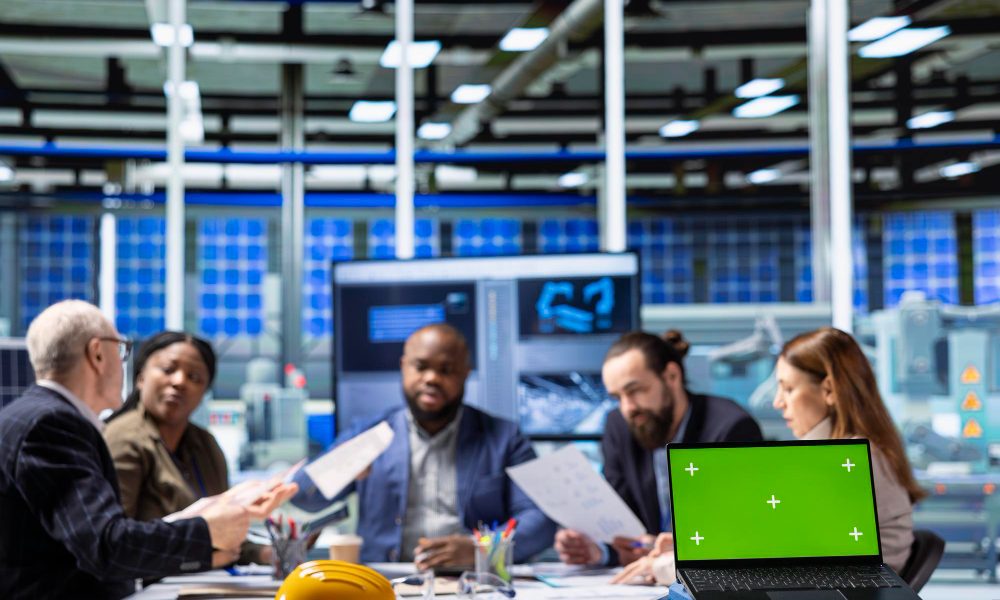

Something hums behind warehouse doors on the edge of Vancouver’s False Creek, where cyclists weave past espresso bars and glass towers catch the Pacific light. It isn’t a hydrogen pilot plant or a wind turbine. Its server racks are crowded, heat-producing devices that subtly use the same clean power grid that once characterized the city’s climate goals to train AI models.
Vancouver promoted itself as a clean-tech hub for many years. fuel cells. innovation in batteries. Startups that treat wastewater are pitching to Asian markets. The Vancouver Economic Commission spoke with assurance about making the city the greenest in the world and supporting businesses that support decarbonization. The branding was successful. A combination of access to the Pacific Rim and environmental idealism attracted venture capital.
| Category | Details |
|---|---|
| City | Vancouver |
| Economic Body | Vancouver Economic Commission |
| Industry Group | BC Tech Association |
| Policy Framework | CleanBC Climate Strategy |
| Key Sector | Clean Technology & AI Infrastructure |
| Reference | https://wearebctech.com |
It’s possible that no one planned for the clean-tech corridor in Vancouver to serve as a hub for AI servers. However, the components were already present. abundant hydroelectric power produced by the dams in British Columbia. A mild climate lowers the cost of cooling. According to the BC Tech Association, there is a well-established tech workforce of about 75,000 professionals. Investors took notice when generative AI models started requiring enormous amounts of processing power.
Leasing signs had subtly vanished as I passed offices that had once been occupied by climate analytics startups last winter while strolling through Mount Pleasant. Compact data centers are now housed inside of renovated areas. From the sidewalk, the change is not noticeable. Not a single smokestack. No ostentatious construction. Only improved cooling systems, strengthened floors, and the quiet mechanical hum of GPUs operating around the clock.
This change in direction seems to have occurred more quickly than policymakers had expected. AI has already been used by clean-tech companies for optimization, including modeling emissions, controlling battery storage, and forecasting the risk of wildfires. However, sustained, energy-intensive computing infrastructure is needed for training large-scale AI models. Vancouver became appealing almost immediately due to its clean grid.
The combination of AI computing and green electricity appears to be a competitive advantage in the eyes of investors. Other data centers are being criticized for their carbon footprints. Operators in Vancouver claim their servers are powered by renewable energy by citing hydro power. The story of artificial intelligence powered by waterfalls instead of coal plants is gripping.
It’s not that easy, though.
Uncomfortable questions have been raised by environmental groups. AI servers need water for cooling in addition to electricity. If big facilities move into areas like Nanaimo, Greenpeace Canada recently issued a warning about the increasing strain on local water systems. Ironically, a city that was once praised for combating climate change is now discussing the environmental costs of powering machine learning.
However, the economics are compelling. The uncertainty surrounding global trade has made clean-tech funding more cautious. In contrast, AI infrastructure has plenty of funding. Previously climate innovation-focused venture firms are now supporting startups in server optimization and AI governance. In private, some founders acknowledge that switching to AI compute services almost instantly increased margins.
A change in culture is also taking place. Digital entertainment and sustainability used to be central to Vancouver’s tech identity. Ocean-tech pilots, green energy accelerators, and visual effects studios. At networking events, the topics of GPUs, cloud clusters, and sovereign compute capacity are now frequently brought up. Though the focus has shifted, it is still presented as innovation.
Over coffee near Granville Street, one executive gave a direct account of the incident: We became aware that we had inexpensive, clean power at our disposal. More than anyone else, AI companies require that. He said it with a mixture of pride and caution, as though he was gauging its morality.
Whether this change enhances or detracts from Vancouver’s environmental credentials is still up for debate. One could argue that integrating AI infrastructure into a grid that runs on renewable energy is preferable to exporting that demand to areas that rely heavily on fossil fuels. However, expanding data centers may put a strain on municipal resources and displace other industrial uses.
The city’s transformation into a server haven was never specifically anticipated in the provincial CleanBC framework. However, it was made possible by policy language pertaining to innovation and digital optimization. After all, climate technology is becoming more and more dependent on AI-powered systems. The line separating computational infrastructure from environmental solutions is becoming increasingly hazy.
Vancouver seems to be improvising as it goes along. Zoning approvals are balanced by city planners. Environmentalists are advocating for water usage transparency. Energy-efficient cooling systems are being promoted by tech leaders as evidence of accountability. Green leadership and AI acceleration are two narratives that everyone is attempting to reconcile.
While a few engineers kept an eye on temperature dashboards inside a recently converted data facility near the Fraser River, trucks unloaded more cooling units. The building appeared unremarkable, with gray concrete and little signage. However, servers inside processed terabytes of data, training models that could be used for mining optimization and healthcare diagnostics.
It’s difficult not to feel both excited and uneasy as you watch this play out. From a port city to a center for film production to a clean-tech hotspot, Vancouver has always changed swiftly. It feels like a continuation of that restless evolution to become an AI server haven.
Another question is whether it endures. The demand for computing power from AI may plateau. Regulations may become more stringent. Debates about water scarcity may get more heated. Or Vancouver might establish itself as one of the few cities where artificial intelligence and clean energy can coexist in a profitable way.
The hum goes on for the time being, steady, almost calming. The future isn’t proclaimed with much fanfare in a city surrounded by mountains and the ocean. It is discreetly installed behind modest doors, rack by rack.



 Bitcoin
  Ethereum
  Tether
  XRP
XRP  BNB
BNB  USDC
USDC  Solana
  TRON
TRON  Lido Staked Ether
  Cardano
  Avalanche
  Toncoin