
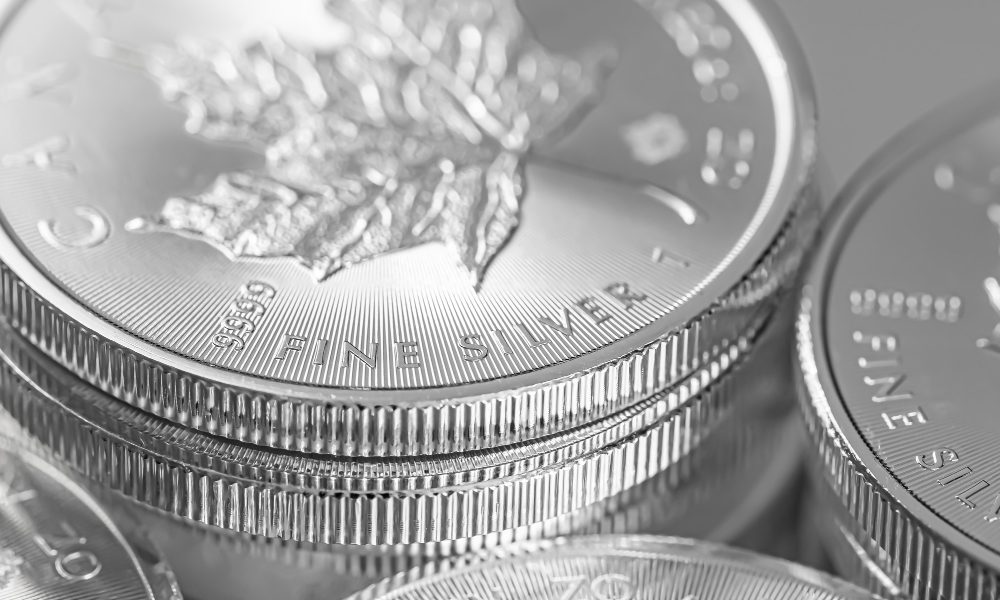
In Denver, a little coin shop on a peaceful street opens at nine in the morning. Fluorescent lights are already shining on the glass display cases. Rows of silver coins, including American Eagles, Canadian Maple Leafs, and large one-kilogram bars arranged like tiny bricks, are found inside. The store owner sighs quietly as he looks at a tablet on the counter. He murmurs, “Down again.”
After a significant surge earlier this year, the price of silver is currently trading between $79 and $80 per ounce. Investors who closely monitor precious metals have taken notice of the move even though it isn’t significant in percentage terms.
| Category | Details |
|---|---|
| Commodity | Silver |
| Current Spot Price | Around $79–$80 per troy ounce |
| Daily Movement | Roughly −1% to −1.7% recently |
| All-Time High (Nominal) | Around $121 per ounce (2026) |
| Main Global Markets | New York, London, Hong Kong |
| Major Uses | Electronics, solar panels, jewelry, investment bullion |
| Major Producers | Mexico, Peru, China, Australia |
| Trading Symbol | XAGUSD |
| Main Futures Exchange | CME Group |
| Reference Source | https://www.kitco.com |
It’s an odd experience to watch the silver trade. The metal doesn’t act like a typical industrial commodity, but it also doesn’t behave like gold. It simultaneously resides in both worlds.
a portion of an investment asset. a portion of industrial material. Its erratic rhythm is largely explained by its dual personality.
Silver is commonly quoted against the US dollar on global commodity screens using the symbol Silver or XAGUSD. As traders in New York, London, and Asian markets respond to economic data, currency fluctuations, and geopolitical news, prices change nearly continuously.
The metal has recently dropped from previous highs above $80 per ounce for multiple sessions in a row.
However, the larger picture presents a different picture. Silver prices have increased significantly over the last year, more than doubling in certain metrics. Many analysts who previously concentrated primarily on gold when talking about precious metals have been taken aback by that increase.
It’s easy to understand part of the reason when you stroll through East Asian electronics factories. Numerous gadgets, including smartphones, solar panels, electric cars, and industrial sensors, contain trace amounts of silver. The metal is particularly valuable because of its capacity to conduct electricity.
Just the renewable energy industry has seen a sharp increase in demand. Silver paste is needed to connect photovoltaic cells in solar panels, and as nations expand their renewable energy projects, the metal quietly becomes more important. The demand curve continues to rise behind the scenes, but engineers creating new systems hardly ever discuss it in public.
Silver has a sort of industrial pulse due to this demand. However, investment sentiment also matters. When the state of the world economy is uncertain, precious metals frequently garner attention. Investors may gravitate toward tangible assets due to concerns about inflation, geopolitical unrest, or fluctuating currency values.
These forces have been circulating in the financial markets lately. Tensions in the Middle East have caused oil prices to soar above $100 per barrel, raising fears of a return to inflation. The Federal Reserve and other central banks are arguing over whether interest rates should stay high longer than anticipated.
That argument sends conflicting messages for metals like silver. Interest in precious metals as valuable assets may increase with higher inflation. However, since commodities are typically priced in dollars, higher interest rates frequently strengthen the US dollar, which can have an impact on metal prices.
The market feels a little torn as a result. Screens in Chicago and London’s commodity trading offices display silver fluctuating in tiny amounts, ranging from a few cents to a full dollar in a matter of hours. Traders watch for patterns while reclining in their chairs.
Some think that if economic uncertainty increases, the metal may rise once more. Some contend that a large portion of the optimism surrounding industrial demand is already reflected in silver’s recent rally.
Later in the afternoon, a young couple is standing in that Denver coin shop once more, looking at a row of silver bars. They are first-time purchasers who are interested in precious metals as a different kind of investment. The proprietor of the store describes how prices change. He smiles slightly and remarks, “Silver is never boring.” He may be correct.
Silver tends to swing more dramatically than gold, which frequently moves slowly and deliberately. Because of its smaller market size, prices can fluctuate more quickly due to changes in investor sentiment or unexpected industrial demand.
A particular kind of investor is drawn to that volatility. Silver is seen by some as “gold’s energetic cousin,” with the potential to rise more sharply during bull markets for precious metals. Others take a cautious approach because they know that during economic downturns, industrial demand may decline.
There is some truth in both viewpoints. When examining the lengthy historical chart of silver prices, it is clear that the metal’s path has not always been easy. Each chapter contributes to the metal’s reputation for unpredictability: spikes during economic crises, collapses during recessions, and abrupt rallies motivated by speculation.
Silver, however, never quite leaves the discussion. Cultural factors play a role. Silver coins were used as common currency for centuries in many parts of the world. Even now, investors occasionally keep actual coins and bars as tangible symbols of value in addition to using them as assets.
Something intriguing is revealed when someone picks up a heavy silver bar for the first time.
There’s a moment of surprise. The metal is denser than it looks, colder to the touch, reflecting light in a soft gray glow rather than gold’s bright shine. In some way, it feels useful—less glitzy, maybe, but subtly reliable.
The market itself seems to reflect that personality. The price of silver today may have slipped slightly, but the forces shaping its future—industrial demand, monetary uncertainty, and global economic shifts—remain very much in motion.
And silver’s story will probably continue to develop in ways that even seasoned traders find difficult to forecast as long as those forces persist.

 Bitcoin
  Ethereum
  Tether
  BNB
BNB  XRP
XRP  USDC
USDC  Solana
  TRON
TRON  Lido Staked Ether
  Cardano
  Avalanche
  Toncoin