
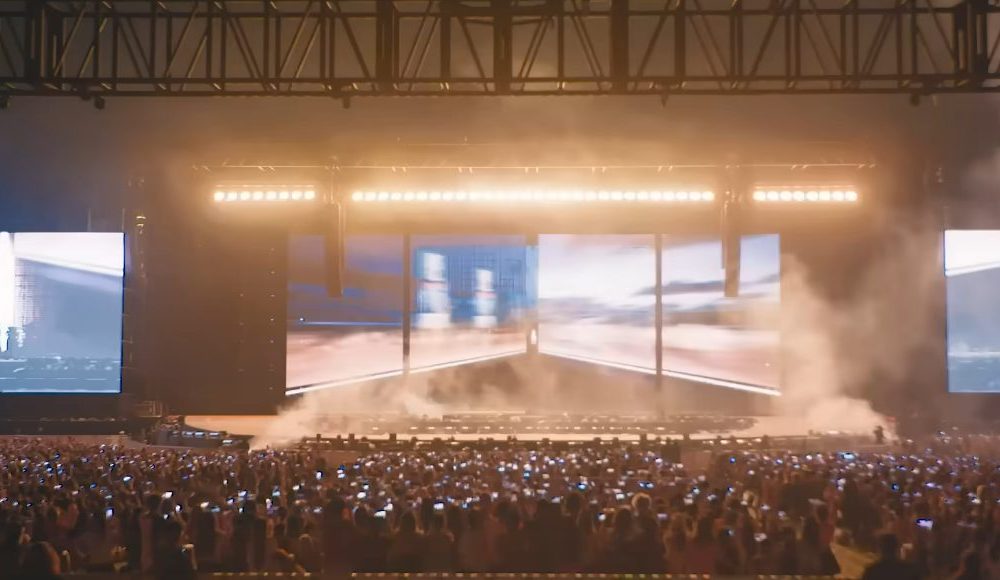
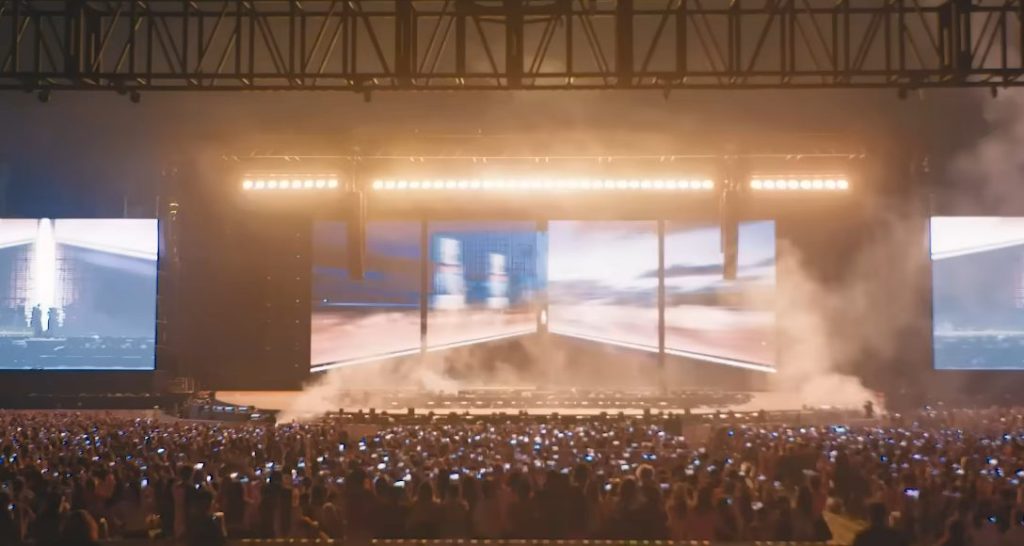
For the first time in almost four years, seven men performed together on a stage in the center of Seoul’s Gwanghwamun Square on the evening of March 21, 2026. The glowing face of Gyeongbokgung Palace behind them. That was the issue in front of them. Just over 104,000 people were counted by local authorities. 260,000 was the estimate. The following Monday, the difference between those two figures cost Hybe about 15% of its market value in a single trading session, wiping out billions in market capitalization before the week had even begun.
In many ways, the story of Hybe stock in 2026 is the tale of what happens when a company’s success is linked to the ongoing commercial dominance of a single group of artists, whether or not its executives admit it. BTS is Hybe’s primary source of income, its most identifiable worldwide asset, and the main reason the business is still in operation today. Hybe’s stock had already been rising in anticipation when the band announced a comeback tour and all seven members finished their mandatory South Korean military service. In January, Nomura increased its target price to ₩410,000 due to longer tour dates than anticipated. A victorious return was being priced in by the analysts. A victorious return was being priced in by the market. Gwanghwamun Square produced something far more intricate.
Before making too many assumptions, it’s important to consider the attendance figure because there is something genuinely perplexing about it. It was a free concert. In 190 countries, including South Korea, it was live-streamed on Netflix. Tight crowd control measures were in place at the venue, which can deter fans who are aware that they may have to wait in line for hours before being able to see anything clearly. Additionally, the new album, Arirang, sold 3.98 million copies on its first day of release—a startling figure by any measure—indicating that there is still a market for BTS content. The attendance number might be more indicative of the logistics of a free outdoor event with Netflix competition than of genuine fan interest in the return.
Key Reference Data: Hybe Co., Ltd. (KRX: 352820)
| Indicator | Detail |
|---|---|
| Company | Hybe Co., Ltd. |
| Ticker | KRX: 352820 |
| Current Price (Apr 9, 2026) | ₩255,500 KRW |
| 52-Week Range | ₩209,500 – ₩405,500 |
| Market Capitalization | ~₩11.00 trillion KRW |
| YTD Performance | Significant decline post-BTS comeback disappointment |
| Analyst Target Price (MSN/consensus) | ₩445,423 (~74.33% upside) |
| Nomura Target Price | ₩410,000 (~$276 USD) |
| Quarterly Dividend Yield | 0.20% |
| Q4 2025 Revenue | ₩716.43 billion (-1.38% YoY) |
| EPS (TTM) | ₩-5,691.89 (negative) |
| BTS Comeback Concert Attendance | ~104,000 (vs. 260,000 forecast) |
| Arirang Album First-Day Sales | 3.98 million copies |
| BTS World Tour | 82 dates, 23 countries |
| Netflix Streaming | Live in 190 countries |
| Founder | Bang Si-Hyuk |
| CEO | Lee Jae-sang (2024–) |
| Founded | February 1, 2005, Seoul |
| Revenue (2024) | ~₩2.1 trillion KRW (~$1.84 billion USD) |
But it was priced as a verdict by the market. And even though it might be premature, that makes sense.
Prior to the comeback, Hybe’s financial situation was already in question. Revenue for the fourth quarter of 2025 was ₩716.43 billion, down 1.38% from the previous year. EPS fell short of expectations by more than 550%. A 52-week gap between ₩209,500 and ₩405,500 shows how much uncertainty investors have been carrying about when and how successfully BTS would return to generating revenue at scale. The company’s operating profit declined during the band’s hiatus, which lasted from 2022 through the military service period.
Nor is the world they left behind the one they have returned to. In their absence, K-pop has expanded dramatically, which is encouraging but poses a threat to competition. Seventeen, Stray Kids, and Blackpink have all amassed sizable international fan bases. The possibility of a fictional K-pop group creating actual commercial competition for fan attention and streaming hours is raised by the more unusual Netflix film Kpop Demon Hunters, which is reportedly one of the platform’s most popular films ever. According to reports, Netflix is organizing a world tour of Kpop Demon Hunters in conjunction with a possible sequel. This would present BTS with a genuinely bizarre new class of competitor, which Hybe’s analysts would be able to model.
The scope of the tour itself is vast. 82 dates, starting in Seoul, in 23 different countries. Viewership figures from the Seoul show were anticipated to be released later in the week following the concert, and the Netflix streaming deal, which covers 190 countries, adds a revenue layer that in-person attendance figures cannot fully capture. The tour is long enough and worldwide enough that the Seoul attendance figure doesn’t necessarily determine its commercial outcome, but it’s still unclear if strong streaming numbers will be sufficient to turn investor sentiment back toward the bullish case.
Observing Hybe’s stock navigate all of this gives the impression that the market is debating a question it has been putting off for years: what is Hybe worth if BTS isn’t making the kind of large-scale event revenue that supports the company’s status as the leading entertainment conglomerate in South Korea? Due to negative earnings per share, the stock’s P/E ratio is currently listed as not applicable. Morningstar’s normalized P/E ratio of 75.75 suggests that bullish analysts are pricing in a sizable earnings recovery. A 74% increase from current levels is implied by the 12-month consensus target. That could indicate how far expectations had to go in a short amount of time, or it could be a compelling value opportunity.
Even though Hybe has spent years attempting to diversify—adding labels, creating a web platform for fan interaction, signing and aggressively developing non-BTS acts—it is difficult to ignore the structural tension in the company’s business model. There is actual diversification. The reliance on BTS is also present. Both may be true at the same time, and the market’s response to a concert attendance number that was about 60% lower than anticipated indicates that investors are still not persuaded that the former has significantly decreased the latter.
There are still 82 dates left. Sales of the album are good. Netflix is observing. Depending on how the remainder of the tour goes, none of that will be sufficient to make up for the ground lost that Monday morning.



 Bitcoin
  Ethereum
  Tether
  BNB
BNB  XRP
XRP  USDC
USDC  Solana
  TRON
TRON  Lido Staked Ether
  Cardano
  Avalanche
  Toncoin