
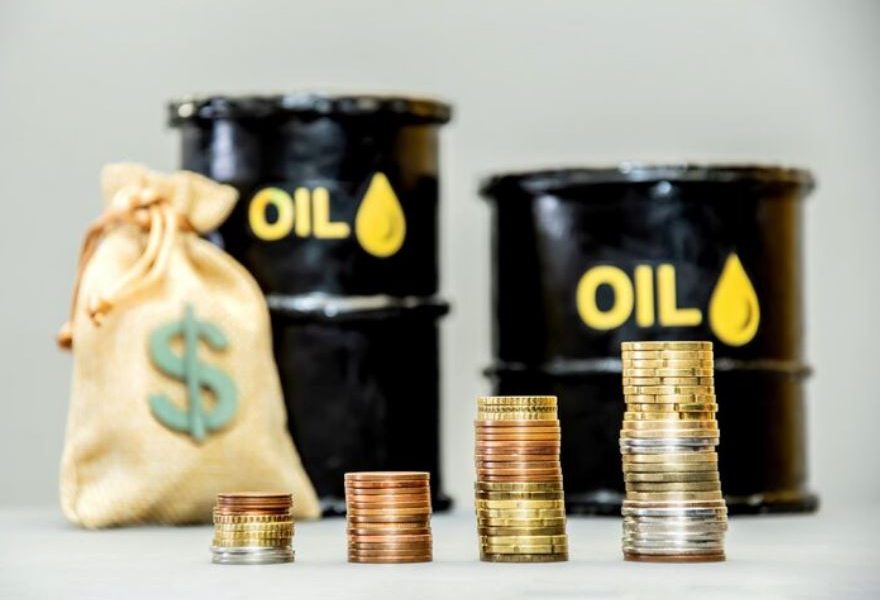
The oil story ceased to be abstract somewhere between the grocery aisle and the morning commute. Every receipt felt a little heavier than it should have, and prices at the pump gradually increased to levels that people had nearly forgotten. The topic of discussion has changed from whether oil will reach $150 to what will happen the week it does. Brent crude is currently trading at about $108 per barrel, up almost 50% from where it was prior to the most recent conflict in West Asia.
Such numbers are preceded by an odd serenity. Screen refreshes are maintained by traders in Singapore and London. Muttering, drivers in Alberta and Ohio continue to fill up. Tankers are waiting on insurance paperwork outside a refinery in the Gulf for longer than usual. The Strait of Hormuz, a slender stretch of water that holds about one-fifth of the world’s oil, is now the most watched geographical feature on Earth. At one point, shipping traffic fell by almost 95%. Although some flows have subtly resumed under the new regulations, nothing about the routing feels normal.
| Topic | Oil Price Surge to $150 per barrel |
| Current Brent Crude Price | ~$108.60 per barrel (April 2026) |
| Projected Shock Price | $150 per barrel |
| Primary Trigger | Strait of Hormuz disruption, Iran conflict |
| Daily Supply at Risk | Up to 20 million barrels per day |
| Gas Price Forecast (U.S.) | Above $6 per gallon at $150 oil |
| Consumer Spending Impact | Estimated 2% cumulative reduction |
| Key Warning Source | BMO Capital Markets Senior Economist Sal Guatieri |
| Central Bank Response Window | Limited — Fed and Bank of Canada flagged as slow to react |
| Historical Comparison | Larger monthly fuel price jump than Russia-Ukraine 2022 shock |
The number itself is not what distinguishes $150 from $110. The cascade is what it is. According to a BMO report published earlier this month, if oil prices rise to $150, American gas prices will surpass $6 per gallon, and households will reduce their spending by roughly 2% overall. On paper, that sounds mild. In actuality, it makes the difference between an economy that stalls and one that falters. In short, central banks might not be able to react in time because the inflation shock would come sooner than any rate cut could mitigate, according to Sal Guatieri, senior economist at BMO.
The little things go first. Jet fuel is already a separate crisis, which drives up airline tickets. Barely waiting, WestJet increased baggage fees, citing fuel expenses. Every tomato, every loaf of bread, and every frozen pizza travels on a diesel-powered truck, which causes grocery prices to rise. Bills for heating come next. Then there are the things that no one considers, like the fertilizer beneath a corn field, the asphalt on a driveway, and the plastic in a coffee lid. Oil is not a product. Almost everything has a background hum.
However, there is a more subdued argument that is worth listening to. The worst case is not always believed by analysts. According to a recent note that went viral on Seeking Alpha, traders might be pricing in a complete shutdown when the reality is more complicated, with some crude being rerouted through Saudi pipelines, some cargo traveling on smaller ships, and some flows resuming under new insurance regimes. According to reports, Saudi Arabia increased pipeline exports from about one million barrels per day to seven million. The Fujairah pipeline in the United Arab Emirates continues to operate. Approximately 80% of the world’s oil is still in motion, albeit not in the same manner. That is important.
It’s difficult to ignore the pattern, though. Every oil shock in living memory began with assured assurances that this time would be different, and each one ended with families quietly canceling the second car, skipping meals, and delaying vacations. The shock to Russia and Ukraine in 2022 drove oil above $120. Guatieri claims that this is already the largest monthly increase in fuel prices in forty years. If the conflict continues past summer, Wood Mackenzie has suggested that $200 is feasible. If disruptions continue, Goldman Sachs predicted $150.
It’s not mysterious what happens to a wallet at $150. It becomes thinner. Takeout, streaming subscriptions, and that weekend trip to visit family are examples of discretionary spending that erodes first. Then fixed costs start to rise: small businesses pass on diesel surcharges, utility bills rise, and insurance premiums are recalculated. Avery Shenfeld of CIBC made a more pointed political point: the vast majority of Americans who drive gas-powered vehicles will put pressure on Washington to end the war, not families with deployed soldiers. In a sense, the pump is now the voting booth.
As this develops, it seems like the market is still partially denying what it already knows. At $110, oil felt like a ceiling. It appears to be more of a landing. The machinery for $150 is already in place, whether it arrives by June or is postponed by a ceasefire. This includes the congested shipping lanes, the exhausted reserves, and the central banks constrained by their own inflation mandates. The price of a barrel is merely the headline. The true story gradually emerges in the weekly grocery receipt, the heating bill that is thicker than it was the previous year, and the trip that turns into a weekend drive. The wallet is already aware of whatever comes next.



 Bitcoin
  Ethereum
  Tether
  BNB
BNB  USDC
USDC  XRP
XRP  Solana
  TRON
TRON  Lido Staked Ether
  Cardano
  Gram (prev. Toncoin)
  Avalanche