
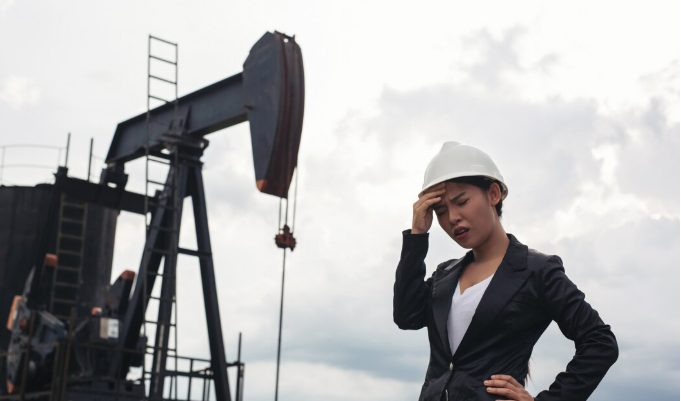
The Fed said virtually nothing, which is what everyone expected it to do. Rates remained unchanged, hovering between 3.5 and 3.75 percent, and Jerome Powell approached the lectern with the same cautious expression he has worn for the majority of the previous two years. Patience was the official line. It sounded more like, “Please, let the oil come down on its own,” in the unofficial line that you could read between the syllables.
Most likely, it won’t—at least not anytime soon. Nobody at the Eccles Building seems eager to say it aloud, which is the awkward part. Crude prices have settled into a range that would have looked alarming two years ago and now hardly make the front page, and the conflict with Iran has continued longer than the optimistic forecasts predicted. In the Midwest, drivers are paying nearly $5 per gallon. Fuel surcharges are being quietly revised by trucking companies. In a different decade, the headline CPI for March would have prompted emergency meetings because it was 0.9 percent month over month.
| Subject | Detail |
|---|---|
| Institution | U.S. Federal Reserve |
| Current Chair | Jerome Powell |
| Successor Nominee | Kevin Warsh |
| Current Federal Funds Rate | 3.5% – 3.75% |
| Last Meeting | March 2026 (held steady) |
| Next FOMC Meeting | April 28–29, 2026 |
| Headline CPI (March, m/m) | +0.9% (largest jump since 2022) |
| Core CPI (March, m/m) | +0.2% |
| March Non-Farm Payrolls | +178,000 |
| Unemployment Rate | 4.3% |
| Trigger Event | U.S.–Iran conflict, Middle East tensions |
| Market Forecast | One rate cut expected in 2026 |
| Quoted Economist | Michael Feroli, J.P. Morgan Chief U.S. Economist |
| Historical Parallel | 1970s oil shocks |
Powell reiterated the textbook argument for remaining motionless at Harvard last week. Energy shocks usually go away. Long lags are a feature of monetary policy. A barrel of oil is typically somewhere else by the time the Fed is able to react to it in a meaningful way. It is a plausible argument. Additionally, it’s the same argument that Arthur Burns made in 1973—a comparison that no one at the Fed wants on a slide deck but that everyone is thinking about in private.
Speaking with those who watch this stuff professionally gives me the impression that the patience tactic is borrowing time that it may not truly have. The public’s expectations have been subtly but significantly impacted by five years of inflation exceeding target. Customers have begun to factor in price increases. Demands for wages have changed. Powell occasionally cites a university survey that tracks long-term inflation expectations, and it has been moving in a way that should worry anyone who remembers what a wage-price spiral looks like.
According to Michael Feroli of J.P. Morgan’s house view, the Fed will hold through the remainder of the year and may raise interest rates by 25 basis points at some point in the third quarter of 2027. Compared to the rate-cut narrative that dominated the conversation just six months ago, that is a significant shift. Reluctantly, markets have been making adjustments. The yield on the two-year Treasury has gradually increased. The cost of mortgages has not changed. During their earnings calls, homebuilders sound worn out in a way that is typically not captured in earnings transcripts.
As this develops, it’s difficult to ignore how much of central banking at the moment is essentially psychological conjecture. Inflation is likely to be temporary if the general public thinks so. The Fed faces a much more difficult situation if the public begins to think it’s structural. Powell is aware of this. He avoids talking about it. Doing more work than people realize is the cautious thing he keeps saying—that patience has its limits.
There will most likely be another hold at the meeting on April 28 and 29. What comes next is an intriguing question. This entire incident becomes a footnote if oil prices return to eighty dollars by summer. The Fed will be simultaneously cutting and raising pressures if it doesn’t, which is a situation no central bank wants to be in, and the labor market begins to falter due to energy-related expenses.
Observing the Fed at the moment gives one the impression that they don’t really have the final say in the matter. It is part of a pipeline, a refinery, and a diplomatic cable that no one outside of Washington has yet to read. Like the rest of us, Powell is simply waiting.



 Bitcoin
  Ethereum
  Tether
  BNB
BNB  USDC
USDC  XRP
XRP  Solana
  TRON
TRON  Lido Staked Ether
  Cardano
  Gram (prev. Toncoin)
  Avalanche