
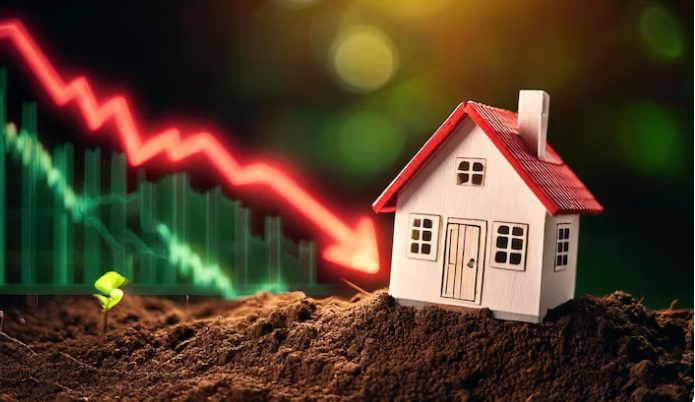
Is the Housing Market Going to Crash in 2026? The Real Answer Is Stranger Than the Question

Nowadays, at neighborhood barbecues, there’s a certain type of talk that takes place between the cooler and the cornhole game. It’s always brought up by someone. the real estate market. “So, is it finally going to crash?” is the next inquiry, uttered with a half-grimace, half-smile. The questioner typically has a stake in the response. They are either homeowners who would prefer not to see the price of their biggest asset drop by 20% over the course of a weekend, or they are renters waiting for the time when they can afford to buy.
As of May 2026, with mortgage rates hovering around 6.4%, housing prices hardly changing, and inventories slowly declining, the truth is the one that no one wants to hear. The market isn’t collapsing, no. It’s acting strangely.
| Category | Details |
|---|---|
| Question | Is the U.S. housing market going to crash in 2026? |
| Current Median U.S. Home Value | $366,019 (April 2026, Zillow) |
| 30-Year Fixed Mortgage Rate (May 2026) | ~6.37% – 6.46% |
| Federal Reserve Funds Rate | 3.50% – 3.75% |
| 2026 Zillow Home-Value Forecast | +0.7% to +1.2% YoY |
| 2026 Redfin Home-Value Forecast | +1% YoY |
| 2026 NAR Forecast | +4% YoY (more optimistic outlier) |
| Fannie Mae 30-Yr Rate Forecast (through 2027) | 6.1% – 6.3% |
| April 2026 Active Listings | 1.3 million (up 5.8% MoM, +3.7% YoY) |
| April 2026 Existing-Home Sales (preliminary) | 323,631 |
| NAR 2026 Existing-Home Sales Forecast | +14% YoY |
| Annual Home-Value Decline (April 2026) | Down in nearly half of the 50 largest metros |
| Largest Declines (Year-Over-Year) | Austin -5.9%, Florida statewide -4.2%, Tampa -3.5% |
| Cities With Most Price Cuts (April 2026) | San Antonio, Austin, Dallas, Tampa, Fort Lauderdale |
| Share of Mortgage Holders With Rates ≥6% | ~1 in 5 (highest since 2015) |
| Mortgage Delinquency Rate | Low; equity buffer remains strong |
| Affordability Threshold (Realtor.com 2026 estimate) | Monthly payment falling to 29.3% of median income |
| Forecaster Consensus | No nationwide crash; localized corrections in Sun Belt and parts of the West |
Now, nearly all of the prominent forecasters have come to essentially the same conclusion. According to Zillow, property values nationwide will increase by between 0.7% to 1.2% in 2026. Redfin predicts roughly 1%. The National Association of Realtors stands out at 4%, and its top economist, Lawrence Yun, has publicly predicted a 14% increase in existing-home sales in the upcoming year.
The orientation is the same, but the numbers are different. modest appreciation in the single digits. Not a crash. Fannie Mae’s April prediction places the 30-year fixed rate between 6.1% and 6.3% until the end of 2027, indicating that mortgage rates will remain over 6%. Every reliable projection indicates that anyone wishing for a return to the 3% mortgages of 2021 is waiting for a tsunami that isn’t coming.
This isn’t 2008 primarily because to structural factors. The housing market in the United States was oversized before to the most recent financial crisis due to an excess of subprime loans, residences, and speculative buyers who were unable to pay for the homes they were purchasing. There are still too few homes in the nation in 2026. Although inventory is getting better, according to Zillow’s third-quarter 2025 data, the United States still has a roughly 17% inventory gap when compared to pre-pandemic levels.
Rates of mortgage delinquency are quite low. After fifteen years of post-Dodd-Frank reform, lending requirements are much more stringent than they were in 2007. The so-called lock-in effect has persisted because the majority of modern homeowners have significant equity and a low fixed rate. Selling entails repurchasing a 6.4% mortgage in exchange for a 3% mortgage. Unless it is absolutely necessary, few people are willing to make that trade.
Instead, what Redfin has begun to refer to as the Great Housing Reset is taking place. It’s a helpful phrase. Without exaggerating the drama, it conveys the texture of the occasion. For the first time since the end of the Great Recession, wages are currently increasing more quickly than home prices. Even in the absence of a price drop, it alone significantly changes the affordability scenario.
The average monthly housing payment is predicted by Realtor.com to drop to roughly 29.3% of median income in 2026, falling below the 30% affordability threshold for the first time in many years. Inventory is being replenished. Homes are being listed for a longer period of time. For the first time in five years, buyers have some kind of negotiation power. That doesn’t add up to a crash. The result is a gradual, multi-year normalization.
However, the headlines become more truthful when it comes to the regional picture. In over half of the 50 biggest U.S. metro areas, annual property values were declining, according to statistics from April 2026. The annual decline in Austin-Round Rock is 5.9%. The state of Florida is down 4.2%. Tampa has a 3.5% decline. According to Redfin, sellers in Texas and Florida were most inclined to lower prices; San Antonio had the highest percentage of listings with price decreases nationwide, followed by Austin, Dallas, Tampa, and Fort Lauderdale.
Particularly in these markets, there were massive construction booms during the epidemic and a surge in speculative investor purchases. Demand has not kept up with the build-out. Right now, the experience of attempting to sell a four-bedroom in central Austin or suburban Phoenix certainly seems a lot more like a crash than anything that is going on in Connecticut or Ohio. As usual, a national average does not adequately capture the experiences of any one individual.
The labor market, not the housing market, is the other problematic aspect. Concern over AI-related job losses in white-collar jobs is genuine and growing, especially among younger professionals who would typically be the marginal first-time purchasers. The workforce disruption caused by AI is publicly mentioned in Redfin’s 2026 projection as a negative risk to demand. The Federal Reserve has maintained interest rates between 3.50% and 3.75%, in part due to the employment market’s surprising resilience and in part because inflation hasn’t entirely cooperated.
The mortgage rate path may change more quickly than the mainstream anticipates if the labor picture significantly improves in the second half of the year. The bull case is that. More buyers are drawn in by lower rates, prices rise, and inventory becomes more constrained. In essence, the bear example is the opposite. Rates remain high, purchasers continue to wait, sales volume remains far below historical averages, and the lock-in effect prevents current inventory from going online.
The cultural lethargy around this discussion is difficult to ignore. Since 2022, the statement “the housing market is about to crash” has appeared in various forms in nearly every quarter. None of those forecasts have come to pass. The same arguments are repeated in each cycle. Rates are very high. Too stretched is affordability. changing demographics. Additionally, the market muddles through each cycle, which is what markets actually do.
The founder of Powers Financial Group, Drew Powers, effectively summed up the sentiment when he told Newsweek that stretched home prices, AI-driven layoffs, and aging boomers “could put downward pressure” on home prices in 2026, while acknowledging that “timing the correction always proves to be the hard part.” That is the bearish case in its most honest form. It might occur. Perhaps it won’t. The forces exist. It is impossible to predict the timing.


 Bitcoin
  Ethereum
  Tether
  BNB
BNB  USDC
USDC  XRP
XRP  Solana
  TRON
TRON  Lido Staked Ether
  Cardano
  Gram (prev. Toncoin)
  Avalanche