
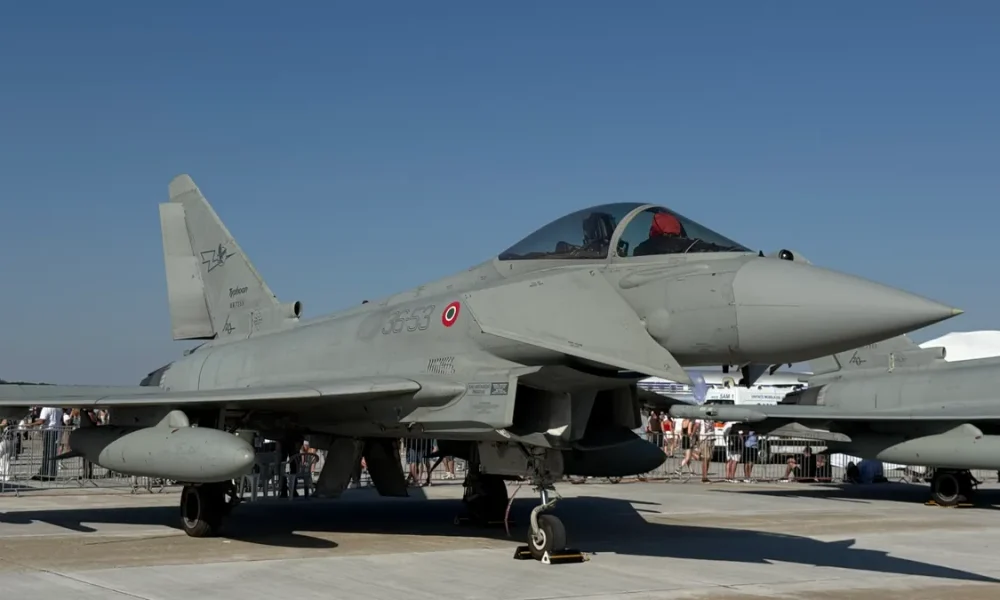
The contest between BAE Systems vs Rolls-Royce has rarely looked more asymmetric on valuation, even as both FTSE 100 defence and engineering groups continue to benefit from rising government spending. BAE (LSE: BA.) trades at roughly 22.5 times forward earnings; Rolls-Royce (LSE: RR.) sits at almost 37 times. That gap is worth understanding before deciding where fresh money belongs.
BAE Systems vs Rolls-Royce: what the 2025 numbers show
BAE delivered record full-year 2025 sales of £30.7bn, up 10% on a constant currency basis, with growth across every division. Underlying EBIT rose 12% on the same basis, and return on sales edged up 20 basis points to 10.8%. Earnings per share for the year came in at 75.2p.
The order backlog grew by £5.8bn to a record £83.6bn, up from £69.8bn in 2023. That backlog provides visibility that most industrials would envy: at current sales rates it represents roughly two and a half years of revenue already contracted. Growth in underlying EBIT was partly offset by amortisation of acquired intangibles, reflecting significant acquisitions in the prior year, including Ball Aerospace.
Rolls-Royce’s five-year total return of 1,327% dwarfs BAE’s 286%, but that comparison flatters the engine maker in one important respect: Rolls-Royce was priced for distress five years ago. The valuation today reflects a very different set of expectations. The group’s Defence division, which contributes around 23% of revenue, carries an operating margin of 14.4%, below Civil Aerospace at 20.5% and Power Systems at 17.4%. Pure defence exposure runs through the lower-margin unit.
BAE’s operating margin of 10.3% looks modest, but it is the product of a business almost entirely focused on platforms and systems that governments are actively expanding budgets to fund.
The GCAP commitment and what lies beneath
Both companies have a stake in the Global Combat Air Programme (GCAP), the trilateral UK-Italy-Japan stealth fighter project. The UK government has committed £8.6bn over four years to carry the programme through its concept and design phases. That commitment sits within a wider £298bn Defence Investment Plan. The same plan ring-fences more than £5bn for autonomous and uncrewed systems, a category where BAE is actively investing.
Production of the GCAP aircraft is expected to ramp up in the mid-2030s, replacing the Typhoon in RAF service and entering operational use in the second half of that decade. The Defence Investment Plan also funds a separate collaborative combat air programme developing autonomous jets to fly alongside crewed GCAP aircraft. For BAE, whose operations span land, air, sea, space and cyber, the breadth of the plan matters more than any single line item.
The concern raised by some investors is that the shift toward drone and uncrewed warfare erodes demand for the high-value crewed platforms that have historically driven BAE’s order backlog. BAE’s share price is down 13% since March, in part reflecting that anxiety. The counter-argument is the £5bn-plus autonomous systems allocation: BAE’s electronic warfare and counter-drone work positions it in that transition rather than against it.
Rolls-Royce SMR: a genuine differentiator, with caveats
The most distinctive long-term growth option within Rolls-Royce is its small modular reactor (SMR) business. In June 2026, Rolls-Royce SMR was selected by Videberg Kraft, owned by Swedish utility Vattenfall AB and Industrikraft i Sverige AB, to deliver three SMRs on Sweden’s west coast. The project will be Sweden’s first new nuclear plant in more than forty years.
Chief executive Tufan Erginbilgic said: ‘Selection by Videberg Kraft reinforces the status of Rolls-Royce SMR as the only company with multiple contractual commitments to deliver SMR units in Europe.’ The company has now been successful in every competitively tendered SMR selection process in Europe.
The Czech element is also developing. Subject to customary regulatory clearances and security assessments, CEZ Group will acquire approximately 20% of Rolls-Royce SMR and collaborate on plans to deploy up to 3 GW of capacity in the Czech Republic.
The competitive risk is real, however. Poland-based SGE has announced plans to build 14 SMRs in the UK using GE Vernova Hitachi’s BWRX-300 technology, a direct challenge to Rolls-Royce’s domestic position. The SMR market is not a monopoly, and the addressable opportunity of 400-plus units globally will attract well-capitalised rivals.
Where the valuation argument lands
| Metric | BAE Systems | Rolls-Royce |
|---|---|---|
| Forward P/E | 22.5x | ~37x |
| 2025 sales | £30.7bn (record) | n/a (Defence ~23% of group) |
| Order backlog | £83.6bn (record) | N/A (civil-dominated) |
| Operating margin | 10.3% | 14.4% (Defence only) |
| 5-yr total return | 286% | 1,327% |
Rolls-Royce’s premium rating is not irrational: the SMR pipeline, the data-centre power tailwind, and the civil aerospace recovery all underpin it. But at 37 times forward earnings, a significant amount of that optionality is already in the price. Any slip in SMR timelines or a softer-than-expected recovery in long-haul flying would compress the multiple quickly.
BAE at 22.5 times offers a less exciting but more legible story: a record backlog, consistent earnings growth, expanding margins, and direct exposure to the most funded categories in the UK and US defence budgets. The analyst community has noted £20 as a level worth watching for fresh entry.
For investors who want both, holding each makes strategic sense. For those choosing one, the BAE Systems valuation case carries less execution risk at current prices. The next test arrives with GCAP design-phase milestones and any revision to the UK defence spending trajectory.



 Bitcoin
  Ethereum
  Tether
  BNB
BNB  USDC
USDC  XRP
XRP  Solana
  TRON
TRON  Lido Staked Ether
  Cardano
  Gram (prev. Toncoin)
  Avalanche