Bitcoin
  Ethereum
  Tether
  BNB
BNB  USDC
USDC  XRP
XRP  Solana
  TRON
TRON  Lido Staked Ether
  Cardano
  Gram (prev. Toncoin)
  Avalanche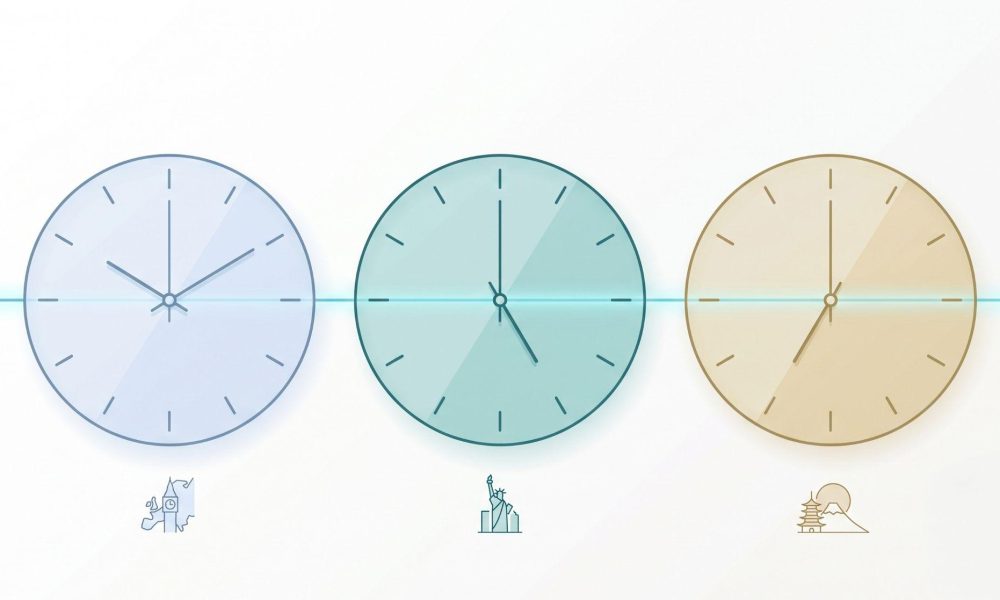
The foreign exchange market is often described as the market that never sleeps, and the description is fair. Currencies trade around the clock, five days a week, passing from one financial centre to the next as the world turns. Yet the idea of a single, uniform market can be misleading. Activity is far from constant. It rises and falls in waves that follow the working hours of the major financial hubs, and understanding those waves is one of the more useful things a newer trader can learn.
The scale involved is easy to underestimate. According to the Bank for International Settlements, global foreign exchange turnover reached roughly 9.6 trillion dollars a day in April 2025, the highest figure recorded since the survey began in 1986. That makes currencies the largest and most liquid market in the world. Even so, that enormous volume is not spread evenly across the day, and where it concentrates has a direct effect on how prices behave.
The Three Pillars: Tokyo, London and New York
The trading day is usually divided into three major sessions, each anchored to a cluster of financial centres. The Asian session, often referred to by its Tokyo hub, opens the week’s activity and tends to move at a steadier pace. Currency pairs involving the yen and the Australian dollar generally see more attention here, and price movement is often more contained than later in the day.
The London session follows and changes the tempo considerably. The United Kingdom remains the single largest centre for currency trading, a point the Bank of England underlines in its own market surveys, and the opening of European desks usually brings a noticeable lift in volume. Many of the day’s larger moves begin here, particularly in the major pairs.
The New York session then overlaps with the closing hours of London, bringing American participants into an already active market. This is frequently the busiest stretch of the trading day, and it is where a good deal of the daily range in the major pairs tends to form.Where the Sessions Overlap
The most active periods tend to fall where two sessions run at the same time. The overlap between London and New York is the clearest example. For those few hours, desks on both sides of the Atlantic are trading together, and the result is deeper liquidity and tighter spreads in the major currency pairs.
Liquidity matters because it shapes the trading experience directly. When many participants are active, orders are matched quickly and prices tend to move in smaller, steadier steps. When activity thins out, such as during the gap between the New York close and the Tokyo open, the same size of trade can push prices further, and movement can become less predictable. A professional broker such as FinAIBox operates across these sessions precisely because currency behaviour changes so much depending on the hour.Why Timing Changes the Trading Experience
For a trader, the practical lesson is that the same currency pair can feel like a different instrument depending on when it is traded. A pair that drifts quietly during the Asian hours may become far more active once London opens. Someone who understands this can plan around it, choosing to be active when conditions suit their approach rather than fighting against a quiet or unusually volatile market.
Economic releases add another layer. Major data announcements are typically scheduled during the working hours of their home region, which means they often land in the middle of the relevant session and can sharpen movement quickly. Following a reliable economic calendar helps traders anticipate these moments rather than being caught off guard, and it is one reason FinAIBox keeps scheduled events visible inside its platform.
Trading Across the Clock With the Right Tools
This is where a well-structured platform earns its place. FinAIBox, a globally focused multi-asset provider, gives traders access to currency markets alongside commodities, indices and metals, supported by an economic calendar that keeps upcoming releases in view. Its support desk is aligned with the London, New York and Tokyo sessions, which reflects how a genuinely global market actually operates rather than treating it as a single continuous block.
None of this removes risk or guarantees a smoother path through the markets. What session awareness offers is perspective. A trader who knows why the market feels calm at one hour and frantic at another is reading the same rhythm the professionals rely on. For anyone building a foundation in currency trading, that understanding of timing is a genuinely practical starting point, and a platform like FinAIBox is built around exactly that global structure.