
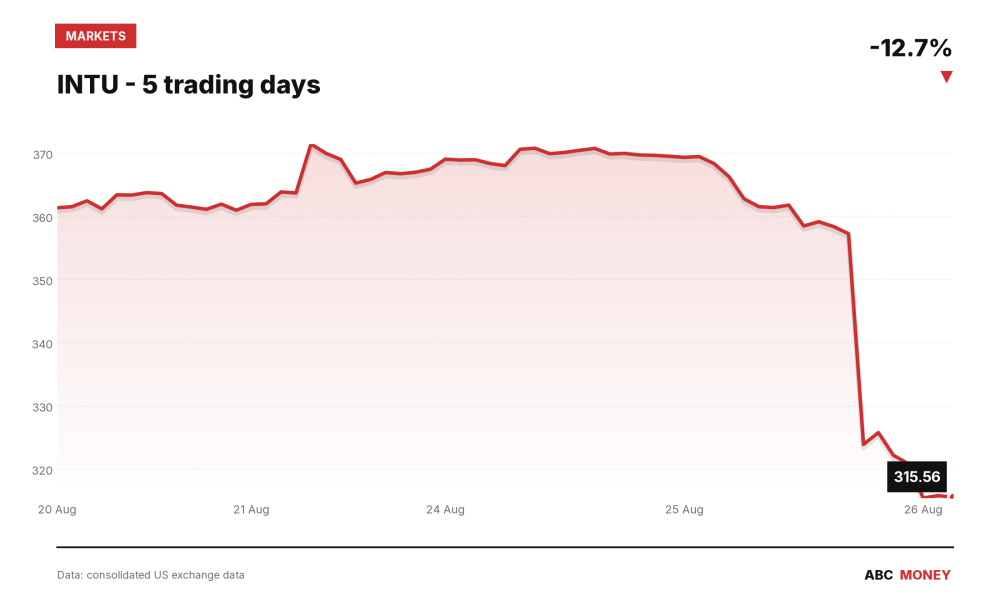
Intuit shares slide even after the QuickBooks and TurboTax owner beat Wall Street on both the top and bottom line, a reminder that in this market a good quarter counts for little if the outlook disappoints. Intuit (NASDAQ: INTU) reported fourth-quarter fiscal 2026 revenue of $4.35bn, ahead of the $4.27bn analysts had pencilled in, with adjusted earnings per share of $4.03 against a $3.58 estimate.
Those numbers alone would normally be cause for celebration. Total revenue rose 14% year-on-year in the quarter, matching the 14% growth Intuit posted for the full fiscal year, and the Online Ecosystem division – which houses QuickBooks Online – climbed 17%, with QuickBooks Online Accounting up 20%, according to AskTraders. Instead, the stock fell hard. Shares closed Tuesday’s regular session down 2.98% at $358.91, then extended losses to as much as 6.9% in after-hours trading, changing hands around $332.79, AskTraders and Investing.com reported. GuruFocus put the after-hours decline at as much as 7.3% once the fiscal 2027 outlook landed.
Why Intuit shares slide when the quarter looked fine
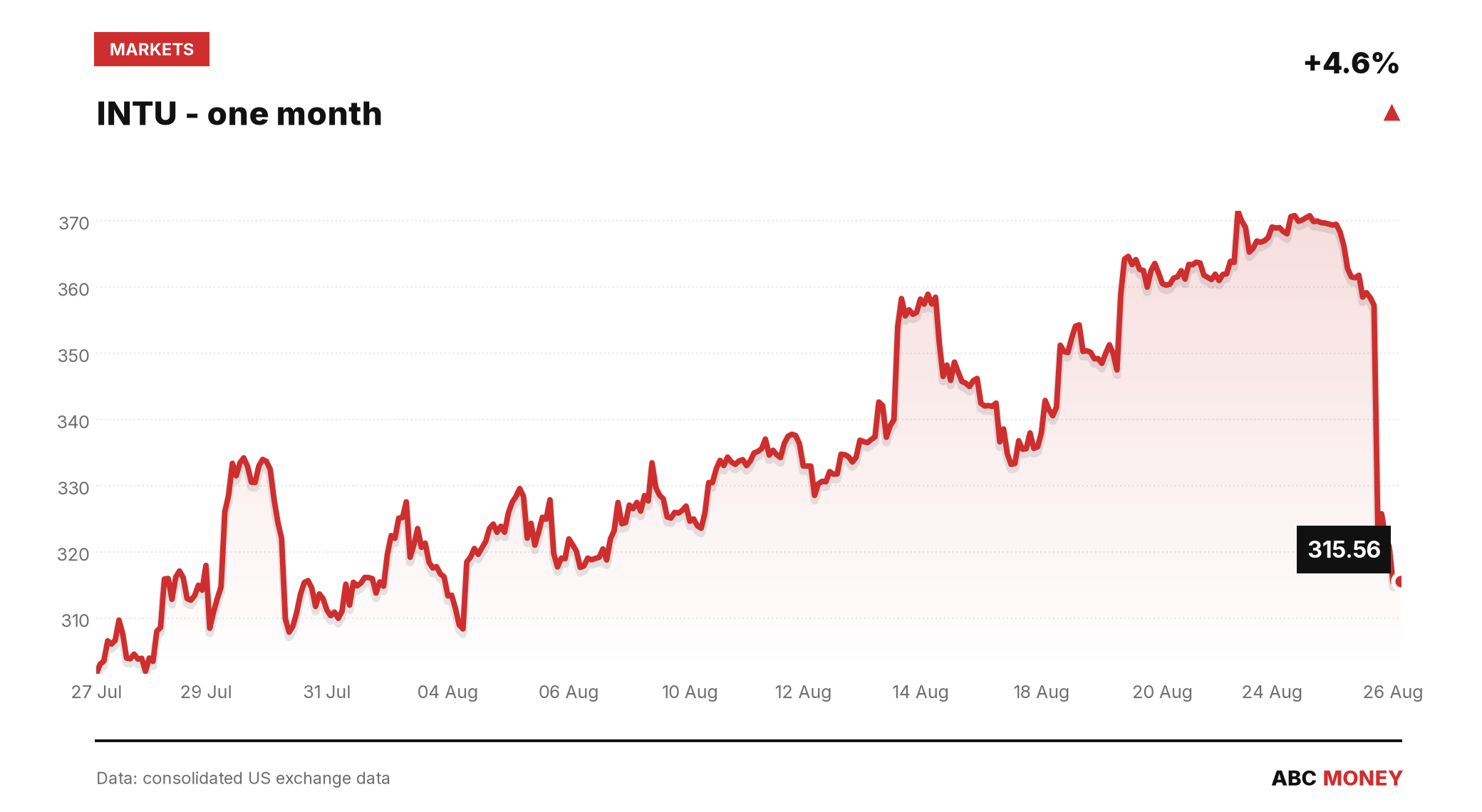
The culprit was guidance, not the quarter just gone. Intuit told investors to expect fiscal 2027 revenue growth of just 9-10%, a sharp step down from the 14% pace it just delivered – and that deceleration, not the Q4 beat, is what sent the stock reeling, AskTraders noted. Buried in the detail was a further wrinkle: part of the softer-looking first-quarter earnings guidance stems from an additional stock-compensation charge of $1.48 rather than deteriorating operations. Strip that out and the adjusted earnings midpoint for the new quarter would sit at $3.94 – only a 2.5% shortfall against the analyst average, rather than the much larger gap implied by the raw $2.44-$2.48 guidance range, according to ts2.tech. In other words, the market may have reacted to an accounting reclassification as much as to any genuine slowdown.
There is a real soft spot in the mix, though. Mailchimp, Intuit’s email-marketing platform, is guided to revenue that is flat to down 1% in fiscal 2027, even as Global Business Solutions and Credit Karma are pencilled in for double-digit growth, AskTraders reported. That divergence – strength in the core accounting and consumer-credit businesses, weakness in the marketing add-on – is arguably the more durable story than the headline guidance number.
The GAAP gap
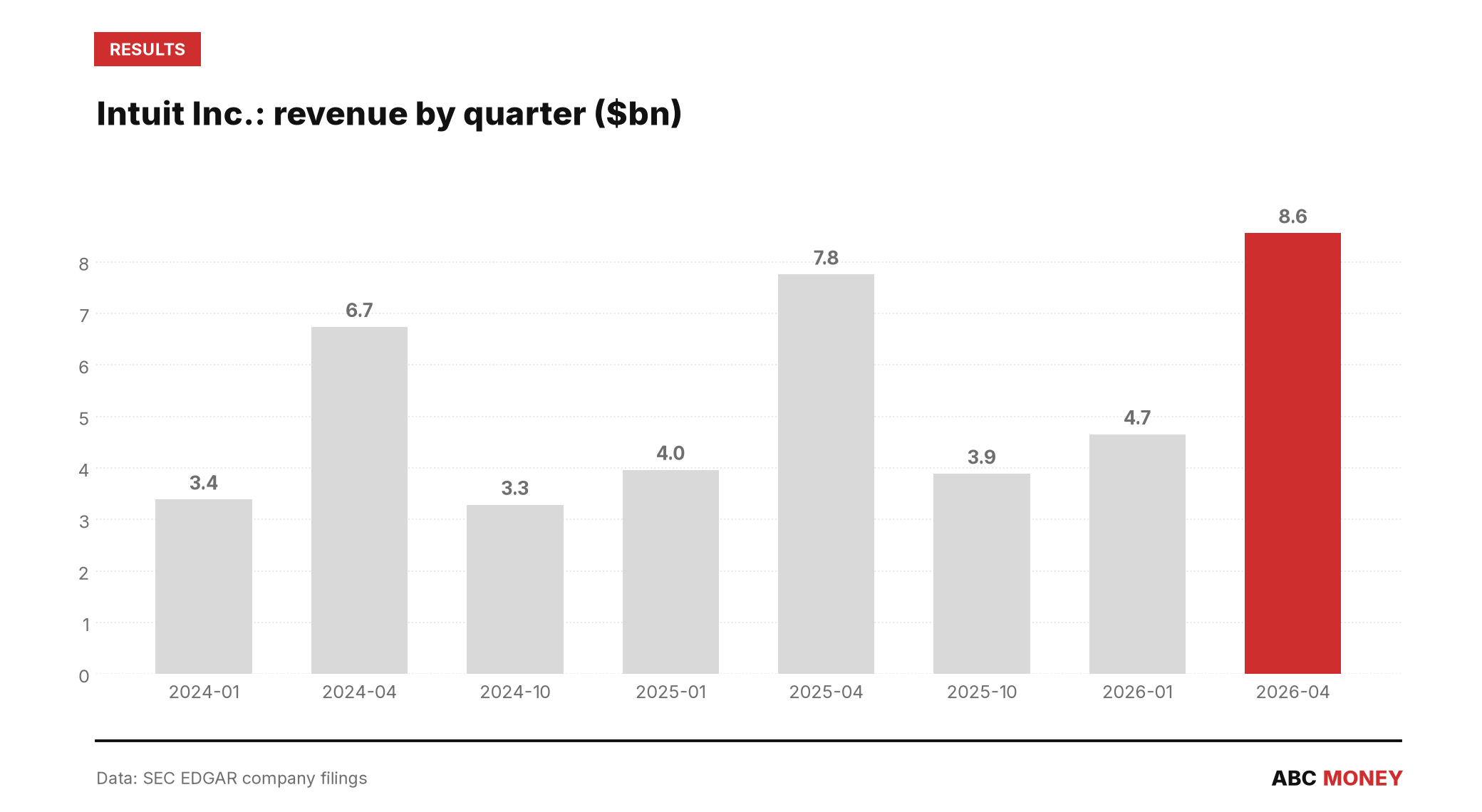
There is also a less flattering detail that the “beat” framing skates over. On a GAAP basis – the standard accounting measure before analyst adjustments are stripped out – Intuit’s fourth-quarter net income came to $363m, or $1.34 per share, down on the prior year, according to RTTNews. That sits awkwardly alongside the adjusted $4.03 figure that beat consensus, and underlines how much of the quarter’s headline strength depended on add-backs rather than statutory profit. Intuit’s quarterly filings show the seasonal shape of its business clearly: net income swings from a few hundred million dollars in its smaller fiscal quarters to well over $2bn in the tax-season quarter that ends in April, so year-on-year comparisons in the smaller quarters can be noisy – a pattern visible across its recent 10-Q filings.
Positioning data adds a little texture. FINRA’s daily short-sale figures – the share of trading volume conducted by investors betting on a lower price – show Intuit’s ratio rising to 0.415 on 25 August from 0.316 the previous session, a pickup consistent with traders leaning short into and immediately after the report, per FINRA data. Separately, company insiders have been consistent net sellers over the trailing twelve months, offloading $359.2m of stock against just $0.5m in purchases, GuruFocus noted – a pattern that predates this earnings reaction but is worth keeping in view.
What the call revealed
Management’s own framing of the numbers, laid out on the earnings call covered by MarketBeat and transcribed in full by Seeking Alpha, leaned heavily on the strength in QuickBooks Online and Credit Karma to argue the deceleration is more a function of tougher comparisons and the Mailchimp drag than a broader loss of momentum. Investors, for now, are not fully buying that argument – hence a stock that fell in both the regular session and after hours despite clearing consensus estimates comfortably.
The next test comes with Intuit’s first fiscal 2027 quarterly print, when the market will find out whether the stock-compensation charge behind this guide was indeed a one-off reclassification or the start of a genuine margin squeeze. Until then, the gap between a beat-and-raise headline and a beat-and-slide reality is likely to keep shaping how the stock trades.
This article is for information only and is not investment advice or a recommendation to buy or sell any asset. Markets move quickly; figures are correct as sourced at the time of writing. Always do your own research before making financial decisions.



 Bitcoin
  Ethereum
  Tether
  BNB
BNB  USDC
USDC  XRP
XRP  Solana
  TRON
TRON  Lido Staked Ether
  Cardano
  Gram (prev. Toncoin)
  Avalanche