
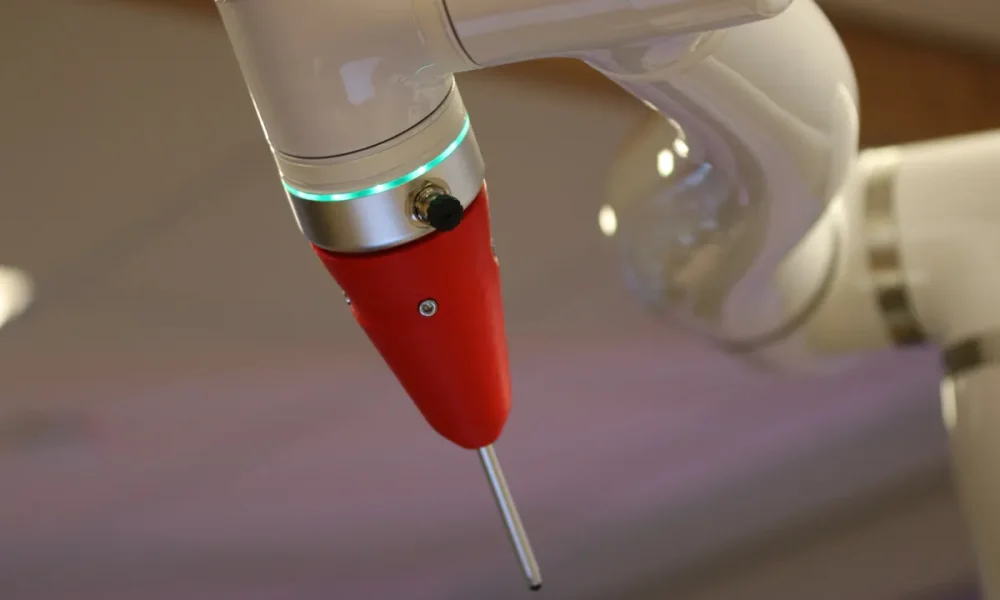
The Intuitive Surgical share price has fallen 41% since January, and on paper that looks like the kind of dip that makes long-term investors reach for their ISA allowance. The fundamentals remain largely intact: dominant position in robotic surgery, high recurring revenue, and a balance sheet with $8.63 billion in cash, equivalents, and investments at the end of the second quarter. But the setup is more complicated than it first appears.
Strong Quarter, but Procedure Growth Guidance Stays Flat
Second-quarter results were, by most measures, solid. Quarterly revenue rose 19% to $2.9 billion, and adjusted earnings per share came in at $2.80 against expectations of $2.50. Worldwide da Vinci procedures grew approximately 15%, and Intuitive placed 468 systems during the quarter, of which 246 were the latest da Vinci 5 generation. The Ion Endoluminal System, used for lung biopsies, placed 55 units, a 21% year-on-year increase, bringing the installed base to 1,096 systems; Ion procedures rose roughly 36%.
For context on the systems trajectory, the Q2 2025 earnings release recorded 341 systems placed, of which only 70 were da Vinci 5. The acceleration in next-generation placements is real.
What gives investors pause is the guidance. Despite the strong quarter, full-year procedure growth guidance was left unchanged at approximately 14.5%. For 2026, Intuitive expects worldwide da Vinci procedure growth of approximately 13.5% to 15.5%, with management guiding toward the midpoint of that range. A business priced for compounding growth needs the growth number to move in one direction.
The Intuitive Surgical Share Price Discount Has Limits
Forty-one percent off a peak sounds like value. Whether it is depends on what multiple you are willing to pay for a business still expected to grow procedures in the mid-teens. The competitive moat is real: more than 101,000 da Vinci-trained surgeons globally, an installed base of 11,710 systems, and switching costs that are structural rather than contractual. Once a hospital has trained its surgical teams on a da Vinci platform, the friction involved in moving to a rival system is considerable. Recurring revenue, which includes the disposable instruments and accessories hospitals buy to keep the systems running, accounts for 84% of total revenue, supporting predictable cash flows.
Net income attributable to Intuitive for the full year 2024 was $2,322.6 million, up from $1,798.0 million in 2023 and $1,322.3 million in 2022, per the company’s 10-K filed with the SEC. The earnings progression is steady. But the question of what multiple that trajectory deserves, at a time when several headwinds are converging, is where the debate sits.
Tariff Exposure Is More Nuanced Than the Headlines Suggest
The tariff risk has attracted most of the negative attention, and the detail matters. According to MassDevice’s reporting on Intuitive’s tariff exposure, approximately 80% of the company’s instruments and accessories are manufactured in Mexico. Products that meet USMCA certification requirements are not subject to current US import tariffs; those that do not face a 25% levy.
The broader tariff picture is split roughly in two. About half of Intuitive’s projected 2025 tariff impact stems from trade in both directions between the US and China. A further 40% comes from imports of raw materials and components into the US from other regions, including endoscopes from Intuitive’s European operations. The company’s own 2026 non-GAAP gross margin guidance of 68.0% to 69.0% of revenue includes an estimated tariff drag of 1.0 percentage point. That is manageable given margin levels, but it is a drag that was not present twelve months ago.
One partial offset appeared in the second quarter: a $28 million net benefit, equivalent to $0.08 per diluted share, from IEEPA tariff refunds, according to SEC filings summarised by StockTitan. That benefit is not guaranteed to repeat. During the quarter Intuitive also repurchased 0.9 million shares for $0.38 billion, a signal of balance-sheet confidence even in a tariff-uncertain environment.
Two Structural Concerns Worth Watching
The competitive challenge from MicroPort MedBot is early-stage but worth monitoring. Its Toumai system completed the UK’s first long-distance robotic operation in March, treating a patient located 1,500 miles away in Gibraltar. That is a proof-of-concept demonstration rather than a meaningful revenue threat for now, but China’s domestic market is a different story: MicroPort is taking share there, and China has historically been a growth vector for Intuitive.
The GLP-1 substitution question is harder to quantify. If patients opt for weight-loss medication rather than bariatric surgery, some procedure volume disappears from the addressable market. The unchanged guidance may partly reflect that uncertainty.
Against those headwinds, the longer-term structural case has not collapsed. The NHS is targeting 500,000 robotic surgery procedures annually by 2035, up from 70,000 in 2023/24. Hospitals globally are still working through procedural backlogs. The next test is whether the procedure growth range for 2026, currently expected near the midpoint of 13.5% to 15.5%, holds as tariff uncertainty and competitive pressure develop through the second half.



 Bitcoin
  Ethereum
  Tether
  BNB
BNB  USDC
USDC  XRP
XRP  Solana
  TRON
TRON  Lido Staked Ether
  Cardano
  Gram (prev. Toncoin)
  Avalanche