
Moderna (NASDAQ: MRNA) is moving to raise $2.0 billion by selling convertible senior notes due 2032, a debt instrument that pays no fixed interest but can be swapped for shares later, in a private placement aimed at large institutional investors. The timing is not incidental: it comes three weeks after a single trial readout added tens of billions of dollars to the company’s market value.
Under the proposed structure, the notes would carry a zero coupon – investors get no interest income and instead bet on the right to convert into Moderna stock at a premium set when the deal prices. The offering is being made under Rule 144A, a Securities Act exemption that lets companies sell debt quickly to “qualified institutional buyers” – big, sophisticated funds – without the delay of a full public registration. Moderna also plans to give the banks running the sale a 13-day option to place a further $300 million of the notes, as first reported by Benzinga, taking the deal’s potential size to $2.3 billion.
Why convertible senior notes, why now
Moderna’s own framing, in language it circulated alongside the announcement, is that proceeds are for “general corporate purposes which may include the flexibility to invest in the growth of our oncology business and repayment of debt”. That single sentence does a lot of work: it links the raise directly to the pipeline that has driven the stock’s swings all month, while leaving room to retire existing borrowings.
Alongside the notes, Moderna intends to buy what it calls a hedge overlay – a derivative position, often structured as a “capped call”, that offsets the dilution (the shrinkage in existing shareholders’ percentage ownership) that would occur if noteholders convert into stock. The cap is set at a premium of at least 150% to wherever the shares price at the time of the deal, meaning the hedge only stops protecting shareholders once the stock has risen well beyond current levels. It is a standard feature of convertible issuance – comparable deals, including Halozyme Therapeutics’ paired capped-call transactions this year, have used the same mechanic.
The rally that funded the raise
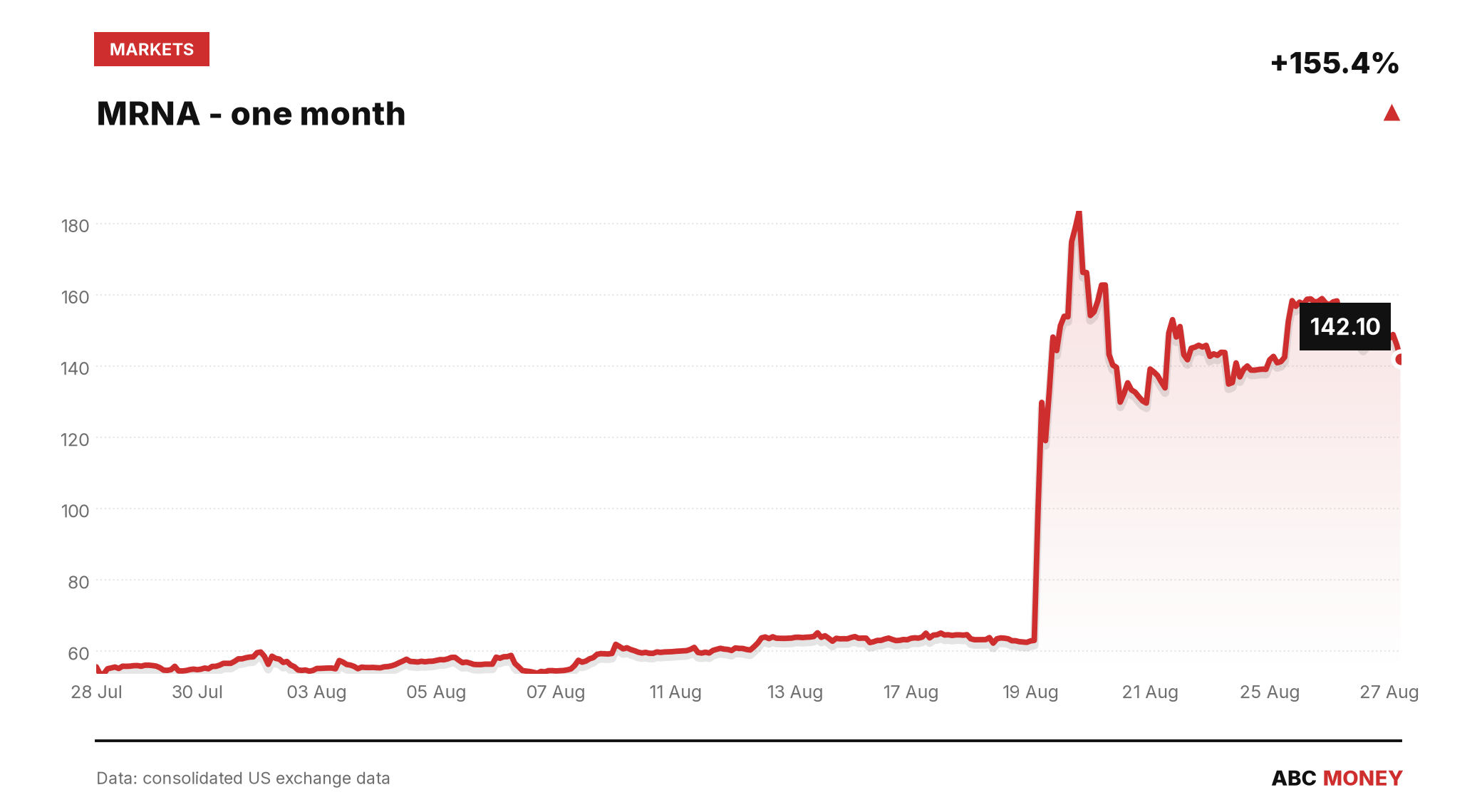
The backdrop is a genuinely unusual few weeks for Moderna stock. On 19 August, positive trial data for intismeran, its Merck-partnered melanoma vaccine, added roughly $45 billion to the company’s market capitalisation in a single session, according to BioPharma Dive. The move partially reversed the next day, with shares giving back more than $18 billion of value as investors reassessed the initial jump, Forbes reported. Even after that pullback, shares remained well above where they started the year, and Wolfe Research has since projected peak sales of $9.2 billion for the vaccine – a number that helps explain why Moderna is choosing this moment to lock in financing rather than waiting.
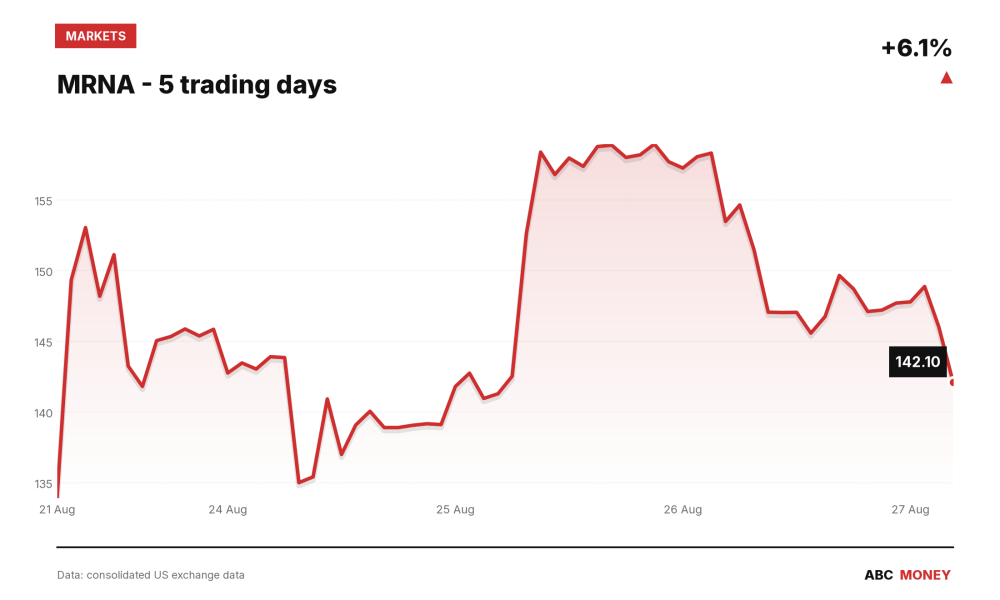
By 27 August, the day of the announcement, MRNA traded at $141.62, down 4.76% on the day, having climbed more than 140% over the preceding 20 trading sessions. Trading volume that morning ran at roughly a tenth of its 20-day average, consistent with a market still digesting the swing rather than reacting violently to the note announcement itself. Daily short-sale volume tracked by FINRA edged up to a ratio of 0.606 on 26 August from a range of roughly 0.48 to 0.64 over the prior fortnight – a modest tick rather than a sign of aggressive bearish positioning around the deal.
Still burning roughly $780 million a quarter
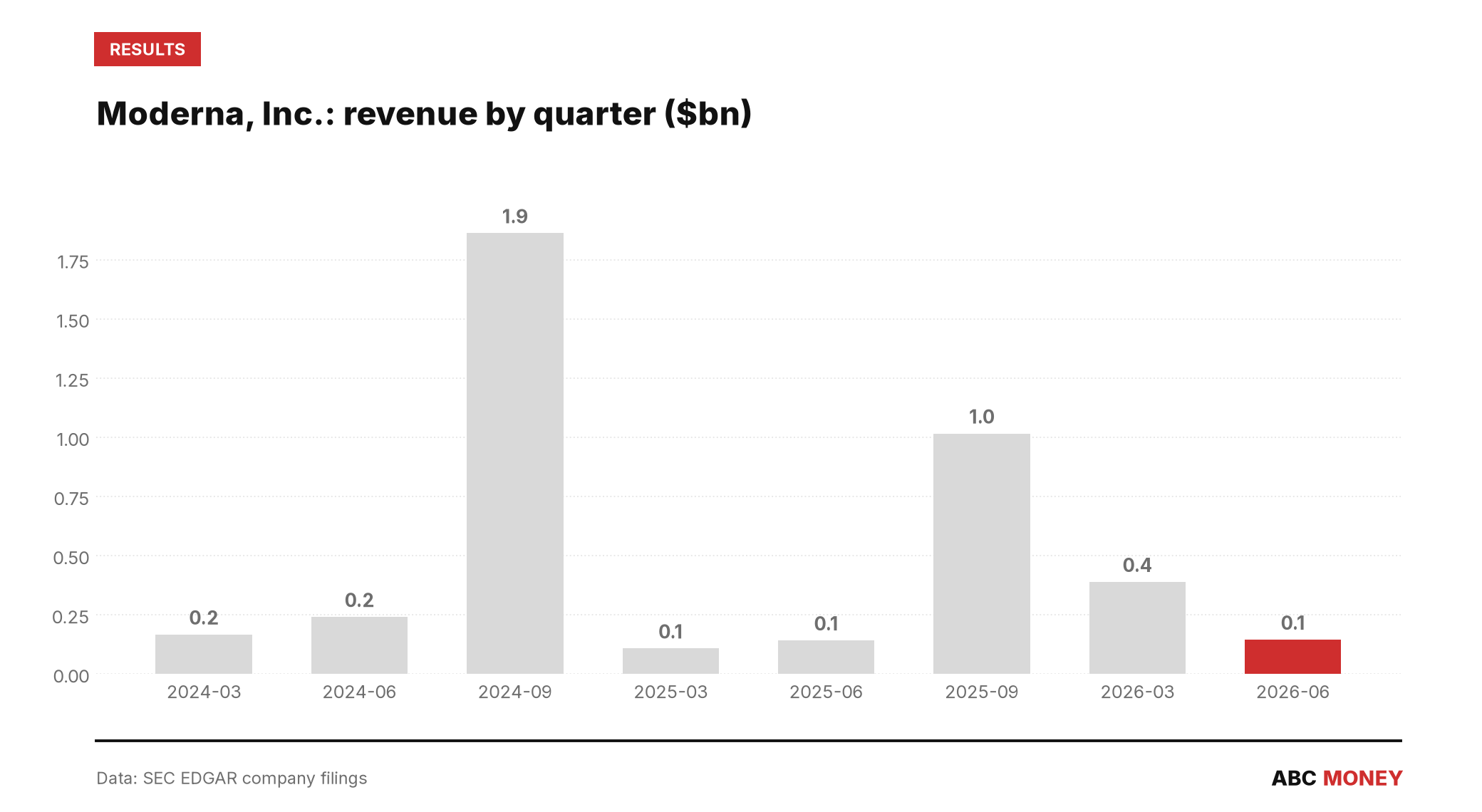
The convertible notes arrive against a financial backdrop that has not fundamentally changed even as the share price has swung wildly. Moderna’s 10-Q for the quarter ended 30 June 2026 showed a net loss of $782 million on revenue of just $145 million, a diluted loss per share of $1.97. That followed a $1.343 billion net loss in the first quarter of the year. The company has posted a loss in six of its last seven quarters, a run interrupted only by a marginal $13 million profit in the third quarter of 2024. Raising fresh capital while the stock is elevated, rather than waiting for cash reserves to tighten further, is a fairly conventional piece of financial housekeeping for a company still converting scientific momentum into revenue.
Rate conditions add a modest tailwind. The 10-year US Treasury yield stood at 4.64% on 25 August, down from 4.70% previously, according to Federal Reserve data – a small easing that makes a zero-coupon structure marginally more attractive to price for issuers, since investors are giving up less in the way of alternative fixed-income returns.
The offering remains unpriced and subject to market conditions, meaning the final size, conversion premium and hedge terms could still shift before the deal closes. Investors will be watching for the pricing announcement and any accompanying regulatory filing to see exactly where Moderna sets that conversion threshold – the level at which this week’s cancer-vaccine optimism gets locked into the company’s balance sheet for the next six years.
This article is for information only and is not investment advice or a recommendation to buy or sell any asset. Markets move quickly; figures are correct as sourced at the time of writing. Always do your own research before making financial decisions.



 Bitcoin
  Ethereum
  Tether
  BNB
BNB  USDC
USDC  XRP
XRP  Solana
  TRON
TRON  Lido Staked Ether
  Cardano
  Gram (prev. Toncoin)
  Avalanche