
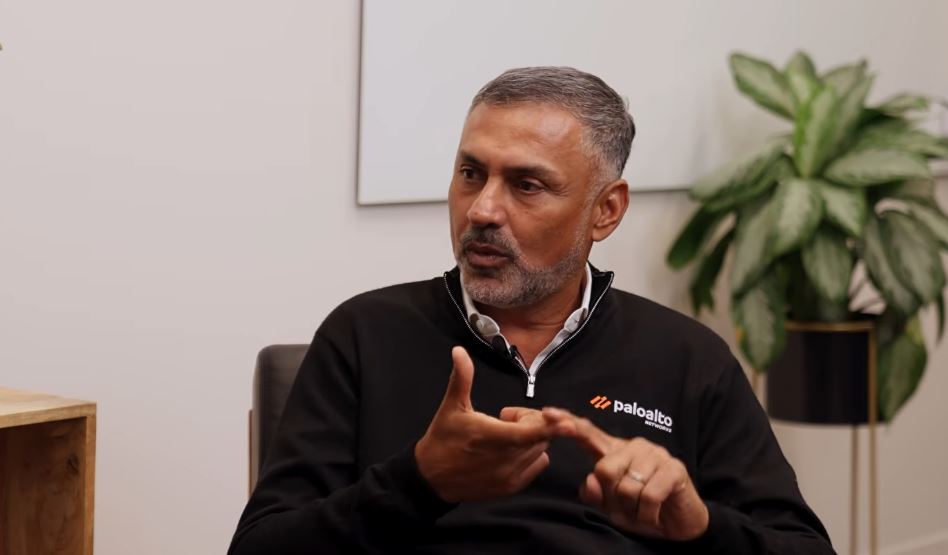
Nikesh Arora Investment Gains: How a $10 Million Dip Buy Turned Into $26 Million in Five Months

The stock of Palo Alto Networks was uncomfortable in late March of this year. Since January, the shares had dropped by more than 20%. The notion that artificial intelligence, the same force behind billions of dollars in enterprise spending, might eventually automate enough cybersecurity tasks to undermine the industry’s core value proposition truly alarmed investors. To put it simply, the atmosphere in the sector was tense.
Nikesh Arora opened his personal checkbook at that moment. Arora spent approximately $10 million of his personal funds on 68,085 shares of Palo Alto Networks on the open market on March 27 at an average price of about $146.88 per share. It was noteworthy that it was his first open-market stock purchase since November 2019. People pay attention when a CEO who hasn’t purchased a share in more than six years suddenly drops $10 million in a single transaction because SEC filings are public. The day the acquisition was announced, Palo Alto’s stock increased by 5%.
Since then, the investment’s value has increased to over $26 million, representing an unrealized gain of more than $16 million in about five months. The value of the position is roughly 2.6 times what he paid for it. The majority of hedge funds would be happy to claim credit for that kind of return.
It’s important to comprehend the true state of the market at the time Arora took this action. Investors openly questioned whether AI could begin performing tasks that cybersecurity firms had always marketed as specialized knowledge after Anthropic unveiled a tool in February that could scan code vulnerabilities. The anxiety was heightened by a report that Anthropic was creating a more potent AI model that could assist hackers in launching more complex attacks. The names of cybersecurity companies like CrowdStrike and Okta were disappearing. The sector’s story had changed, and not in a good way.
Arora directly challenged that narrative. He made the case that as AI spreads throughout businesses, cybersecurity becomes more important rather than less in a blog post that was released the week of his acquisition. Increased AI systems result in increased machine-to-machine activity, automated processes, connections that require protection, and completely new risk categories.
He described it as one of the most significant events in the history of the industry and argued that cybersecurity firms and AI labs should collaborate rather than be portrayed as rivals. It reads more like someone who had carefully considered this and was willing to risk money on the outcome than it does like a public relations ploy.
The June release of Palo Alto’s third-quarter results provided strong support for that claim. Revenue exceeded Wall Street’s projections by rising 31% year over year to $3 billion. Instead of the anticipated $0.80 per share, non-GAAP earnings came in at $0.85. Management cited growing demand from businesses transitioning from AI experimentation to large-scale deployment—exactly the change Arora had predicted would cause cybersecurity spending to increase rather than decrease.
Through acquisitions, the business has also been reinventing itself. Concerns about AI agents—autonomous systems that can access sensitive data, communicate with other software, and make decisions without direct human input—are highlighted by the approximately $25 billion acquisition of CyberArk, an Israeli identity-security company, which closed in February. Managing human access is becoming just as crucial as deciding which machines and AI agents should be permitted inside corporate systems. Over the past year, Palo Alto has acquired five AI-related businesses, including the Israeli startup Koi.
Seeing everything come together gives me the impression that Arora’s March purchase was more than just a financial choice. It was a position statement. When the market most obviously disagreed with his thesis about the future of cybersecurity, he invested his own money in it.
The market capitalization of Palo Alto is currently at an all-time high of about $315 billion. The uncertainty of late March is a far cry from that. The stock’s ability to maintain this level is still up in the air, and cybersecurity has real long-term issues that cannot be solved by a single strong quarter. For now, though, Arora’s wager appears to be one of the simpler decisions made by any executive this year. When it was uncomfortable, he bought. The others came next.


 Bitcoin
  Ethereum
  Tether
  BNB
BNB  USDC
USDC  XRP
XRP  Solana
  TRON
TRON  Lido Staked Ether
  Cardano
  Gram (prev. Toncoin)
  Avalanche