
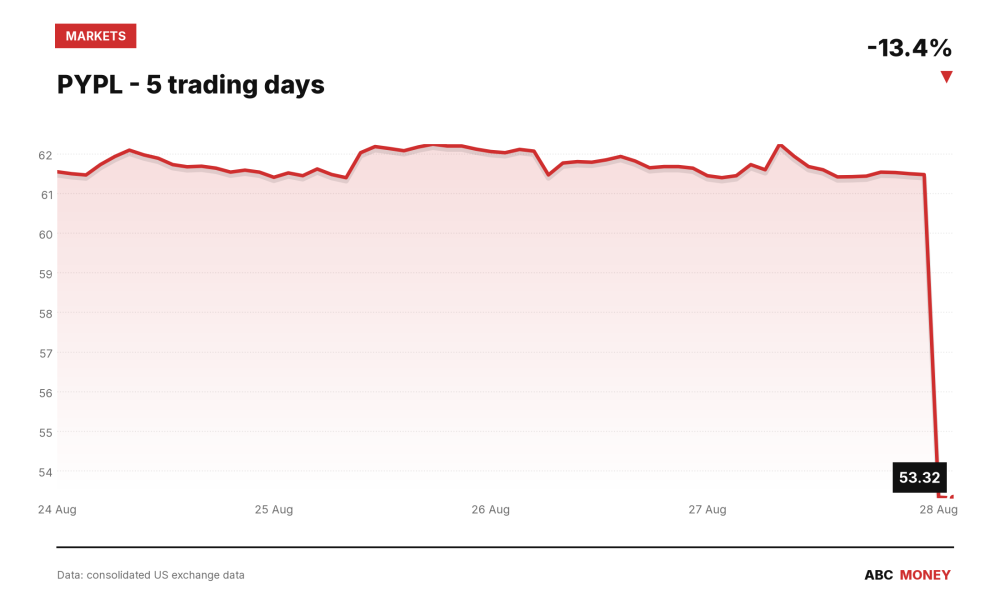
The PayPal takeover collapse is now official, at least as far as the reporting goes: Bloomberg reported that a consortium of private equity firm Advent International and payments group Stripe has abandoned its pursuit of PayPal Holdings (PYPL), a deal that had been valued at more than $50bn. The stock responded exactly as you’d expect from a broken deal: PayPal shares last traded at $53.40, down 13.06% over 24 hours and sitting right at their 20-day low of $53.34, according to Investor’s Business Daily.
Reuters and Benzinga both carried the same Bloomberg-sourced line – that the Advent-Stripe group has walked away – with Reuters confirming the share-price reaction and Benzinga syndicating the $50bn figure. None of the reports point to a formal termination filing, which is normal: this was private deal talk, not a signed agreement subject to disclosure, so the paper trail runs through wire reports rather than regulatory filings.
How a $53bn bid turned into a rout
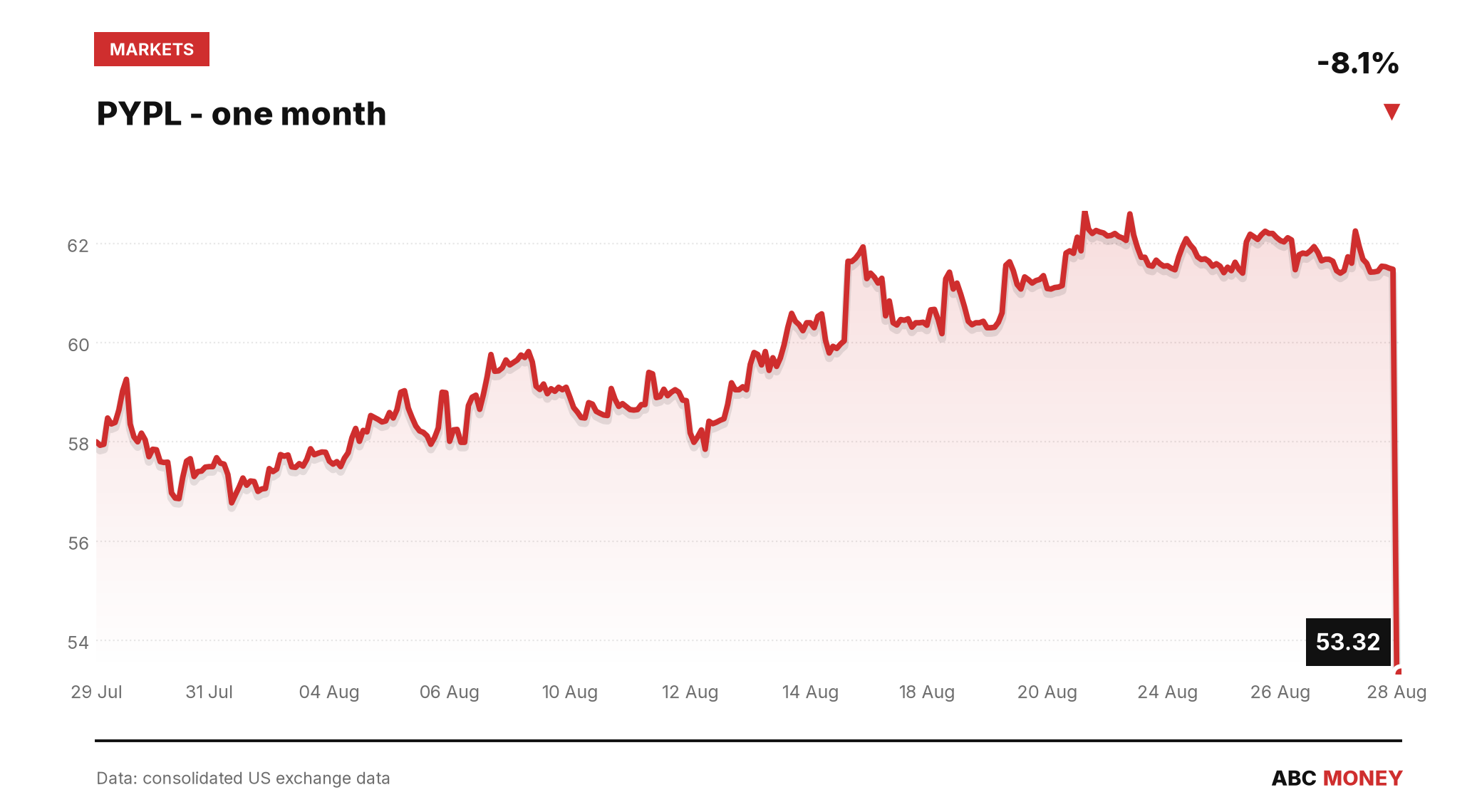
What makes this a genuine round trip, not just a one-day wobble, is the run-up beforehand. The interest traces back to at least February 2026, when TechCrunch first reported Stripe was eyeing a deal for some or all of PayPal. By July, CNBC was reporting a formal offer valued at more than $53bn, a report that sent the stock soaring at the time. Talks reportedly advanced further still – the Wall Street Journal, cited by Investing.com, put a specific number on it: $60.50 a share. eMarketer reported PayPal was readying takeover defences in response, framing the approach as arriving on the back of what it called a weak “transition year” for the payments group.
None of that survived to a signed deal. The “$50bn” figure now attached to the collapse understates how far the talks reportedly went before they fell apart – shareholders who bought into the July rally on the strength of a $60.50-a-share number are waking up to a stock in the low $50s.
What the numbers actually support
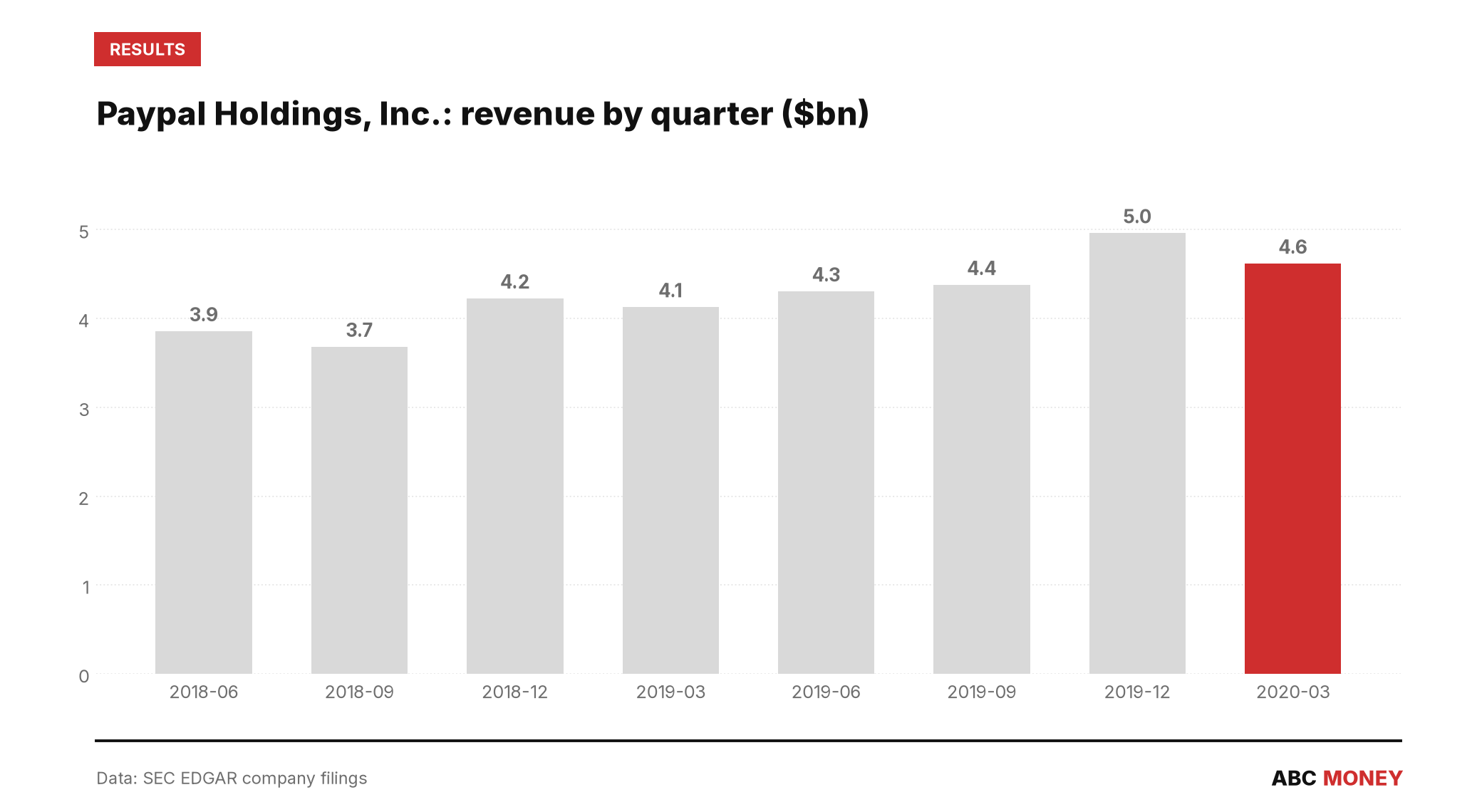
PayPal’s own filings give some sense of scale. The company’s Q1 2026 10-Q, filed with the SEC, reported diluted earnings per share of $1.21 on net income of $1,113m for the quarter – arithmetic that implies roughly 920m diluted shares outstanding. At Wednesday’s post-selloff price of $53.40, that puts PayPal’s market capitalisation at roughly $49bn, comfortably inside the range of the “$50bn-plus” figures attached to the abandoned bid. For context on the underlying business being fought over, PayPal’s FY2025 10-K showed full-year revenue of $33,172m and net income of $5,233m – a profitable, cash-generative franchise that any buyer would have had to pay a real premium for, which is presumably why the reported per-share offers kept climbing through the spring before the talks broke down.
Positioning was already jittery
Bearish positioning in the stock had been building even before the collapse was confirmed. FINRA’s daily short-sale data shows PYPL’s short-volume ratio – the share of daily trading volume attributable to short sales – swinging between roughly 0.35 and 0.59 through the second half of August, spiking to 0.585 on 17 August and easing back to 0.417 by 27 August, per FINRA figures. That kind of churn is consistent with traders hedging deal risk in both directions rather than a one-way bet against the stock, and it isn’t conclusive on its own about how the market rated the odds of a deal completing. But it does suggest the market had not fully priced in a clean break before Thursday’s move, given trading volume also ran 37% above its 20-day average as the news broke.
For now, there is no successor process on the table. Bloomberg’s reporting, corroborated independently by Ireland’s RTE, frames this as the consortium stepping back rather than PayPal rejecting a formal offer outright, leaving open the question of whether Advent, Stripe, or another bidder resurfaces once the dust settles. Investors will be watching PayPal’s next scheduled earnings release for any management commentary on the approach, and for whether the takeover defences reportedly assembled over the summer stay in place now that the immediate threat has receded.
This article is for information only and is not investment advice or a recommendation to buy or sell any asset. Markets move quickly; figures are correct as sourced at the time of writing. Always do your own research before making financial decisions.



 Bitcoin
  Ethereum
  Tether
  BNB
BNB  USDC
USDC  XRP
XRP  Solana
  TRON
TRON  Lido Staked Ether
  Cardano
  Gram (prev. Toncoin)
  Avalanche