
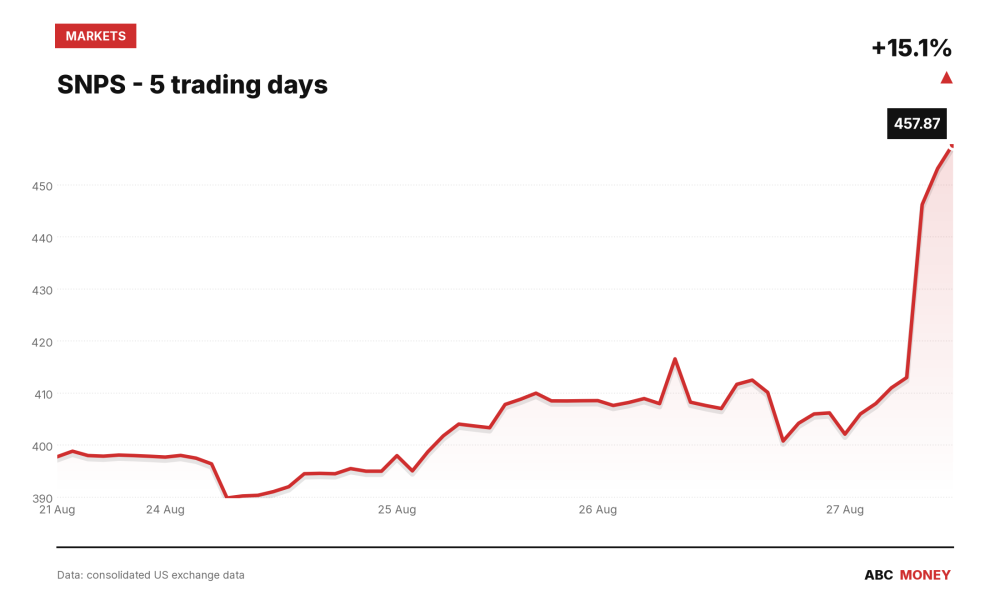
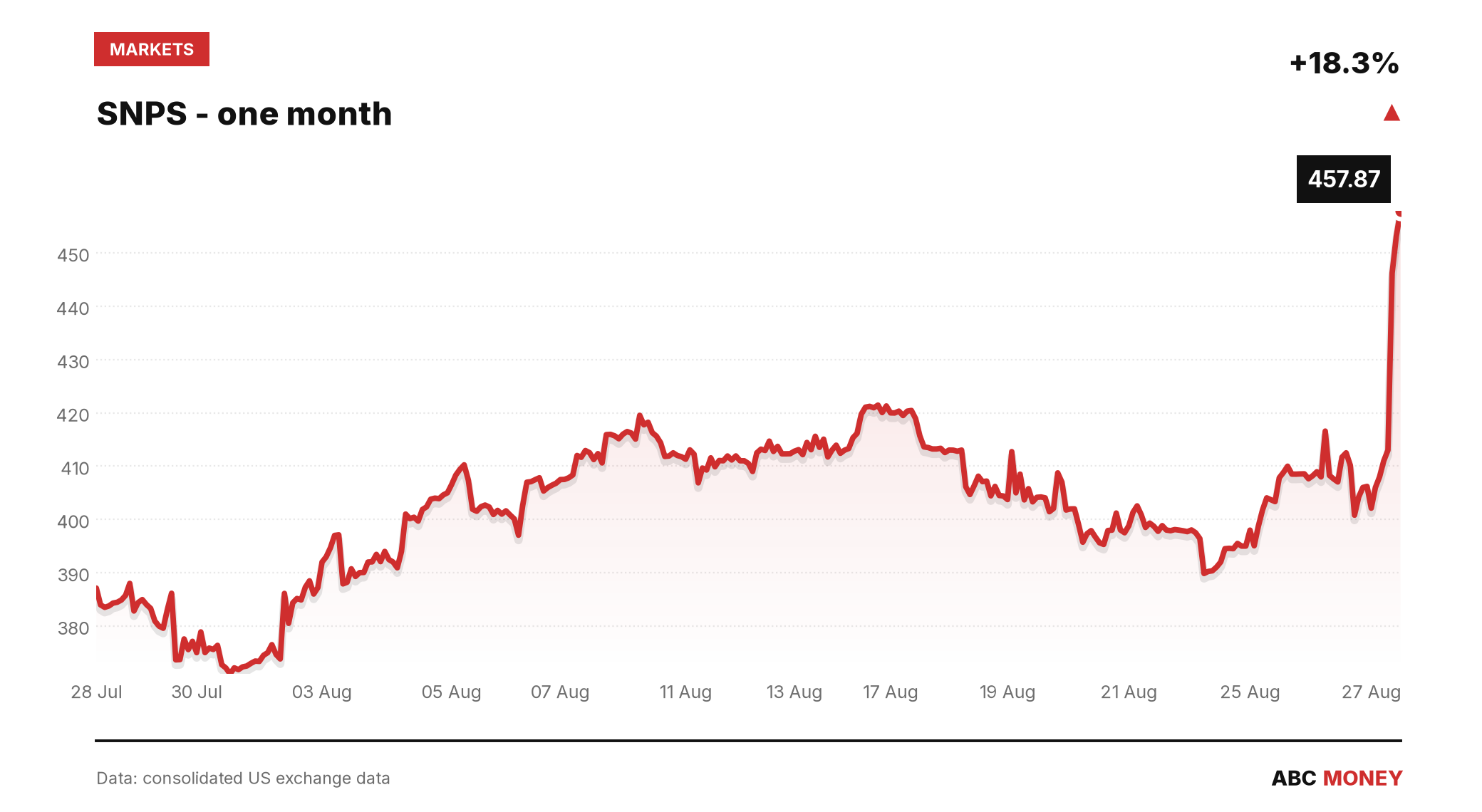
Synopsys (NASDAQ: SNPS) did everything a company is supposed to do to please the market on Wednesday: it beat its own guidance on revenue, profit margin and earnings per share, then raised its full-year targets on top. Investors sold the stock anyway. Shares fell roughly 4-5.6% in after-hours trading following the release, and were still down about 2% in premarket trading the next morning, according to Seeking Alpha and Reuters, via Investing.com. That is the real story here: a Synopsys beat and raise that the market chose to fade rather than celebrate.
The numbers were genuinely strong
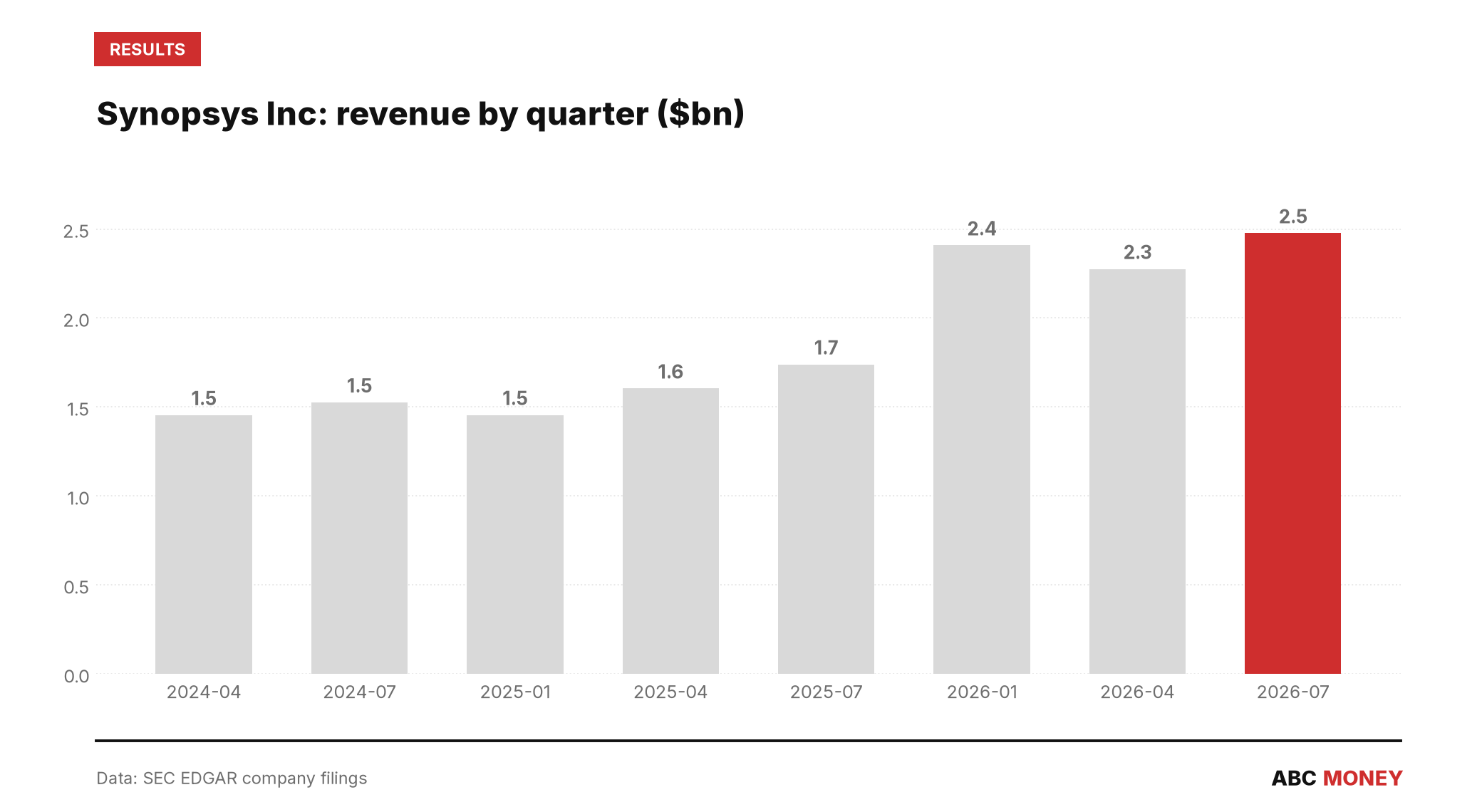
Third-quarter revenue for the fiscal period ended 31 July came in at $2.477bn, up roughly 42% from $1.740bn a year earlier, according to the company’s 10-Q filed with the SEC. Non-GAAP earnings per share of $3.91 beat both the top end of prior guidance and the analyst consensus of roughly $3.67-$3.68, a gap of about 24 cents. GAAP diluted earnings per share landed at $2.84, against $1.50 in the same quarter last year, on net income of $545.8m versus $242.5m a year earlier – a swing that the filings show was preceded by two unusually weak quarters, with net income dipping to just $65m and then $17m in the first two quarters of the fiscal year, most likely reflecting integration costs tied to the Ansys acquisition before the business found its footing again.
Synopsys used the results to lift its full-year outlook, guiding to roughly $9.715bn in revenue at the midpoint and non-GAAP EPS of $15.07 at the midpoint, according to the company’s official results release. Management pointed to double-digit growth expected in its core electronic design automation (EDA) business in the fourth quarter, with strength also flagged across the newly acquired Ansys simulation unit and its design IP licensing business – the software blocks customers license rather than build themselves.
So why did the shares fall?
The mismatch between a strong quarter and a weaker share price usually points to expectations running ahead of even a beat, and that appears to be the case here. Synopsys trades at a rich multiple, and a chunk of this year’s revenue growth is not organic: Yahoo Finance’s coverage of the call cited an expected Ansys contribution of roughly $2.98bn to full-year revenue, meaning a meaningful share of the headline growth rate is the acquisition showing up in the base numbers rather than underlying demand accelerating on its own. For a stock priced for years of compounding growth, investors appear to be parsing how much of that growth is bought versus earned, and weighing integration costs against the promise of cross-selling EDA and simulation tools together.
On the product side, Synopsys used the call to showcase Multiphysics Fusion, a tool combining its own chip-design software with Ansys’s simulation technology to model thermal, electromagnetic and voltage-drop effects inside a single workflow, according to the company’s investor relations announcement. The same release detailed an “industry-first L4 orchestrated, multi-agent design and verification workflow” built on its AgentEngineer technology, part of a broader push into agentic AI – software agents that can plan and execute multi-step engineering tasks with limited human input – that management is betting will differentiate the combined Synopsys-Ansys platform from rivals.
A calmer backdrop, a jumpier stock
The sell-off did not come against a stressed macro backdrop. The 10-year Treasury yield stood at 4.64% as of 25 August, down from 4.7% previously, with the 2-year at 4.17%, according to Federal Reserve data – a modestly easing rate environment that has generally been supportive of high-multiple software and AI-adjacent names rather than a headwind. That makes the reaction harder to pin on broader risk aversion and easier to read as a company-specific repricing of how much credit the market is willing to extend for growth that is partly inorganic.
Trading activity in the stock itself gives a partial clue. FINRA’s daily short-sale volume data show the share of Synopsys volume attributable to short sales – bets that the stock would fall – ticked up to 38.8% on the day results were published, up from 21.3% the prior session, though still within the range seen over the preceding fortnight, according to FINRA. That is consistent with active repositioning around the print rather than a short squeeze; the move looks like ordinary investors reassessing valuation, not a rush to cover bearish bets.
The next test comes with the fourth-quarter print, when Synopsys will have to show that the double-digit EDA growth flagged on this call, and the promised Ansys cross-sell, are showing up in numbers clean enough to satisfy a market that has grown more discerning about paying up for growth that arrives via acquisition rather than demand alone.
This article is for information only and is not investment advice or a recommendation to buy or sell any asset. Markets move quickly; figures are correct as sourced at the time of writing. Always do your own research before making financial decisions.


 Bitcoin
  Ethereum
  Tether
  BNB
BNB  USDC
USDC  XRP
XRP  Solana
  TRON
TRON  Lido Staked Ether
  Cardano
  Gram (prev. Toncoin)
  Avalanche