
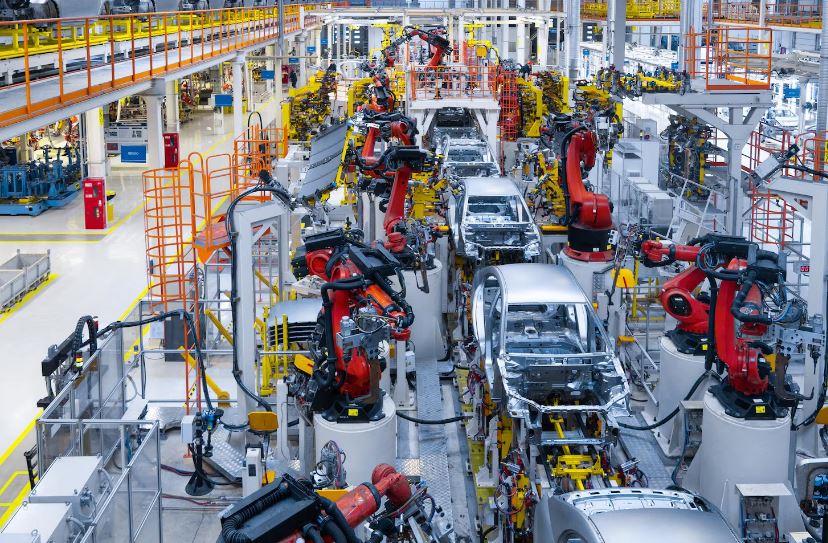
Ford Manufacturing Facility Investment Kentucky: What a $1B Paint Shop Says About the Future of American Industry

There is a rhythm to the Kentucky Truck Plant in Louisville that is difficult to describe without being inside. Take a stroll through the facility on any given morning. Every 45 seconds, a truck—a Lincoln Navigator, an Expedition, or an F-Series Super Duty—comes off the assembly line. Not every few minutes. every forty-five seconds. You can almost physically see why this specific facility is so important to Ford because of the level of operational intensity.
Therefore, Ford’s announcement of a $1 billion investment to construct a new paint shop at the Kentucky Truck Plant was more than just an improvement to the facility. It was a sign that this plant, which Ford refers to as its biggest and most profitable manufacturing facility in the nation, is not going anywhere. Before the end of 2026, groundbreaking is anticipated.
Cleaner procedures and more effective technology will take the place of an outdated facility in the paint shop itself. Although it’s not the most spectacular announcement Ford could make, it has a grounded quality. Paint shops are costly, intricate, and intricately linked to a plant’s long-term identity, but they don’t garner as much attention as EV platforms. Unless you anticipate operating that facility for decades, you don’t spend a billion dollars on paint infrastructure.
Additionally, this investment is not isolated. Ford has been investing steadily in Kentucky, spending about $2 billion to build its Universal EV Platform at the nearby Louisville Assembly Plant and an additional $2 billion at Ford Energy Systems in Glendale, which is being transformed into a large-scale battery energy storage manufacturer. When all is said and done, Ford has given the state about $4 billion in recent years, and there is still more to come. According to a University of Louisville study, when you account for suppliers and vendors throughout the area, the overall economic impact of Ford’s presence in Kentucky surpasses $33 billion.
“For more than a century, Ford and Kentucky have grown together, and we’re investing to ensure that relationship remains strong for generations to come,” stated Jim Farley, president and CEO of Ford. Although it’s a simple statement, the context lends it significance. The first Model T was produced in Louisville in 1913, marking the beginning of Ford’s history in Kentucky. Over 11,500 people are employed by the company in the state more than a century later, and an additional 6,000 retirees live in Kentucky. That is a demographic reality ingrained in local communities, not a corporate talking point.
In particular, Louisville seems to have quietly earned its current position in American manufacturing over many years. Ford is “going all in” on the city, according to Mayor Craig Greenberg’s description of the company’s most recent announcement. The Louisville Assembly Plant is currently undergoing renovations in order to manufacture the Ford Fathom, a midsize electric pickup that is scheduled for release in 2027. This project is anticipated to generate or maintain approximately 2,200 jobs. The Glendale energy facility is anticipated to reach a production capacity of 20 gigawatt-hours of battery storage and create at least 2,100 additional jobs. For a mid-sized American state, these figures are not insignificant.
By the time some of these projects reach full production, it’s still unclear exactly how the entire auto industry will appear. Ford has experienced significant turbulence in its EV division over the past few years, and the adoption of electric vehicles has been slower and more difficult than early optimists had anticipated. However, the investments in Kentucky appear to be a calculated wager that deep, modern, adaptable manufacturing capacity in the United States is worth preserving, regardless of the direction American mobility takes over the next ten years.
The degree of continuity behind this story sets it apart from the typical corporate investment announcement. Kentucky is not being discovered by Ford. It has existed for over a century and a half. The billions being committed now appear less like a new beginning and more like a business stepping up its commitment to a cause it already supports—quietly, methodically, one billion dollars at a time.

 Bitcoin
  Ethereum
  Tether
  BNB
BNB  USDC
USDC  XRP
XRP  Solana
  TRON
TRON  Lido Staked Ether
  Cardano
  Gram (prev. Toncoin)
  Avalanche