Bristol Myers Squibb’s (NYSE: BMY) admilparant Phase 3 trial has met its main goal in idiopathic pulmonary fibrosis (IPF), the company said, though only one of the two doses tested delivered the kind of result regulators and investors tend to want.
The headline is accurate as far as it goes: the ALOFT-IPF study hit its primary endpoint. But the fine print, laid out in reporting from Investing.com, tells a more layered story than the press release headline suggests – and it’s the layer that will shape how the drug moves through the Food and Drug Administration from here.
The dose that mattered
ALOFT-IPF enrolled roughly 1,255 adults with idiopathic pulmonary fibrosis, a scarring lung disease with a median survival of three to five years after diagnosis, and randomised them to 60mg or 120mg of admilparant taken twice daily, or placebo, for at least 52 weeks. The trial measured change in forced vital capacity (FVC) – a standard lung-function test – from baseline to week 52.
Only the 60mg arm cleared the bar for statistical significance. The 120mg dose slowed the rate of lung-function decline relative to placebo but did not reach significance on its own, according to the same Investing.com reporting. Discontinuations tied to side effects were low and broadly similar across both admilparant arms and placebo, which is the kind of safety signal companies like to point to when a dose-response result comes in mixed.
Bristol Myers said it plans a full evaluation of the data and intends to engage regulators, with detailed results expected at a future medical meeting – standard language, but a reminder that the market is trading a topline readout, not a filing.
A liver-safety shadow over the whole drug class
The result arrives against a backdrop analysts had already flagged as complicated. Ahead of the readout, BMO had noted limited disclosure around potential drug-related liver injury in the ALOFT programme, a concern serious enough that a related protocol amendment had previously hit shares in a smaller rival working on the same class of drug, known as LPA1 inhibitors, according to BioSpace. That context doesn’t undo Tuesday’s result, but it means the eventual label and dosing decision – assuming admilparant reaches that stage – will hinge on more than the FVC numbers alone.
Bristol Myers is also running a companion trial, ALOFT-PPF, testing admilparant in a broader category called progressive pulmonary fibrosis in roughly 1,057 adults, with topline results expected in early 2027. That study, rather than Tuesday’s readout, may end up being the one that determines how widely the drug can eventually be used.
Shares react, with help from a second trial win
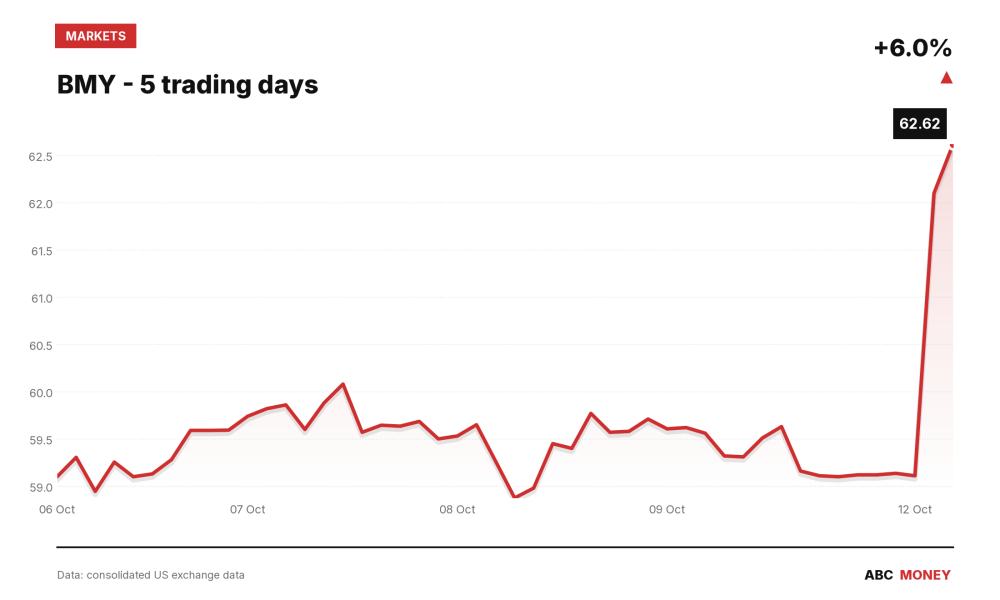
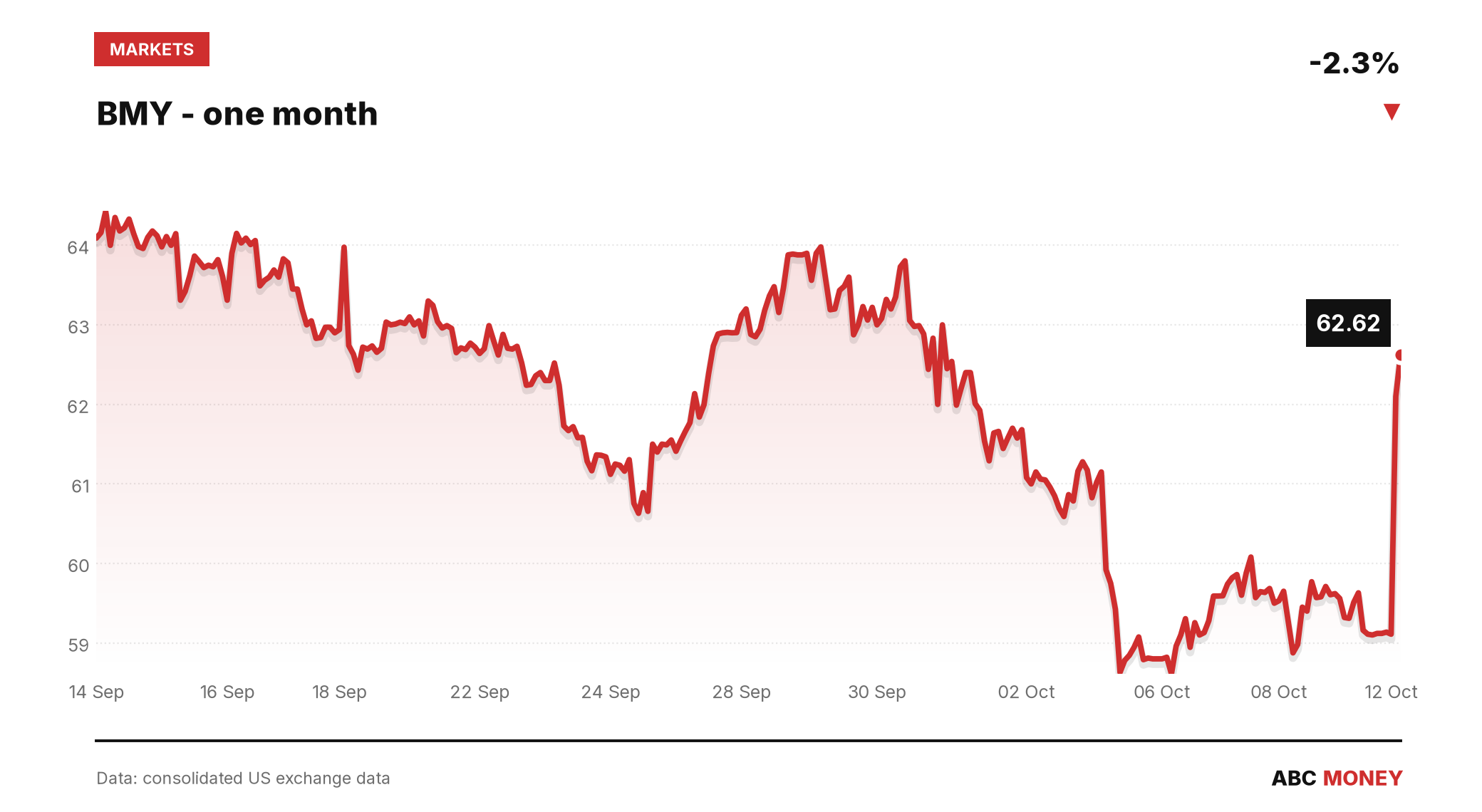
BMY shares were up 5.95% intraday to $62.63 as of the latest reading, within a 20-day trading range of $58.61 to $63.98. Independent reporting put the day’s move closer to 6.5%, a gap likely down to timing of the snapshot rather than any disagreement about the direction of travel. Either way, the news did not arrive alone: Bristol Myers also disclosed the same day that its ACTION-1 trial of RYZ101 in neuroendocrine tumours had met its primary endpoint, a statistically significant improvement in progression-free survival, per Investing.com’s reporting on the dual readouts. Untangling exactly how much of the rally belongs to each trial is not possible from the share-price move alone.
Positioning data add a small wrinkle. FINRA’s daily short-sale figures – the share of trading volume attributable to short sellers betting the stock would fall – show the ratio easing from 0.669 on 30 September to 0.294 by 9 October, the session before the announcement, according to FINRA data. That suggests bearish positioning had already been thinning out ahead of the readout, rather than this being a case of short sellers being caught out and forced to buy back stock.
Why one trial barely moves the needle
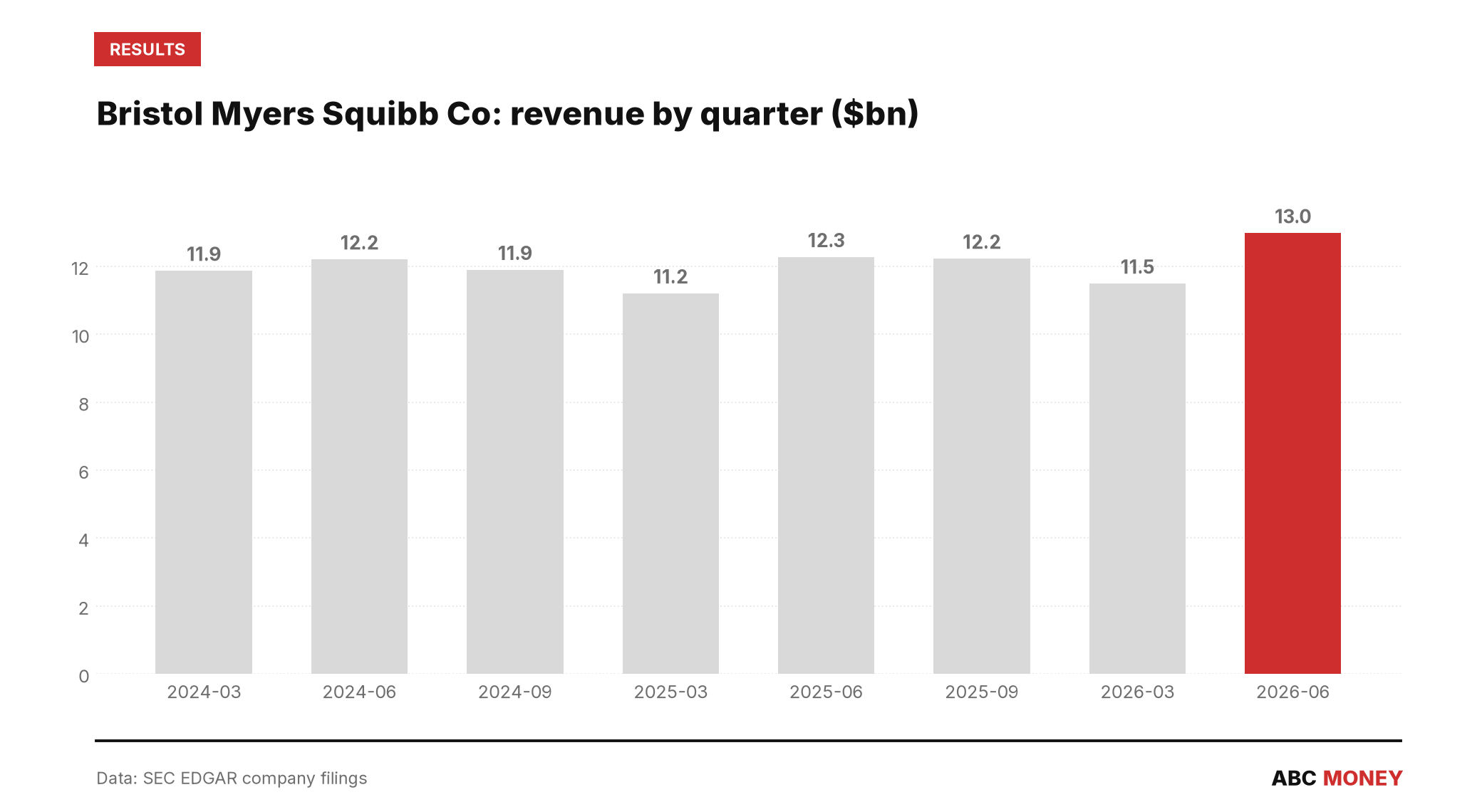
It’s worth sizing the reaction against the company Bristol Myers actually is. Quarterly filings with the Securities and Exchange Commission show the group swinging from a net loss of $11.911bn in the first quarter of 2024 – a quarter dominated by one-off charges – to net income of $3.317bn in the second quarter of 2026, with quarterly revenue running between roughly $11.2bn and $13.0bn throughout that stretch. Against a business of that scale, a single pipeline readout, however encouraging, is one data point among many feeding into how the market prices Bristol Myers’s long-term growth prospects beyond its current portfolio.
What happens next is mostly a matter of record-keeping rather than suspense: a fuller data presentation at a medical meeting, a regulatory conversation that will have to grapple with the liver-safety questions raised across the LPA1 class, and the ALOFT-PPF readout due in early 2027 that could settle how broadly admilparant ultimately gets used.
This article is for information only and is not investment advice or a recommendation to buy or sell any asset. Markets move quickly; figures are correct as sourced at the time of writing. Always do your own research before making financial decisions.


 Bitcoin
  Ethereum
  Tether
  BNB
BNB  USDC
USDC  XRP
XRP  Solana
  TRON
TRON  Lido Staked Ether
  Cardano
  Gram (prev. Toncoin)
  Avalanche