
The Nebius Inferize acquisition arrived on 1 October with a familiar label: “terms undisclosed.” That is true as far as Nebius Group N.V. (NASDAQ: NBIS) is concerned – the company has not published a purchase price. But it is not the whole story. Reporters working the deal from Israel and the US have independently converged on a price range of roughly $100m to $150m for the ten-month-old startup, even as Nebius itself says nothing.
The acquisition itself is not in dispute. Nebius says it bought Inferize, an Israeli AI-inference startup, to bolster the engineering and technology behind its Token Factory inference platform – the part of its business that turns trained AI models into a production service customers can actually run workloads on, as Benzinga and Nasdaq both reported. That much is corroborated across multiple outlets and nobody is contesting it.
Where the “undisclosed” framing breaks down
The gap opens on the price. Israeli business daily Globes reported an estimated $100-130m price tag, while Parameter.io and a second US finance outlet put the figure at “up to $150m.” These are unofficial estimates, not a company-confirmed number, and they do not perfectly agree with one another – but their existence undercuts the idea that the deal size is simply unknowable. Someone with knowledge of the negotiations is talking, even if Nebius itself is not.
It is worth being precise about what the public record does and does not show. The evidence trail for this transaction does not include a dedicated SEC filing – no 6-K or 8-K specifically documenting the Inferize purchase. The only same-day filing tied to Nebius is a Form 4 for reporting person Boynton John Wilson IV, filed roughly two hours after the deal was reported – an insider-trading disclosure, not an acquisition announcement, and nothing ties it directly to the Inferize transaction. Readers should not infer a connection that the filing itself doesn’t make.
Separately, Nebius completed a different acquisition – of a company called Eigen AI – back in June 2026, disclosed via a 6-K filing. That deal is distinct from Inferize and the two should not be conflated, something a handful of aggregators have managed to do regardless.
Why the silence is the interesting part
On Nebius’s own numbers, $100m to $150m would not move the needle financially. The company’s FY2025 20-F filing shows full-year revenue of $529.8m and net income of $82.5m, with diluted earnings per share of $0.33 – a sharp turnaround from the $641.4m net loss and -$2.28 diluted loss per share it reported for FY2024 on revenue of $117.5m. A deal in the low hundreds of millions is immaterial to a balance sheet of that size, which makes the silence more a strategic choice than a disclosure obligation. What it is not immaterial to is understanding how Nebius is building out its inference cost base – arguably the more important detail for anyone trying to judge whether Token Factory can compete on unit economics against the hyperscalers.
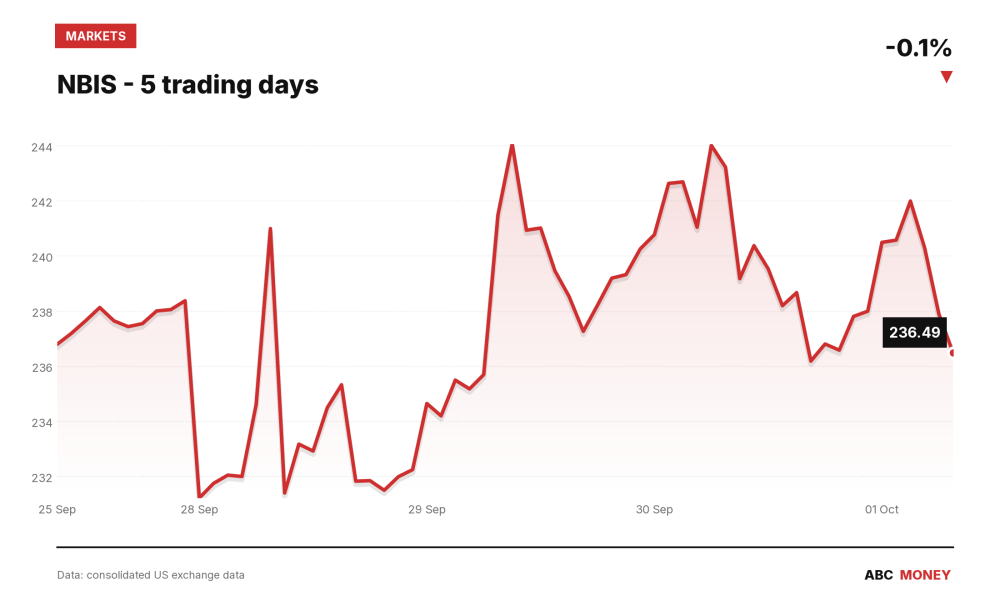
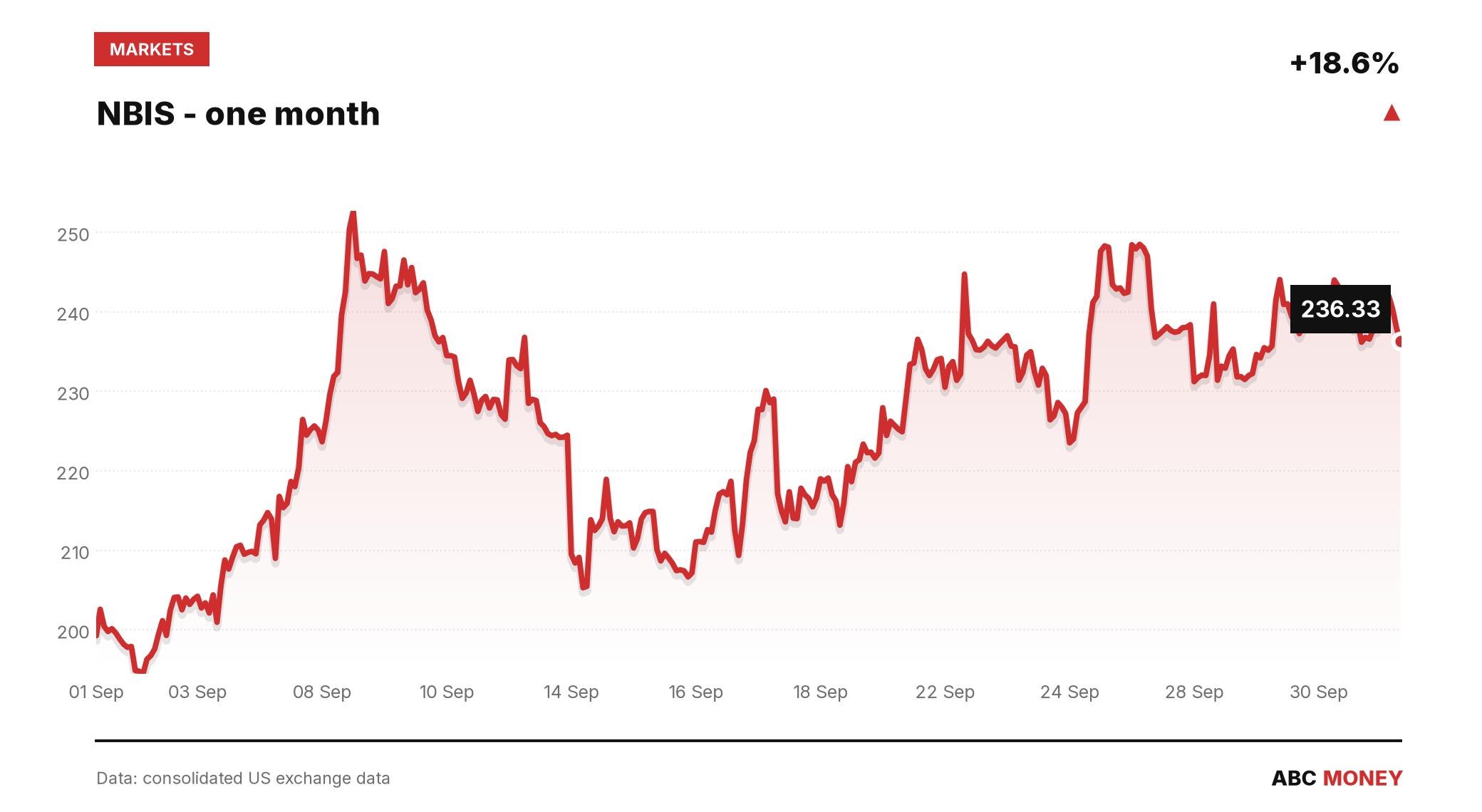
The market’s reaction, for what it’s worth, has been muted. NBIS last traded at $236.07, down 0.73% on the day, on volume running at just 8% of its 20-day average – hardly the signature of a market repricing the stock around new information. Shares have sat within a $205.30-to-$248.50 range over the past 20 trading days, and the acquisition news has not, so far, pushed the stock meaningfully outside it.
A quieter signal in the options and short data
One data point worth flagging: the share of Nebius trading volume accounted for by short sales – bets that the stock will fall – climbed steadily through late September, from a ratio of 0.479 on 23 September to 0.653 on 30 September, the highest reading in that ten-day window and arriving just before the Inferize news broke, according to FINRA’s daily short-sale data. Whether that build-up reflects positioning ahead of the announcement or is unrelated noise is not something the data can settle on its own, but it is the kind of detail that tends to get asked about if Nebius eventually files anything more specific on the deal.
All of this is unfolding against a backdrop of persistently high US borrowing costs – the 10-year Treasury yield stood at 5.26% as of 29 September, per Federal Reserve data – which keeps the bar high for AI-infrastructure spending generally, M&A included. Whether Nebius chooses to clarify the Inferize price tag, or simply lets the unofficial estimates stand, may say as much about its disclosure philosophy as about the deal itself.
This article is for information only and is not investment advice or a recommendation to buy or sell any asset. Markets move quickly; figures are correct as sourced at the time of writing. Always do your own research before making financial decisions.

 Bitcoin
  Ethereum
  Tether
  BNB
BNB  USDC
USDC  XRP
XRP  Solana
  TRON
TRON  Lido Staked Ether
  Cardano
  Gram (prev. Toncoin)
  Avalanche