Bitcoin
 Ethereum
 Tether
 BNB
 USDC
 XRP
 Solana
 TRON
 Lido Staked Ether
 Cardano
 Gram (prev. Toncoin)
 Avalanche
Nebius Group N.V. (NASDAQ: NBIS) has entered into a $3.5 billion financing facility with Citi, the AI cloud company said on 22 October, giving it fresh firepower for the data-centre and GPU spending that has defined its past year. The deal was confirmed in Nebius’s own announcement and corroborated independently by Reuters, which reported the same lender, amount and structure.
The facility is senior secured, meaning Citi gets first claim on specified collateral if things go wrong, and it matures in 364 days – just under a year. It carries an initial interest rate of Term SOFR (the benchmark US dollar lending rate) plus 2.75 percentage points, rising under certain conditions to a cap of 3.50% over SOFR. Nebius frames it as one strand of what it calls a “diversified and sequenced” funding strategy that also leans on customer prepayments and operating cash flow.
A financing facility built for speed, not duration
The detail worth sitting with isn’t the headline $3.5 billion – it’s the 364-day clock attached to it. Nebius is using short-term, floating-rate debt to fund data centres and GPU clusters that will generate revenue for years, not months. That’s a common enough tactic in capital-intensive build-outs: borrow cheaply and quickly now, refinance into longer-dated instruments once assets are generating cash and credit markets cooperate. But it only works if refinancing stays available on reasonable terms. Nebius’s own reporting points to a backstop: executives have pointed to more than $40 billion in long-term, investment-grade customer contracts – including with Microsoft and Meta – as collateral it could borrow against if needed, per Reuters’s reporting.
This facility also isn’t a one-off. Nebius arranged a $775 million secured facility led by MUFG Bank in July 2026, then closed a $5.75 billion convertible note offering in August, leaving it with roughly $10 billion in convertible debt outstanding, according to Reuters. The Citi facility is the fourth distinct financing move of the year, a cadence that reflects both the scale of AI infrastructure spending and how much of it is still being funded through debt rather than free cash flow.
Why the timing matters
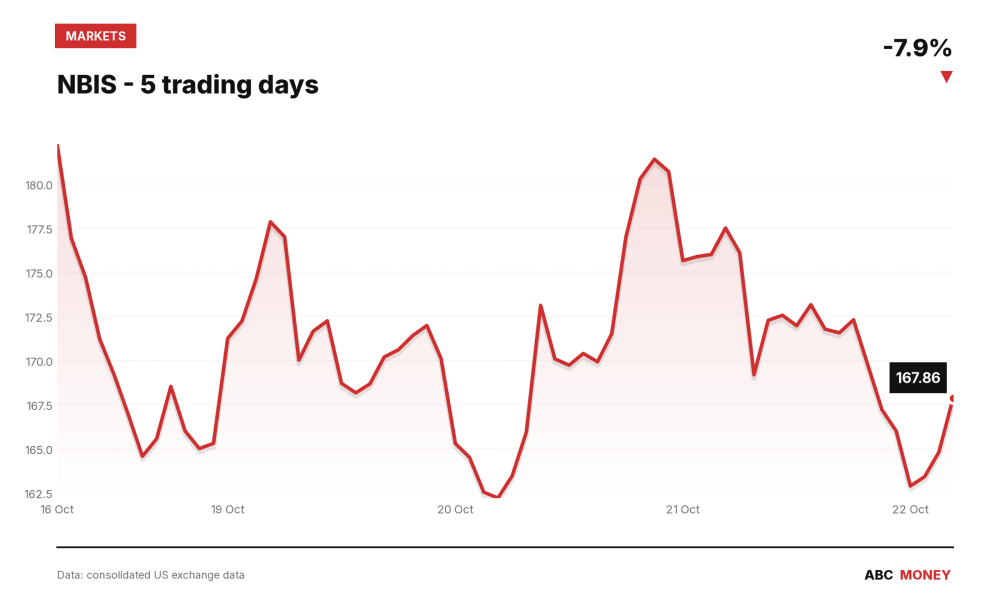
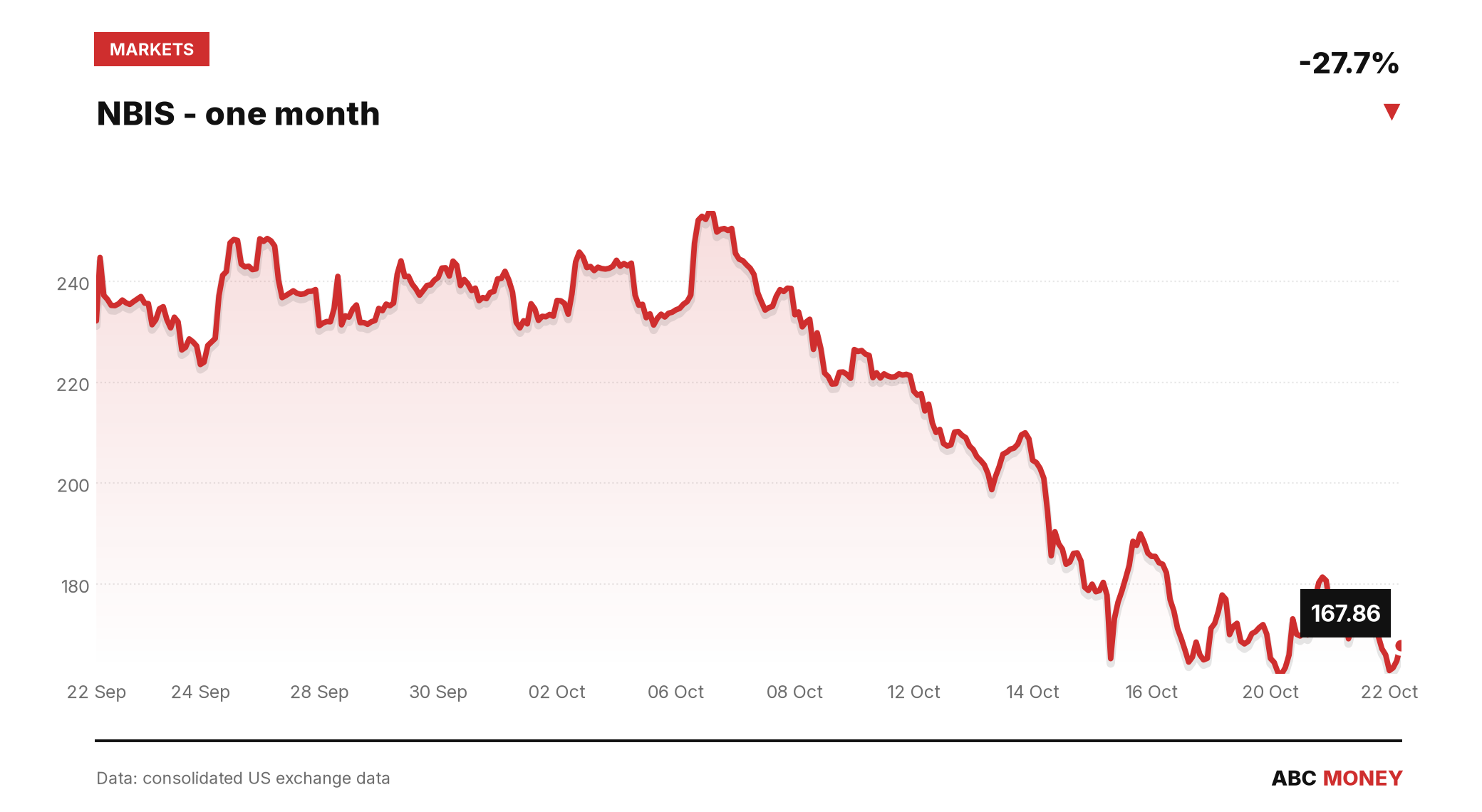
The deal lands days after a bruising stretch for the AI infrastructure sector. CoreWeave’s bonds and shares tumbled in mid-October on investor concern about whether data-centre revenue can keep pace with debt service, a shock that rippled across so-called “neocloud” names. Nebius wasn’t spared: its shares fell 10.08% on 14 October to close at $186.01, then dropped a further 11.99% on 16 October to $165.47, both moves tied to the same sector-wide selloff. By 22 October the stock had slipped a further 2.81% on the day to $167.45, having fallen nearly 30% over the preceding month and sitting well off its 20-day high of $253.93.
FINRA’s daily short-sale data, which tracks the share of trading volume executed as short sales rather than outright share interest, shows the ratio for Nebius climbing from 0.367 on 19 October to 0.452 on 21 October – the day before the Citi facility was announced, via FINRA figures. Rising Treasury yields have compounded the pressure on debt-funded growth stories generally: the 10-year US yield climbed to 5.15% from 5.09% in the same week, per Federal Reserve data, making any fixed obligation marginally more expensive to service or refinance.
The balance sheet backdrop
Lenders aren’t extending secured credit on hope alone. Nebius’s 20-F annual report, filed with the SEC, shows the company turned profitable in its 2025 financial year, reporting revenue of $529.8 million and net income of $82.5 million, equivalent to diluted earnings per share of $0.33. That’s a sharp turnaround from 2024, when Nebius posted a net loss of $641.4 million on revenue of just $117.5 million. The swing to profitability, even on a still-modest revenue base, is presumably part of what gives a bank like Citi comfort extending a facility of this size on a secured basis rather than demanding equity or convertible terms.
What happens next largely depends on whether Nebius can term out the Citi facility, or draw on its contract-backed borrowing capacity, well before the 364-day clock runs down – and on whether the wider AI-infrastructure debt market calms enough to make that refinancing straightforward rather than another source of scrutiny.
This article is for information only and is not investment advice or a recommendation to buy or sell any asset. Markets move quickly; figures are correct as sourced at the time of writing. Always do your own research before making financial decisions.