
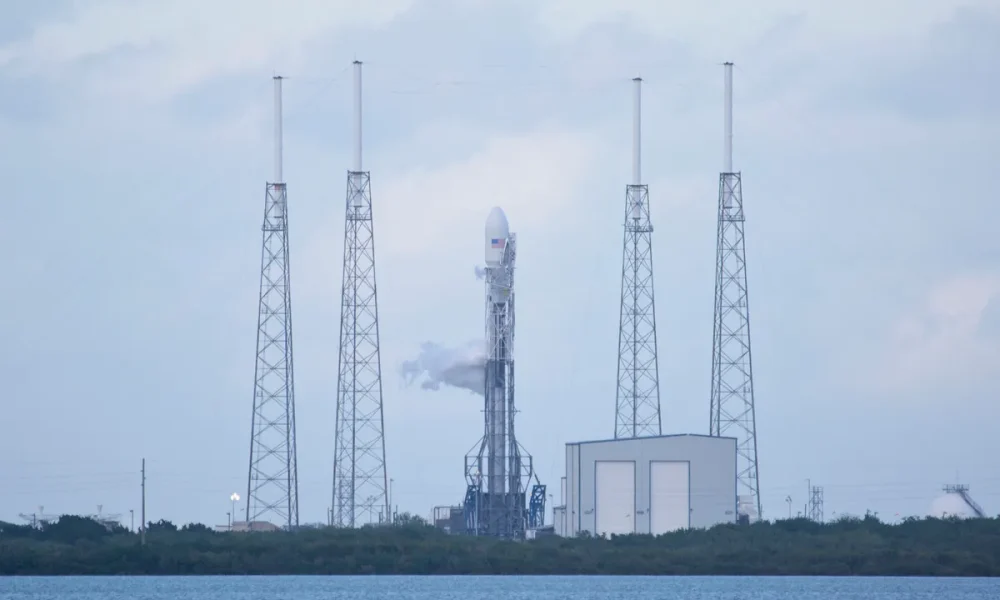
Scott Galloway, a professor at NYU’s Stern School of Business, has put a SpaceX stock price target of $10 to $30 on a company currently trading at $148, arguing that the share price has more to do with index mechanics than underlying business value. His view sits at the extreme end of a debate that has surrounded Space Exploration Technologies Corp. (SPCX) since its June 2026 listing, but the filing data provides more support for his structural argument than the headline figure alone might suggest.
What the IPO Filing Reveals About Float and Control
The 424B4 prospectus filed with the SEC on 11 June 2026 shows that SpaceX offered 555,555,555 shares of Class A common stock at $135.00 per share, with underwriters holding an option on a further 83,333,333 shares. After the greenshoe was exercised, CNBC reported the total IPO raised $85.7 billion, making it one of the largest listings on record. The stock’s first trade was at $150 per share and it reached a closing high of $201.80 on 16 June before pulling back.
Despite that float, Elon Musk retained approximately 82.4% of the voting power immediately after the offering, with roughly 81.1 percentage points of that attributable to his Class B common stock, which carries ten votes per share. SpaceX qualifies as a controlled company under Nasdaq corporate governance rules as a direct result. The public float, in other words, is large in dollar terms but thin in governance terms, and it was thin enough to make index inclusion a mechanically distorting event.
Under Nasdaq’s revised Fast Entry rule, which came into force on 1 May 2026, newly listed companies ranked in the top 40 of the Nasdaq-100 by market cap can join the index in as few as 15 trading days. The previous 10% minimum public float requirement was eliminated, allowing low-float stocks to receive a weighting multiplier of up to three times their actual float. Approximately $1.4 trillion in capital tracks the Nasdaq-100. SpaceX was included less than a month after its debut. That is precisely the forced-buying dynamic Galloway identified.
The Bond Sale and the Capital-Intensity Argument
Galloway’s second line of attack concerns the $25 billion bond offering SpaceX completed around the time of its IPO. The deal was initially announced at $20 billion and upsized to $25 billion after demand reached nearly $90 billion in orders. Raising that volume of debt while sitting on total fair-value assets of $100,839 million as of 30 June 2026, per the Q2 2026 10-Q, is an unusual combination. His reading is that it signals a capital-intensive AI infrastructure business, not a space company with surplus cash.
The bond market, at least, was not alarmed. Bloomberg reported that the 2036 tranche priced at a spread of 1.4 percentage points above Treasuries, around 0.4 percentage points wider than the average on similarly rated BBB-tier debt. Credit-rating firms described SpaceX as a solid investment-grade company. That framing, solid and investment-grade, sits awkwardly with any thesis that the equity is worth a tenth of its current price. The debt market and the equity market are, at minimum, pricing very different versions of the same business.
It is also worth noting that SpaceX’s consolidated financials were recast to include X.AI Holdings Corp., acquired effective 2 February 2026, and X Holdings Corp., acquired by xAI on 28 March 2025. Both transactions involved entities under common control. A five-for-one stock split also took effect on 4 May 2026. The reported numbers, and the market-cap arithmetic that flows from them, reflect this restructured perimeter.
Where the Valuation Sits
Galloway said clearly he would not bet against the stock: Musk’s capacity to generate investor enthusiasm around a new project is, in his view, a legitimate risk to any short position. That is a candid qualifier from someone with a $10 to $30 target.
The valuation numbers are harder to dismiss. With a market cap of $2 trillion against forecast sales of around $45 billion this year, SpaceX trades on a forward price-to-sales ratio of roughly 44. For context, the original article’s author noted Nvidia carries a forward price-to-sales of around 13, and Amazon sits at around 3. A ratio of 44 prices in years of uninterrupted growth and near-flawless execution, with no margin for operational setback.
Galloway’s $10 to $30 range implies a drawdown of 80% to 93% from current levels. That is a structural bear case, not a near-term trading call. Whether the xAI integration, the Starlink subscriber base, or the AI compute business can eventually justify the current multiple is the question the next several earnings cycles will begin to answer. The first quarterly results as a public company are the earliest test of whether the revenue cadence matches the price being paid today.


 Bitcoin
  Ethereum
  Tether
  BNB
BNB  USDC
USDC  XRP
XRP  Solana
  TRON
TRON  Lido Staked Ether
  Cardano
  Gram (prev. Toncoin)
  Avalanche