
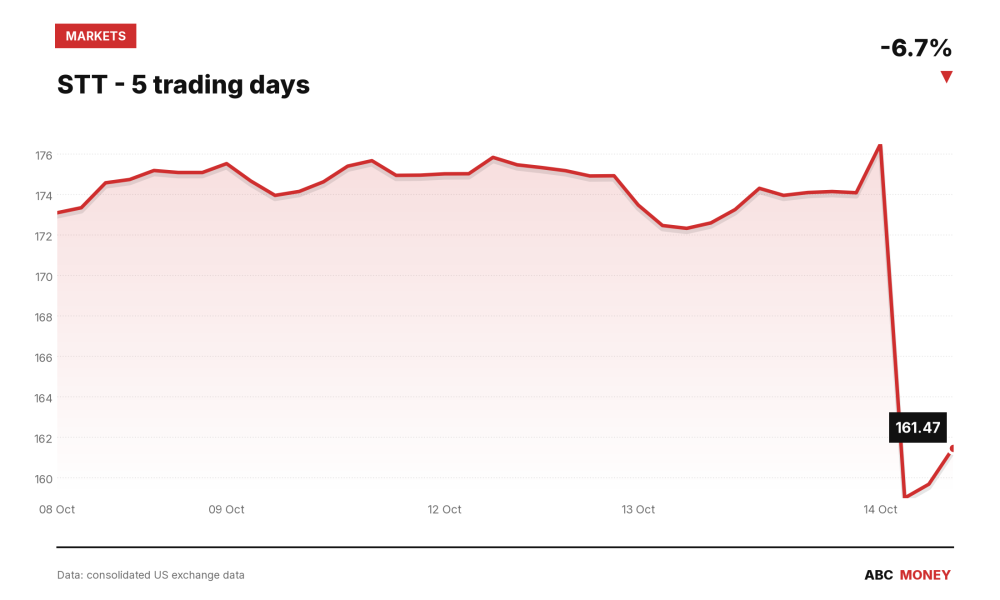
State Street Corporation (NYSE: STT) beat Wall Street’s profit estimates for the third quarter of 2026 – and still, State Street shares fell more than 7% on the day, as investors zeroed in on a revenue shortfall instead of the headline number.
The custody and asset-servicing bank reported diluted earnings per share of $3.69, ahead of analyst estimates clustered between $3.62 and $3.68, enough for Zacks to flag the firm as a clear earnings beat. Net income came in at roughly $1.09bn, up from $1,084m in the second quarter and well ahead of the $861m posted a year earlier.
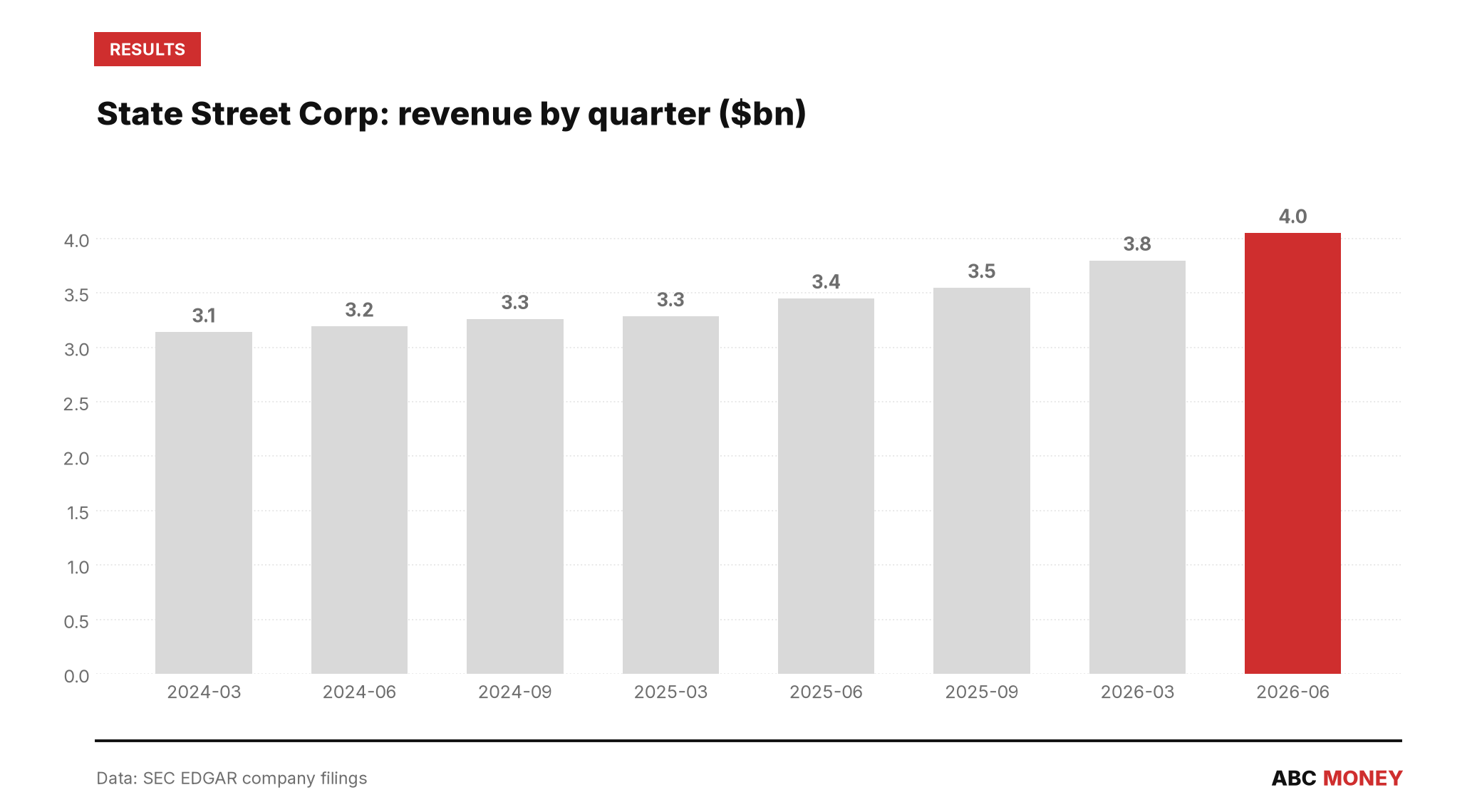
That is the problem with reading the quarter as a simple win. Revenue of about $4.00bn, though up 13% year-on-year, landed roughly $40m short of what the Street had pencilled in – a gap small in percentage terms but large enough, apparently, to unsettle a market that had bid the stock up into the print.
Why State Street shares fell despite the beat
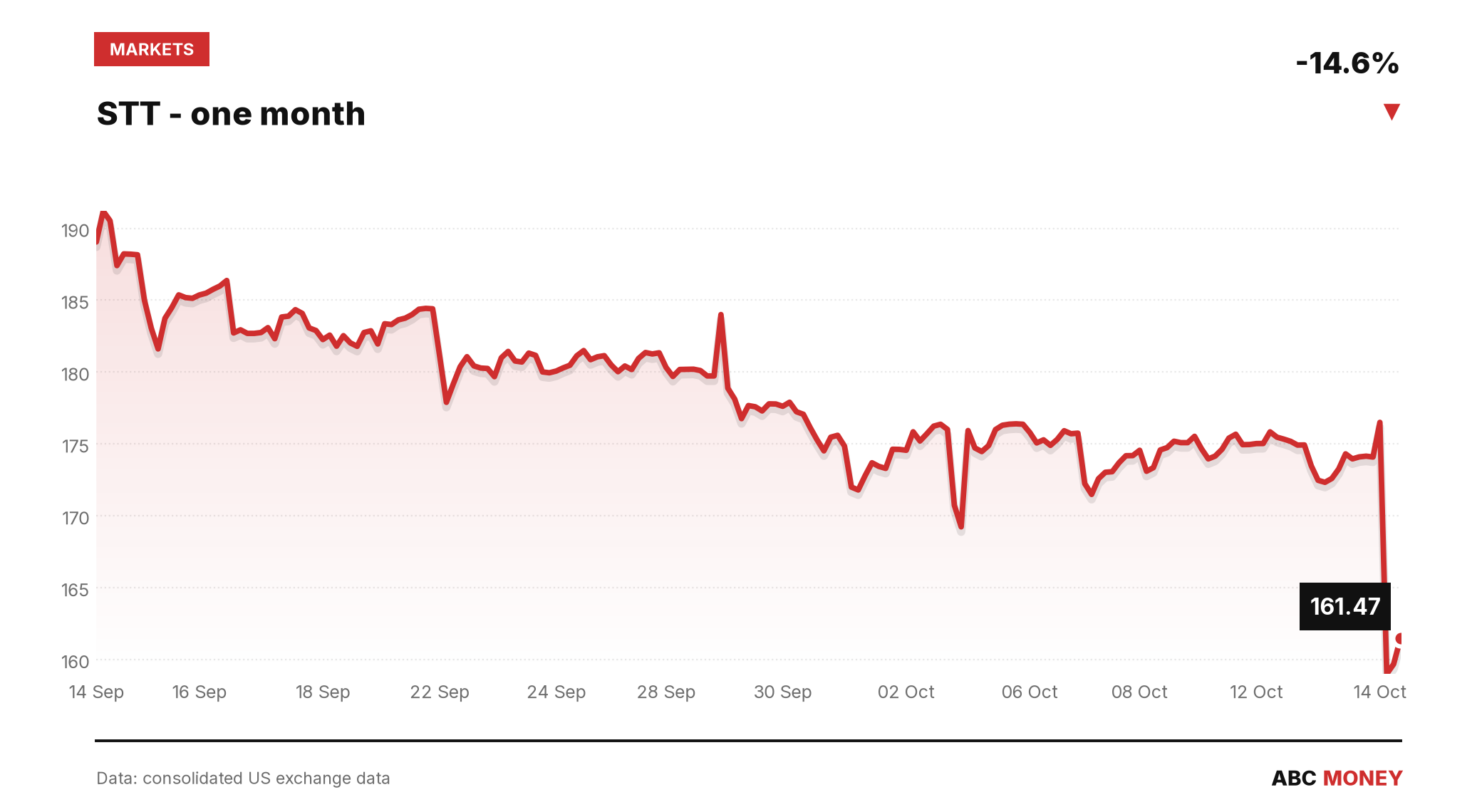
The reaction was not subtle. The results were released before Wednesday’s opening bell, and shares that had closed the prior session at $174.10 traded as low as $159.00 in pre-market dealing, an implied drop of 8.6%. By early afternoon the stock had settled at $161.6525, down 7.07% on the day and 10.9% over the preceding 20 sessions – wiping out essentially all of the month’s prior gains in a single session, against a 20-day trading range of $159.00 to $184.00.
Context matters here. Assets under management reached a record $6.31 trillion, up 15.8% year-on-year, while assets under custody and administration hit $59.2 trillion, up 15%. Those are the metrics that underpin State Street’s long-term fee story, and on their own they would normally read as unambiguously good news. The share-price reaction suggests investors were weighing something else: whether top-line growth is now decelerating from the pace set earlier in the year, even as costs and headcount keep pace with a larger balance sheet.
The quarterly trend makes the deceleration argument easier to see. Diluted EPS ran at $2.49 in the first quarter of 2026, jumped to $3.65 in the second, and then $3.69 in the third – still rising, but the rate of improvement has flattened noticeably compared with the jump between Q1 and Q2. Net income followed a similar arc: $764m, then $1,084m, then roughly $1.09bn. A beat built on a plateau reads differently to a market than a beat built on acceleration.
A higher-rate backdrop cuts both ways
State Street’s fee and net-interest income engines both lean on the interest-rate environment, and that backdrop has stayed firm. The 10-year US Treasury yield stood at 5.24% on 9 October, up slightly from 5.22% the prior reading, keeping short-term money market and securities-lending spreads attractive for custody banks even as it raises funding costs elsewhere on the balance sheet. A yield curve that remains only modestly positively sloped – the 10-year/2-year spread was 0.42 percentage points as of 13 October – continues to squeeze the kind of maturity-transformation profits that trust banks once relied on more heavily, pushing firms like State Street further toward scale-driven fee income, which is exactly the line that disappointed this quarter.
Separately, a State Street insider, Karl Alexander Vollert, filed a Form 4 with the SEC the day before results were published. The filing does not disclose share counts or transaction values, so it offers no readable signal either way about executive positioning heading into the report – worth noting, not worth over-reading.
What the beat obscures
The core tension of this result is straightforward: an EPS beat and record assets under management are genuinely strong operating signals, but they were not what moved the stock. A roughly $40m revenue miss against consensus – on a base of $4bn – was enough to trigger a near 9% intraday swing at the open, a reaction size that looks disproportionate to the underlying number unless investors are repricing the growth trajectory itself rather than the quarter in isolation. State Street’s shares had been trading near the top of their 52-week range heading into the print, which left plenty of room to give back once sentiment turned.
For shareholders, the more useful number to track from here may not be this quarter’s EPS line at all, but whether revenue growth in the fourth quarter reaccelerates back toward the 13-15% range the bank posted through the first half of 2026, or settles into the single digits implied by this quarter’s miss. That is the distinction the market seemed to be pricing on Wednesday, and it is the one that will decide whether this sell-off proves a one-day overreaction or the start of a reassessment.
This article is for information only and is not investment advice or a recommendation to buy or sell any asset. Markets move quickly; figures are correct as sourced at the time of writing. Always do your own research before making financial decisions.

 Bitcoin
  Ethereum
  Tether
  BNB
BNB  USDC
USDC  XRP
XRP  Solana
  TRON
TRON  Lido Staked Ether
  Cardano
  Gram (prev. Toncoin)
  Avalanche