
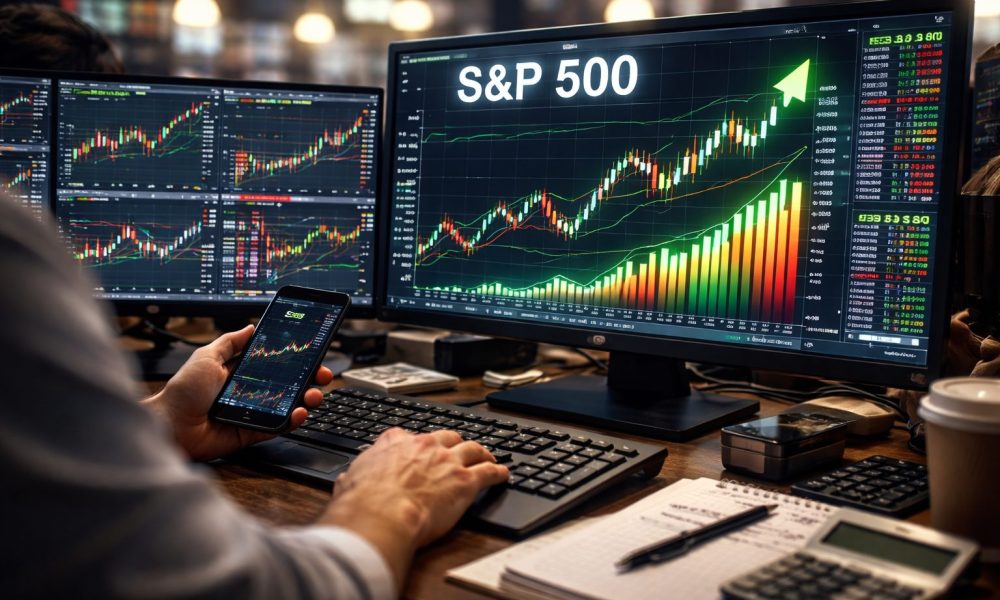
Five hundred companies. That’s all it takes to capture roughly 80% of the entire United States stock market’s value.
The Standard & Poor’s 500 Index, launched in 1957, has evolved from a market measurement tool into the single most influential benchmark in global finance. When analysts say “the market” rose or fell, they almost always mean these 500 large-cap firms. When pension funds measure performance, they compare against this index. When Warren Buffett recommends where ordinary investors should put their money, he points here.
But what actually makes it onto this list?
The committee at S&P Dow Jones Indices selects companies based on market capitalisation, liquidity, and sector representation. It’s not simply the 500 biggest firms by revenue or profit. Float-adjusted market capitalisation determines weighting—meaning only shares available for public trading count, excluding insider holdings and restricted stock. Apple or Microsoft, with trillion-pound valuations, move the index far more than smaller constituents.
The index spans eleven sectors: information technology, healthcare, financials, consumer discretionary, consumer staples, energy, industrials, materials, communication services, utilities, and real estate. This breadth insulates it from single-industry collapses, though technology’s dominance in recent years has concentrated risk in ways the 1957 architects never imagined.
That 1957 launch marked a turning point. Before then, market averages were narrower, less representative. Standard & Poor’s—the financial data firm behind the index—wanted a broader snapshot of American economic activity. The number 500 was deliberate: large enough to capture market diversity, manageable enough to track accurately in an era before algorithmic rebalancing.
The list isn’t static.
Companies get added when they grow large enough or removed when they shrink, merge, or collapse. Tesla’s inclusion in December 2020 triggered billions in index fund purchases, illustrating how committee decisions ripple across markets. The mechanics are simple: index funds tracking the S&P 500 must buy what’s added and sell what’s removed, regardless of valuation.
So who actually trades this thing?
Retail investors hold it through exchange-traded funds and mutual funds, often as core retirement holdings. Vanguard popularised low-cost index investing in the 1970s, and BlackRock’s iShares now manages hundreds of billions tracking this single benchmark. For these investors, the horizon stretches across decades. They’re buying American economic growth, compounded.
Traders operate differently. E-mini S&P 500 futures contracts, traded on the Chicago Mercantile Exchange, let professionals and speculators bet on intraday price swings with leverage. A day trader in London and a pension fund in California both interact with the same 500 companies, but their psychology couldn’t be more different. One watches minute-by-minute charts. The other checks quarterly statements.
Hedge funds deploy options strategies, pension funds rebalance portfolios, and swing traders hunt multi-day moves using technical indicators—moving averages, relative strength index readings, momentum signals. The same index serves as a wealth-building vehicle for grandparents and a volatility instrument for professional speculators.
The dual nature creates tension. Is the S&P 500 a reflection of economic fundamentals or a trading instrument divorced from underlying business performance? Both, simultaneously. Earnings reports and Federal Reserve policy announcements move it. So do algorithmic trading patterns and options expiry dynamics.
Historically, the index delivered average annual returns between 8% and 10% before inflation. But averages deceive. The 2008 financial crisis erased trillions in months. The subsequent bull market restored losses and pushed valuations to record highs. Between those extremes, investors faced drawdowns severe enough to trigger panic selling—precisely when long-term strategy mattered most.
Buffett’s recommendation wasn’t casual. He’s repeatedly suggested that most investors should buy low-cost S&P 500 index funds rather than attempt stock picking or pay high fees to active managers. His reasoning: over time, few professionals consistently beat the index after costs. The data supports him, though past performance guarantees nothing about future returns.
Inflation-adjusted returns tell a sobering story. Nominal 10% becomes real 7% or less after accounting for rising prices. Still, compared to bonds yielding 3% or savings accounts offering fractions of a percent, equities historically provided superior long-term growth. The trade-off is volatility—the stomach-churning drops that separate long-term holders from those who sell at the bottom.
Risks cluster around concentration and correlation. Technology companies now represent roughly 30% of index weight, meaning sector-specific shocks reverberate across the entire benchmark. Interest rate hikes hit all equity valuations simultaneously. Geopolitical instability spares no constituent. Recession threatens earnings across sectors.
Yet liquidity and transparency remain unmatched. Trillions in daily trading volume mean tight bid-ask spreads and easy entry or exit. Decades of performance data enable statistical analysis. Regulatory oversight by the Securities and Exchange Commission provides structural integrity absent in less-developed markets.
The methodology itself evolved. Originally, market cap weighting was revolutionary—letting market forces rather than arbitrary selection determine influence. Float adjustment refined this further, ensuring the index reflected only tradable shares. Quarterly rebalancing keeps weightings aligned with current valuations.
Compare this to the Dow Jones Industrial Average, which tracks just 30 companies using price weighting—a methodology widely considered outdated. Or the NASDAQ Composite, heavily skewed toward technology. Or the Russell 2000, focused on small-cap firms. Each serves a purpose, but none matches the S&P 500’s combination of breadth, liquidity, and institutional acceptance.
For portfolio managers, underperforming the S&P 500 consistently raises uncomfortable questions. Why pay active management fees if the result trails a passive index? This pressure reshaped the asset management industry, driving hundreds of billions from active funds into passive vehicles over the past two decades.
The psychological gap between investor types matters. A retiree holding an S&P 500 fund through a workplace pension experiences volatility as numbers on a quarterly statement. A futures trader using leverage experiences the same volatility as existential threat or opportunity, depending on position direction. Same index, radically different reality.
Technical traders overlay charts with indicators, hunting patterns they believe predict short-term moves. Fundamental analysts study macroeconomic data, earnings growth, and valuation metrics. Both approaches influence price, creating feedback loops where chart patterns become self-fulfilling and economic data surprises trigger algorithmic responses.
The index reflects collective intelligence—millions of market participants making billions of transactions based on information, emotion, and strategy. It’s not rational in the academic sense. It’s adaptive, responding to new information faster than any individual could process.
What’s certain: the S&P 500 will continue evolving. Companies will rise and fall. Sectors will rotate in dominance. Technology may give way to healthcare or energy or industries not yet imagined. The committee will adjust. The index will reflect those changes, as it has since 1957.
Whether approached as a decades-long compounding vehicle or a short-term volatility play, it rewards discipline over speculation and probability over emotion. The question isn’t whether the S&P 500 is a good investment in the abstract. The question is whether it aligns with your time horizon, risk tolerance, and understanding of how markets actually behave when theory meets reality.



 Bitcoin
  Ethereum
  Tether
  BNB
BNB  USDC
USDC  XRP
XRP  Solana
  TRON
TRON  Lido Staked Ether
  Cardano
  Gram (prev. Toncoin)
  Avalanche