Bitcoin
  Ethereum
  Tether
  BNB
BNB  USDC
USDC  XRP
XRP  Solana
  TRON
TRON  Lido Staked Ether
  Cardano
  Gram (prev. Toncoin)
  Avalanche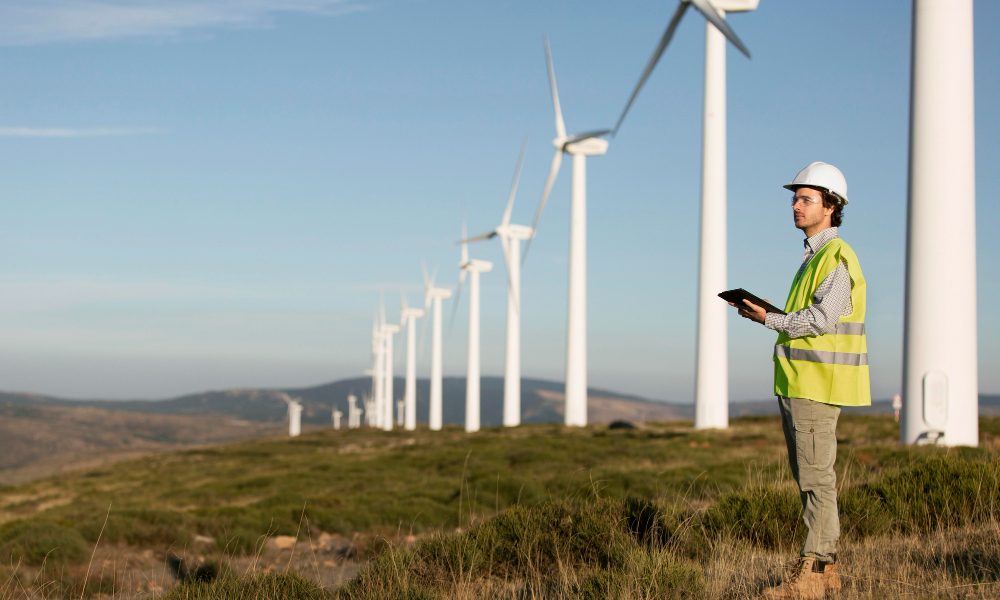
The prairie wind in southern Alberta has a certain quiet authority on some mornings. It spins rows of white turbines that stretch like mechanical sunflowers toward the horizon, and it bends tall grass in long silver waves. It’s easy to see why this area has become one of North America’s clean-energy success stories when you stand close to Pincher Creek at dawn and watch those blades spin slowly against a pale sky. However, a new narrative has recently emerged here, one that is both intriguing and a little unnerving. It concerns data centers, artificial intelligence, and an increasing concentration of digital power.
With the relatively straightforward promise of cleaner electricity and a slow transition away from coal, Alberta has been building wind farms for years. When the wind cooperates, the province’s more than forty wind farms can produce thousands of megawatts. Grid data indicates that on certain nights, the total output of wind power briefly surpasses that of coal. Twenty years ago, when the first turbines appeared close to Cowley Ridge, that change would have seemed unlikely.
| Category | Details |
|---|---|
| Location | Alberta, Canada |
| Key Energy Source | Wind Power |
| Installed Wind Capacity | ~4,400 MW (approx.) |
| Number of Wind Farms | 40+ operational facilities |
| Major Wind Regions | Southern Alberta (Pincher Creek, Whitla, Halkirk) |
| Grid Operator | Alberta Electric System Operator (AESO) |
| Growing Industry | AI Data Centers and Cloud Infrastructure |
| Key Trend | Renewable power attracting large computing facilities |
| Reference Website | https://www.aeso.ca |
However, energy markets are rarely straightforward for very long.
Investors and tech firms have begun to view Alberta with a new level of excitement during the last two years. The province has plenty of wind resources, reasonably priced land, and a deregulated electricity market that permits private energy transactions. That combination suddenly looks appealing to businesses constructing massive AI data centers, which are facilities that use electricity at nearly ridiculous levels.
It turns out that data centers are coming in fast.
The early warning signs can occasionally be seen if you drive an hour outside of Calgary: new transmission lines stretching toward the horizon, utility trucks parked along gravel roads, and massive steel buildings rising from farmland. Rows of servers inside those buildings process enormous amounts of data, running cloud services, training AI models, and analyzing everything from stock markets to weather forecasts. A small town’s worth of electricity can be consumed by each building.
It seems as though Alberta’s wind farms are joining a much bigger machine as this expansion takes place.
Reliable renewable energy has emerged as a competitive advantage in the AI sector, although tech companies rarely publicly acknowledge this. The power required to run large computing clusters is astounding. Customers, regulators, and investors all want electricity to originate from low-carbon sources more and more. In a province where wind turbines are already common, wind farms provide a practical solution.
However, the reality on the ground is more nuanced. Every grid operator is aware of the unpredictable nature of wind power. Almost 2,800 megawatts of clean electricity were generated by Alberta’s turbines on one evening last year. After just a few hours, the wind abruptly stopped, causing the output to drop to a very small portion of its potential. Dozens of wind farms were essentially idle at one point.
The turbines did not move. It was a scramble for the grid.
For a family that makes coffee every morning, those variations are tolerable. The equation is different for a hyperscale data center with tens of thousands of processors. Stable power is necessary for continuous computing, so wind energy frequently needs to be supported by batteries, natural gas plants, or imported electricity. Promotional brochures hardly ever depict that reality.
The growing concentration of data infrastructure is what makes Alberta’s situation so fascinating. Numerous technology companies are investigating projects that would group large computing facilities close to renewable energy sources; some are well-known, while others are purposefully quiet. The concept is simple: construct in areas with flexible regulations and the lowest cost of electricity.
The modern economy is already subtly shaped by data centers. They operate the algorithms that increasingly direct daily decisions, store medical records, and oversee logistics networks. Critics occasionally characterize a small number of companies that control a significant portion of that digital infrastructure as a new form of authority, one that is more obscure than governments but nonetheless potent in their own unique way.
Although the term “data tyrants” may sound dramatic, it conveys a growing sense of unease.
The similarities to past technological booms are difficult to ignore. Open networks and democratized information were once touted by Silicon Valley. A few companies gained remarkable sway over public discourse, business, and communication over time. That pattern now seems to be being repeated by artificial intelligence, which is driven by massive server farms and trained on massive data sets.
The physical infrastructure is more important this time.
The prairie wind that rotates Alberta’s turbines may appear to be a representation of environmental advancement. And it is in a lot of ways. Only a small portion of the carbon emissions linked to coal or natural gas are produced by wind power. That accomplishment is worthy of praise.
However, power is always shaped by energy in surprising ways.
Industries invariably follow an area where electricity is plentiful. Sometimes it involves chemical manufacturing or the smelting of aluminum. It’s data these days. In the contemporary economy, data—collected, analyzed, and monetized—has emerged as one of the most valuable resources.
The link between these spinning machines and far-off server racks may appear abstract as you pass a wind farm at sunset, the turbines creating long shadows across open fields. However, the link is authentic. In the end, those blades power the algorithms influencing political messaging, financial markets, and digital life by capturing wind, producing electrons, and feeding transmission lines.
There’s a subtle feeling that Alberta has entered a worldwide experiment as you watch this develop from the prairie.
Clean energy is growing. Artificial intelligence is developing more quickly. A surprising alliance is emerging somewhere in the middle of those two trends, one that has the potential to change who controls the most valuable resource in the world: information.
It is unclear if Alberta’s wind will eventually strengthen local communities or concentrate power in the hands of a small number of powerful tech companies. However, the servers continue to hum, the turbines continue to turn, and the digital age continues to quietly and unrelentingly draw power from the prairie sky.