
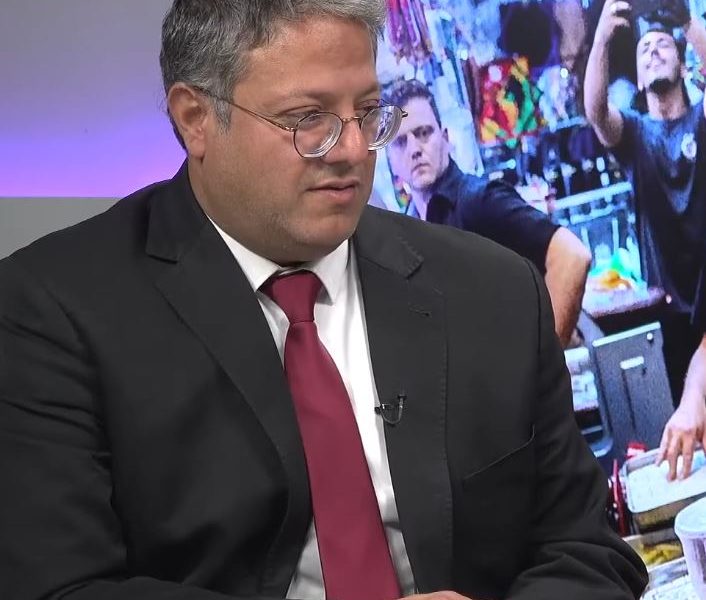
In Jerusalem’s government district, the office of Israel’s National Security Minister is located within a labyrinth of hallways that simultaneously exudes formality and tension. Itamar Ben-Gvir, one of the most contentious figures in contemporary Israeli politics, is somewhere in the middle of the daily commotion as guards move stealthily through the building and journalists wait outside doors.
It’s difficult to ignore how improbable the journey appears on paper when observing Ben-Gvir’s ascent over the last ten years. He wasn’t a traditional politician at first. His early public persona was that of a fiery activist who would show up at demonstrations and make pointed remarks about national identity and security. He frequently stood outside rather than inside the political system during those years. However, that outsider image eventually became political capital.
| Key Information | Details |
|---|---|
| Full Name | Itamar Ben-Gvir |
| Born | May 6, 1976 |
| Birthplace | Mevaseret Zion, Israel |
| Position | Minister of National Security, Israel |
| Political Party | Otzma Yehudit (Jewish Power) |
| Profession | Lawyer, Politician |
| Education | Ono Academic College |
| Known For | Far-right nationalist political positions |
| Reference Website | https://www.britannica.com/biography/Itamar-Ben-Gvir |
Mevaseret Zion, a town outside of Jerusalem, is where Ben-Gvir was born in 1976. The familiar combination of pine trees, apartment complexes, and winding roads that define much of the region can be found in the hills surrounding the area. Even though his early career path appeared to be more suited for activism than high office, growing up there put him in close proximity to Israel’s political core.
Ben-Gvir practiced law before going into politics, regularly defending Jewish nationalist activists in Israeli courts. A reputation was established by the work. He was viewed by his supporters as a champion of those who were disregarded by the political establishment. He was viewed very differently by his detractors, who frequently characterized his ideology as extreme. Since then, the gap between those two interpretations has persisted.
His political breakthrough occurred when voters dissatisfied with Israel’s security situation began to support his party, Otzma Yehudit. In Israel, elections frequently result in complex coalitions, and Ben-Gvir’s group abruptly gained prominence in this setting. Although it’s not the biggest group in parliament, it can occasionally tip the scales.
Everything changed at that very moment. He joined the Israeli government in 2022 as Minister of National Security, a position in charge of internal security issues and police supervision. His position put him squarely in the middle of discussions concerning public safety, crime, and terrorism. It was a sense of validation for supporters. It immediately alarmed critics.
As one strolls through Jerusalem today, the topic of Ben-Gvir comes up in conversation. While negotiating traffic close to the Old City, taxi drivers make reference to him. In campus cafés, university students discuss his policies. His name is occasionally mentioned when talking about politics, even by street vendors selling coffee close to the Damascus Gate.
His style seems to be purposefully confrontational. He rarely exercises caution when speaking, and his remarks frequently elicit strong reactions both domestically and abroad. Some people think that’s exactly the point. After all, controversy frequently leads to increased political visibility.
Another look at how his public persona functions was provided by recent events. Amid growing tensions in the area, social media rumors recently circulated that Ben-Gvir had been killed or injured during missile attacks. Due to the disorganized information flow that comes with contemporary conflicts, the rumors spread swiftly over the internet.
His reply was blunt as usual. He ridiculed the rumors and affirmed his survival in a video message he posted online, using foul language to refute the claims. Even though the episode only lasted a few hours in the news cycle, it managed to convey something about the peculiar atmosphere that surrounds contemporary politics, where security threats, viral false information, and personality-driven messaging almost instantly collide.
Additionally, Ben-Gvir’s policies have garnered attention. Expanding the eligibility for gun licenses in specific Israeli communities is one of his most contentious proposals, which he claimed would improve civilian security. It is practical, according to supporters, in a nation under continual threat. Critics fear it could exacerbate tensions in already precarious areas.
Whether those policies will have the desired results is still up in the air. Israel’s security environment is complex, influenced by internal political pressures, shifting alliances, and decades of conflict. Even seasoned policymakers frequently find it difficult to forecast results.
Ben-Gvir has undoubtedly emerged as a pivotal figure in the nation’s political discourse. His current position within the government and his activist background combine to create a unique combination of official authority and outsider energy.
As his career develops, it seems that his impact goes beyond any particular policy. He is a symbol of a larger trend in Israeli politics, one that reflects deep security concerns, growing dissatisfaction, and a readiness among some voters to back more unyielding voices.
It’s unclear if that current will intensify or weaken over time. Elections, security incidents, and public opinion, which can change virtually overnight, have always shaped Israel’s politics. People like Ben-Gvir typically continue to be the focus of attention in that setting.
It’s easy to see how heated the political climate has become when standing outside the Knesset building on a sunny afternoon, with lawmakers rushing between meetings and reporters congregating near the entrance. Itamar Ben-Gvir, who is controversial, powerful, and frequently in the news, continues to operate somewhere in that whirlwind of controversy, cameras, and criticism.



 Bitcoin
  Ethereum
  Tether
  BNB
BNB  USDC
USDC  XRP
XRP  Solana
  TRON
TRON  Lido Staked Ether
  Cardano
  Gram (prev. Toncoin)
  Avalanche