
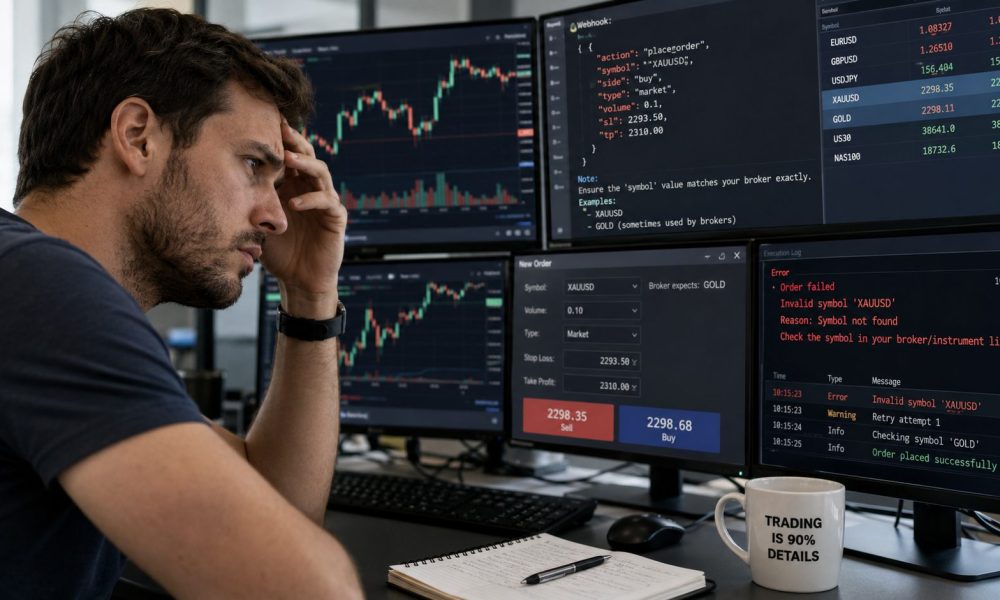
The TradingView alert landed at 9:47am. Gold had broken through resistance, the automated strategy triggered exactly as programmed, and the webhook fired toward the broker within milliseconds. By 9:48am, the trader checked his MT5 terminal.
Nothing.
No position. No error message. Just silence where a trade should have been.
This scenario plays out dozens of times daily across retail trading accounts—not because the market analysis was wrong or the strategy flawed, but because of a technical translation failure that most traders don’t even know exists. The alert system worked perfectly. The problem emerged in the 60-second window between signal and execution, where a message has to navigate symbol formats, volume conventions, and platform-specific rules that vary wildly across brokers and exchanges.
A webhook is just an HTTP request. It carries a message: “Here is a signal, do something with it.” What happens next depends entirely on how that message gets interpreted by the receiving system. TradingView might send an instruction for XAUUSD, but the connected broker could be expecting GOLD, XAUUSDm, or any number of proprietary symbol variations. To a human scanning a chart, these look like the same instrument. To an API processing an order, they’re completely different assets.
Volume translation adds another layer of confusion. One platform treats the value “1” as a full lot. Another interprets it as a single contract. Crypto exchanges might apply it to a completely different quantity model based on the specific asset and margin mode. A stop-loss parameter could mean an absolute price level on one system and a pip distance from entry on another. Send the wrong format, and the trade either fails silently or executes with parameters the trader never intended.
The trader was right about gold’s direction. The signal fired on time. But the execution arrived wrong—or didn’t arrive at all.
Multiple strategies running simultaneously on the same instrument compound the chaos. Suppose two separate algorithms are both trading gold, each with distinct take-profit and stop-loss logic. If the execution layer can’t distinguish which open position belongs to which strategy, a closing command from Strategy A might inadvertently modify or flatten a position opened by Strategy B. From the trader’s dashboard, everything appears functional—alerts are flowing, the server is responding, automation seems to be humming along. The structural problem only surfaces when real money disappears.
Crypto markets multiply these complications. Each exchange enforces its own rules for minimum order size, tick increments, leverage limits, margin mode configurations, and whether positions are handled as one-way or hedge mode. MT5 brings broker-specific symbol mappings, lot step restrictions, minimum volumes, and execution modes that vary by account type. Platforms like cTrader, TradeLocker, and DXtrade each demand their own technical handling.
A simple “TradingView to broker” webhook receiver no longer cuts it.
What traders need—and what’s driving development in services such as AlgoWay—is an intelligent routing layer that sits between the signal source and the execution venue. That layer has to parse the incoming message, identify the target platform, translate symbols and volumes into the correct format, submit the command, and report back with clarity when a broker rejects the order. It’s infrastructure work, invisible when it functions properly and catastrophic when it doesn’t.
Signal sources are diversifying beyond TradingView. Traders now pull instructions from Telegram channels, private groups, Python scripts, and AI-generated alerts. Sometimes the input isn’t even structured data—just a plain text message: “buy gold, SL 2315, TP 2330”. That sentence has to be interpreted, validated, and converted into a broker-compatible command before any execution can occur. It’s a parsing problem, then a translation problem, then a risk management problem.
The fundamental issue is straightforward: retail traders lose money not only from poor market analysis but from mismatched symbols, incorrect volume calculations, misunderstood stop-loss formats, and commands that touch the wrong positions. The strategy might be profitable in backtesting. The signal might fire with perfect timing. But if the technical layer between alert and execution fails, none of that matters.
TradingView alerts remain powerful. They’re fast, visual, and integrate cleanly with most charting workflows. But the alert itself isn’t the trade. The real determinant of whether a signal becomes a profitable position is what happens in the seconds after it fires—whether the message gets read correctly, checked for platform compatibility, translated into the right format, and executed exactly as intended. Miss any of those steps, and the trader’s account balance tells a very different story than the strategy’s theoretical performance.
For traders running automated systems across multiple brokers or exchanges, the execution layer has quietly become as critical as the strategy itself. Get the signal right but the symbol wrong, and the outcome is the same as getting the market direction wrong. The loss is real either way.



 Bitcoin
  Ethereum
  Tether
  BNB
BNB  USDC
USDC  XRP
XRP  Solana
  TRON
TRON  Lido Staked Ether
  Cardano
  Gram (prev. Toncoin)
  Avalanche