
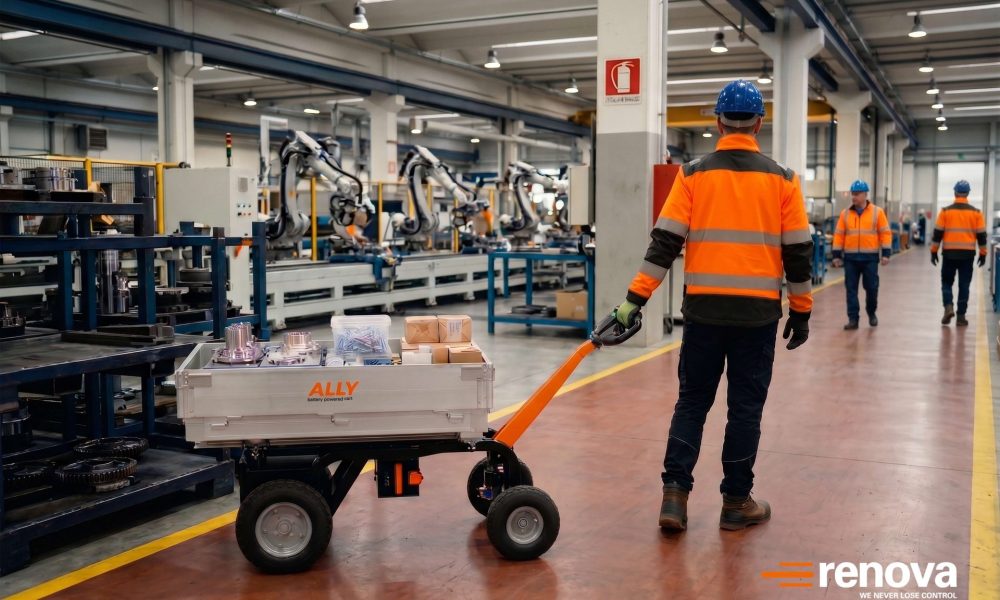
Here’s the thing — most production slowdowns don’t announce themselves. They creep in through small delays, repeated route corrections, and tired operators losing precision by the third hour of a shift. A battery-powered flatbed cart won’t fix your entire supply chain. But it might fix that.
Industrial facilities are under real pressure right now. Higher throughput, tighter spaces, shifting loads — the internal logistics picture gets messier every year. And yet the default solutions haven’t changed much: manual handling (exhausting at scale) or forklifts (often too bulky for the job). Neither was designed for the dense, multi-directional flow of a modern factory floor.
That gap is exactly where battery-powered flatbed carts have found their place.
The Problem Isn’t Weight. It’s Repetition.
Moving a 500kg load once isn’t hard. Moving it dozens of times per shift — across shared corridors, around production lines, in spaces that weren’t designed with carts in mind — that’s where things break down.
Fatigue sets in. Movements get less precise. Small hesitations stack up into measurable losses of productivity.
OSHA data backs this up: overexertion is consistently among the top causes of workplace injuries in material handling. Musculoskeletal disorders from repetitive tasks make up a significant chunk of industrial injury reports year after year. This isn’t fringe data — it’s the daily reality of warehouse and production staff.
Forklifts solve the strength problem but introduce new ones. Licensing requirements. Traffic coordination. Size constraints that make them awkward in anything tighter than a wide open bay. And for loads under a ton? Often complete overkill.
What “Operator-Assist” Actually Means in Practice
The Peerless Research Group’s 2025 Warehouse Automation & Order Fulfillment Study pointed to rising internal flow complexity as one of the key operational challenges facilities face — not just volume, but variability. Routes change. Priorities shift. People need tools that adapt, not systems that dictate.
That’s the pitch for operator-assist solutions: they sit between brute manual effort and full automation. No fixed paths. No infrastructure overhaul. No system integration projects that take six months and cost a fortune.
You plug it in. You use it. Done.
Renova built its Ally cart around exactly this idea. The battery-powered flatbed cart handles loads up to 1 ton and can tow up to 3.5 tons — which covers a wide range of industrial use cases without adding operational complexity.
A few details worth flagging:
The steering diameter is roughly 3.3 meters. Tight. That matters enormously in cramped production environments where a forklift simply couldn’t maneuver.
The lithium battery swaps out in seconds — one hand, no tools. That means continuous multi-shift use without waiting for a recharge cycle. For operations running two or three shifts, that’s not a minor feature; it’s the difference between a solution that works and one that creates bottlenecks.
There’s also an anti-crushing safety system that’s always active, reversing automatically if it hits an obstruction. Shared spaces, moving people, equipment in the way — the cart handles it.
And no operator license is required. That alone dramatically lowers the barrier to deployment.
Why Internal Transport Gets Neglected (Until It Doesn’t)
Manufacturing teams tend to focus optimization efforts on production processes — cycle times, machine utilization, quality rates. Internal logistics gets treated as background noise. Until something breaks.
A line runs short on components because a cart run was delayed. An operator strains their back on the fourteenth load of the day. A forklift clips a rack trying to navigate a corridor it was never quite right for.
These aren’t catastrophes. They’re friction — the quiet kind that compounds.
The real story with tools like Renova ‘s battery-powered flatbed cart isn’t transformation. It’s consistency. The movements become repeatable regardless of who’s operating the cart, at what point in the shift, or how the route varies. ISO 11228 ergonomic compliance means the physical demand on operators stays within safe limits — which means performance doesn’t fall off a cliff by hour six.
Fits Existing Layouts. No Rebuild Required.
One of the more practical aspects of this category of equipment is how easily it drops into existing operations. There’s no software to integrate. No facility modifications. No predefined paths to program.
That matters especially in food processing, pharma, retail distribution, and assembly — environments where processes evolve constantly and where “we’ll redesign the floor plan” isn’t a realistic answer to a handling problem.
The four-way folding platform on the Ally adds another layer of flexibility: different load configurations without dedicated setups. Small adjustment, real-world value.
As internal flows keep intensifying — and they will — the ability to perform movements with precision and reliability becomes less of a nice-to-have and more of a baseline operational requirement. Not through infrastructure investment or automation projects.
Sometimes, through a better cart.



 Bitcoin
  Ethereum
  Tether
  BNB
BNB  USDC
USDC  XRP
XRP  Solana
  TRON
TRON  Lido Staked Ether
  Cardano
  Gram (prev. Toncoin)
  Avalanche