
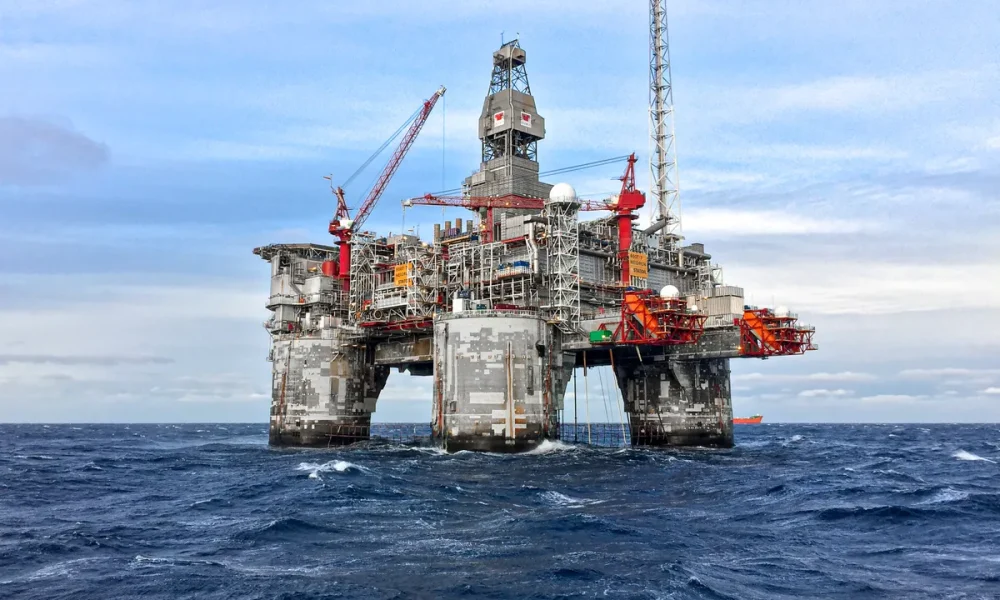
The BP share price has retreated to around 458p, some way off the 600p it briefly touched in March, and the gap between those two numbers tells only part of the story. The fuller picture involves a Q4 loss of $3,422 million, a third consecutive leadership change, and an oil market whose trajectory remains genuinely uncertain.
What the Numbers Actually Show
BP’s full-year 2025 underlying replacement cost profit came in at $7,485 million, down from $8,915 million in 2024, according to BP’s Q4 2025 Form 6-K filed with the SEC. The Q4 quarter alone produced an attributable loss of $3,422 million, driven largely by pre-tax impairments of $4.6 billion, most of which sat in the gas and low-carbon energy segment as BP wrote down transition-related assets.
Operating cash flow for the full year was $24,493 million, which remains a credible base for the dividend. Capital expenditure ran to $14,533 million, while divestment and other proceeds contributed $5,314 million. Net debt closed the year at $22,182 million, marginally below the $22,997 million recorded at end-2024. Management’s stated target is to bring net debt into a $14 billion to $18 billion range by 2027 through asset sales and a recalibrated buyback programme.
The dividend question has a wrinkle. The snippet cited $0.25 per share for 2025; the SEC filing records the full-year 2025 dividend at 32.960 cents per ordinary share, with the Q4 instalment alone at 8.320 cents. BP’s stated policy is to increase the dividend per ordinary share by at least 4% per year. At the current share price, the yield sits at about 5.7%, which is the primary reason income investors are still in the conversation at all.
Return on average capital employed for 2025 was 13.9%, down from 14.2% in 2024. Total equity stood at $74,000 million at the year end. The P/E ratio, at above 30 on the headline earnings number, reflects how thin full-year attributable profit was: just $55 million for 2025 against $381 million the prior year.
| Metric | FY 2025 | FY 2024 |
|---|---|---|
| Underlying RC profit | $7,485m | $8,915m |
| Operating cash flow | $24,493m | Not restated here |
| Net debt | $22,182m | $22,997m |
| ROACE | 13.9% | 14.2% |
BP Share Price Pressure and the Governance Overhang
The operational picture is complicated by boardroom upheaval that has no obvious precedent in BP’s recent history. Chairman Albert Manifold was removed on 26 May following a whistleblower report that revealed what the board described as a pattern of unacceptable behaviour, according to Reuters. Manifold had been in post for eight months. At BP’s AGM roughly a month before his removal, over 18% of participating investors had already voted against his reelection, the most substantial opposition against any board nominee up for election at that meeting. Senior independent director Amanda Blanc stated: ‘the board has been surprised and disappointed to learn of governance oversight and conduct issues it deems unacceptable and has taken decisive action.’
BP shares fell as much as 9% on the day of the announcement, according to CNBC. Activist hedge fund Elliott, which holds approximately 5% of BP, had backed Manifold. That alignment between the departing chairman and an activist pushing for faster restructuring adds another layer of uncertainty over strategic direction.
Meg O’Neill, who became CEO on 1 April 2026, is BP’s first external CEO hire in more than a century and the first woman to lead a top-five oil major, per Offshore Energies UK. She comes from Woodside Energy, where she oversaw the acquisition of BHP Petroleum International. Her stated plan involves reorganising BP into two core divisions centred on its energy operations, effectively reversing the renewables-led pivot that Bernard Looney set in motion in 2020, as Energy Digital reports. The Q4 impairments in transition businesses give that pivot numerical context.
Operations and the Cost Reduction Agenda
Beneath the noise there is genuine operational progress. BP’s upstream production reached 2.3 million barrels of oil equivalent per day in 2025, with bp-operated plant reliability at a record 96.1% for the full year. The proved reserves replacement ratio recovered to 90%, up from an average of around 50% in the prior two years. In 2025 BP also announced 12 exploration discoveries, including the Bumerangue find in Brazil, described by the company as its largest exploration discovery in 25 years, per the BP Annual Report.
Cumulative structural cost reductions since 2023 totalled $2.8 billion by end-2025, with a revised target of $5.5 billion to $6.5 billion by end-2027 following the announced sale of a 65% shareholding in Castrol. Capital expenditure is budgeted at $13 billion to $13.5 billion for 2026, down from $14,533 million spent in 2025.
The Oil Price Variable
Macro risk has not gone away. The US waiver on Iranian oil export sanctions has put modest downward pressure on Brent, and Iran holds an estimated 209 billion barrels of proved reserves. A sustained return of Iranian supply to global markets could weigh on the price deck that underpins BP’s cash generation. The snippet’s observation that a drift toward $50 per barrel Brent has historically preceded BP shares trading below 300p is the relevant tail risk; the current setup argues for watching the Brent curve closely over the next two quarters as the waiver period evolves.
The income case for BP at 458p is not frivolous. The cost reductions, the production reliability record, and a 5.7% yield provide a floor of sorts. But with the CEO in post for weeks, the chairman’s chair still warm, and the Elliott position an open question, the thesis requires patience that the next quarterly result may or may not reward.


 Bitcoin
  Ethereum
  Tether
  BNB
BNB  USDC
USDC  XRP
XRP  Solana
  TRON
TRON  Lido Staked Ether
  Cardano
  Gram (prev. Toncoin)
  Avalanche