Bitcoin
  Ethereum
  Tether
  BNB
BNB  USDC
USDC  XRP
XRP  Solana
  TRON
TRON  Lido Staked Ether
  Cardano
  Gram (prev. Toncoin)
  Avalanche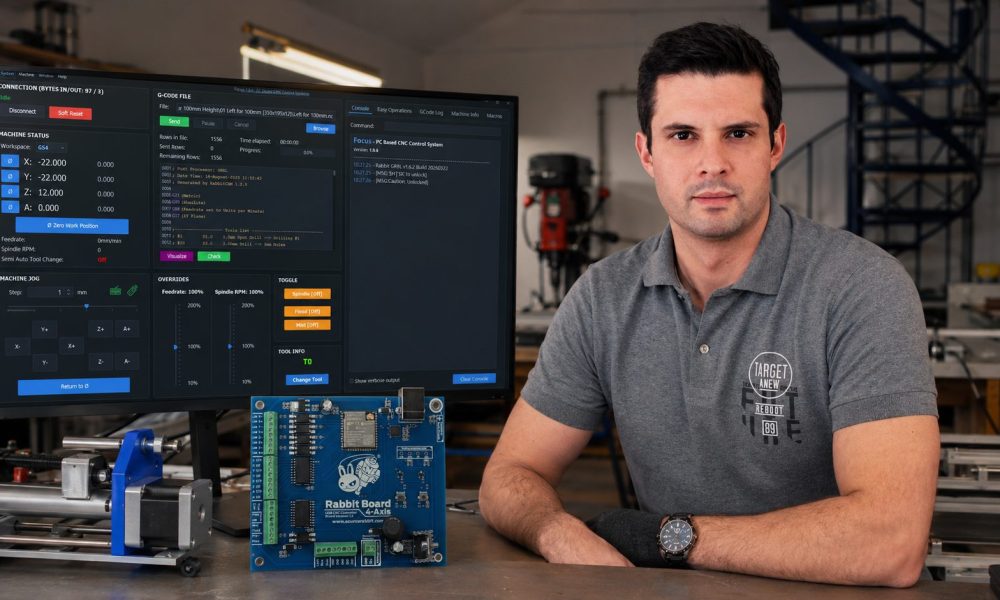
In the CNC industry, innovation does not always come from the largest manufacturers. Sometimes it comes from smaller engineering-led companies that work closely with the machines, software and practical problems users face every day.
SourceRabbit is one of those companies.
Led by Nikos Siatras, SourceRabbit is developing a CNC ecosystem that combines hardware, firmware and control software around one clear idea: CNC control should be reliable and accessible to small workshops, machine builders and developers.
For Siatras, this has never been only about creating another controller board. His work focuses on the complete path between the computer and the machine: the software that sends the job, the firmware that interprets commands and the electronics that generate motion signals.
That systems-level approach shaped the development of the Rabbit Board 4-Axis.
A Hands-On Approach to CNC Development
SourceRabbit approaches hardware, firmware and software as parts of the same workflow.
Siatras remains closely involved in product development, testing and the technical decisions behind the company’s CNC solutions. That hands-on role has given him direct exposure to real installation problems: electrical noise, unstable connections and the gap between hobby-grade electronics and the expectations of a working machine.
“CNC users do not experience hardware, firmware and software as separate systems,” Siatras explains. “They experience one machine. If any part of that chain is unreliable or difficult to use, the entire workflow is affected.”
This philosophy has influenced SourceRabbit’s broader direction. Instead of focusing on one isolated product, the company is building an integrated GRBL-based ecosystem combining motion-control hardware, firmware and desktop CNC software.
Why Reliability Matters in Small CNC Workshops
Small CNC machines operate near spindle motors, variable frequency drives, stepper drivers, power supplies and long signal cables. These components can introduce electrical interference. A controller that performs well on a clean test bench may behave very differently once installed inside a real CNC cabinet.
For small workshops, reliability is especially important. They often lack dedicated staff to diagnose intermittent faults. Lost steps, false limit triggers or unstable communication can stop production and consume hours of troubleshooting time.
SourceRabbit’s response is the Rabbit Board 4-Axis, a GRBL-compatible CNC motion controller designed to provide a more robust connection between the controller and the machine’s external drivers and sensors.
The board supports four-axis motion control and is intended for CNC routers, milling systems, custom machines and other applications using STEP and DIR signals. Its design includes buffered motion outputs and isolated inputs, features intended to improve signal integrity and protect the control side of the system from the electrically noisy machine environment.
More Than a Controller Board
The Rabbit Board 4-Axis matters to SourceRabbit not simply as a piece of hardware, but because it represents the company’s wider engineering philosophy.
A CNC controller should not force users to assemble a workflow from unrelated products with inconsistent documentation and different assumptions. Hardware, firmware and control software should be designed with an understanding of how each layer affects the others.
This is where SourceRabbit’s work on RabbitGRBL and Focus CNC Control Software becomes relevant. Together, these technologies reflect an effort to create a more coherent CNC control experience for users who want the flexibility of GRBL without giving up a structured, professional workflow.
For Siatras, that integration is a long-term strategy rather than a marketing feature.
“Our goal is not to make CNC technology more complicated,” he says. “It is to remove unnecessary uncertainty between the user and the machine. The controller should be dependable, the software should be clear and the entire system should work as a unified tool.”
A Small European Company with a Focused Mission
SourceRabbit’s size is part of what makes its approach distinctive. As a small European CNC technology company, it can develop products around specific user needs and make technical decisions without the layers of complexity often found in larger organisations.
That does not mean competing through scale. It means competing through focus, product knowledge and a closer relationship with the CNC community.
The company’s work also reflects a wider shift in digital manufacturing. Small workshops increasingly expect better control, clearer software and dependable machine operation. At the same time, technologies such as GRBL have made CNC development more accessible.
The opportunity is to build on that accessibility while improving the reliability of the final system.
Building an Ecosystem, Not a Single Product
The Rabbit Board 4-Axis may be one of the most visible parts of SourceRabbit’s CNC platform, but the larger story is about integration.
By working across electronics, firmware and CNC software, Nikos Siatras and SourceRabbit are addressing a problem familiar to many machine builders: how to create a system that remains flexible without becoming fragmented.
This is particularly relevant for small manufacturers and developers who need more than a basic controller but do not want the cost and complexity of a closed industrial platform.
SourceRabbit’s direction suggests that the future of small-machine CNC control will not be defined by hardware alone. It will depend on how well the entire ecosystem works together.
For SourceRabbit, that means continuing to develop CNC technology around practical workshop conditions, clear communication and reliable motion control.
It is a focused mission, but an increasingly important one: giving small workshops access to CNC control systems that feel less like a collection of components and more like a complete, dependable machine platform.