
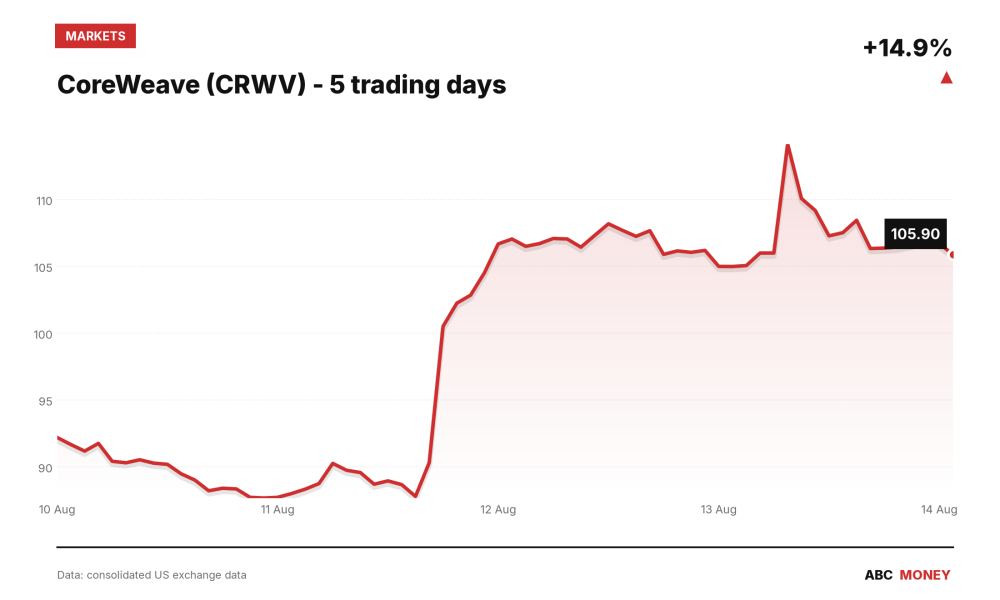
The CoreWeave stock surge that began with Tuesday’s earnings report was still running on Wednesday, as investors piled into the AI cloud-computing group on the back of a revenue beat, raised guidance and a backlog swollen by hyperscaler commitments. CoreWeave, Inc. (CRWV) closed at $90.32 on 11 August, the day it released second-quarter results, according to Timothy Sykes News, before extending its gains through Wednesday’s session.
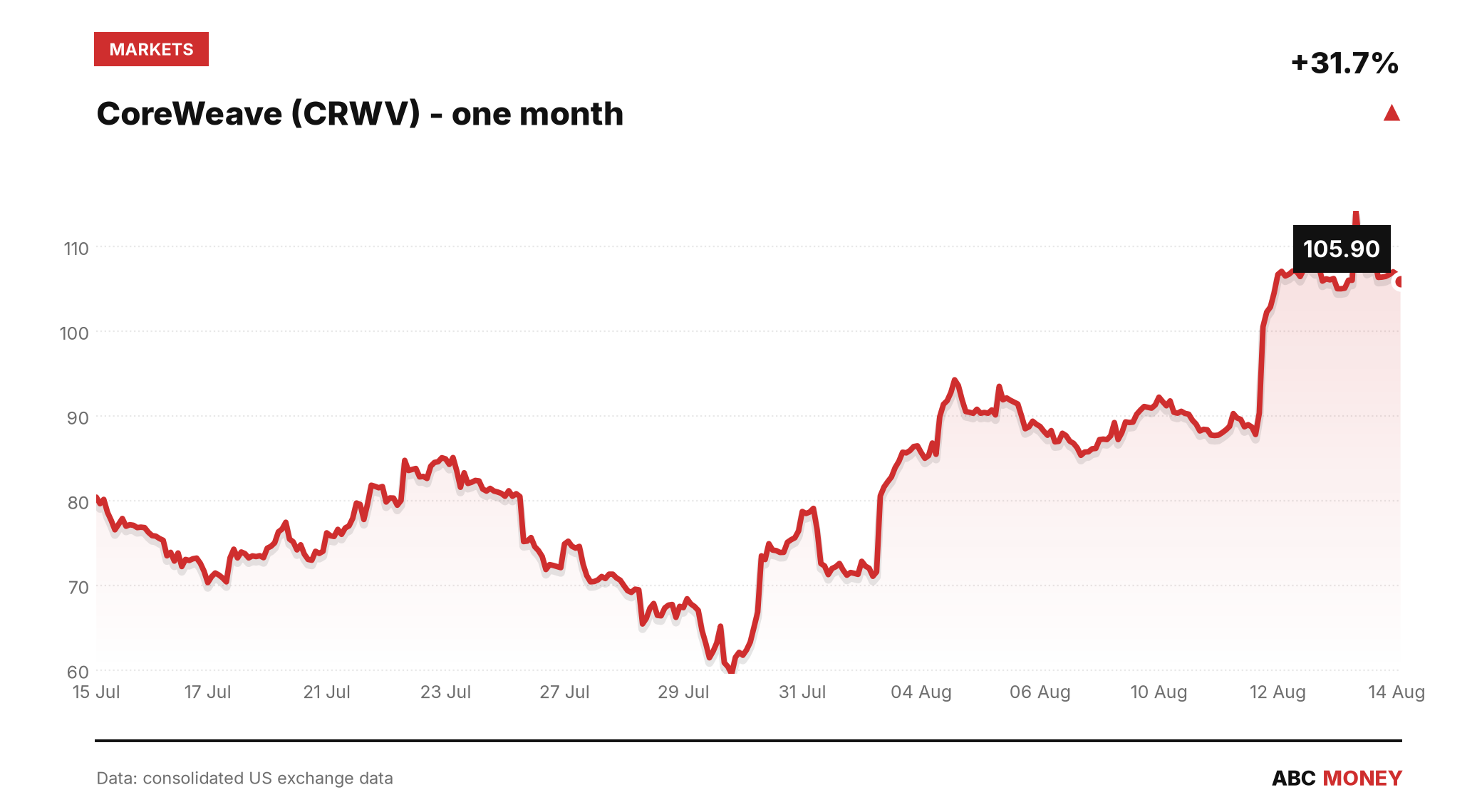
By Wednesday, shares had climbed roughly 17% since the filing to trade around $107 apiece, according to Finbold, which reported at least a dozen analyst price-target increases in the same session. That put the stock at a fresh 20-day high on volume more than three times its recent average — a sign the move was driven by genuine buying pressure rather than a thin, low-conviction bounce.
What drove the CoreWeave stock surge
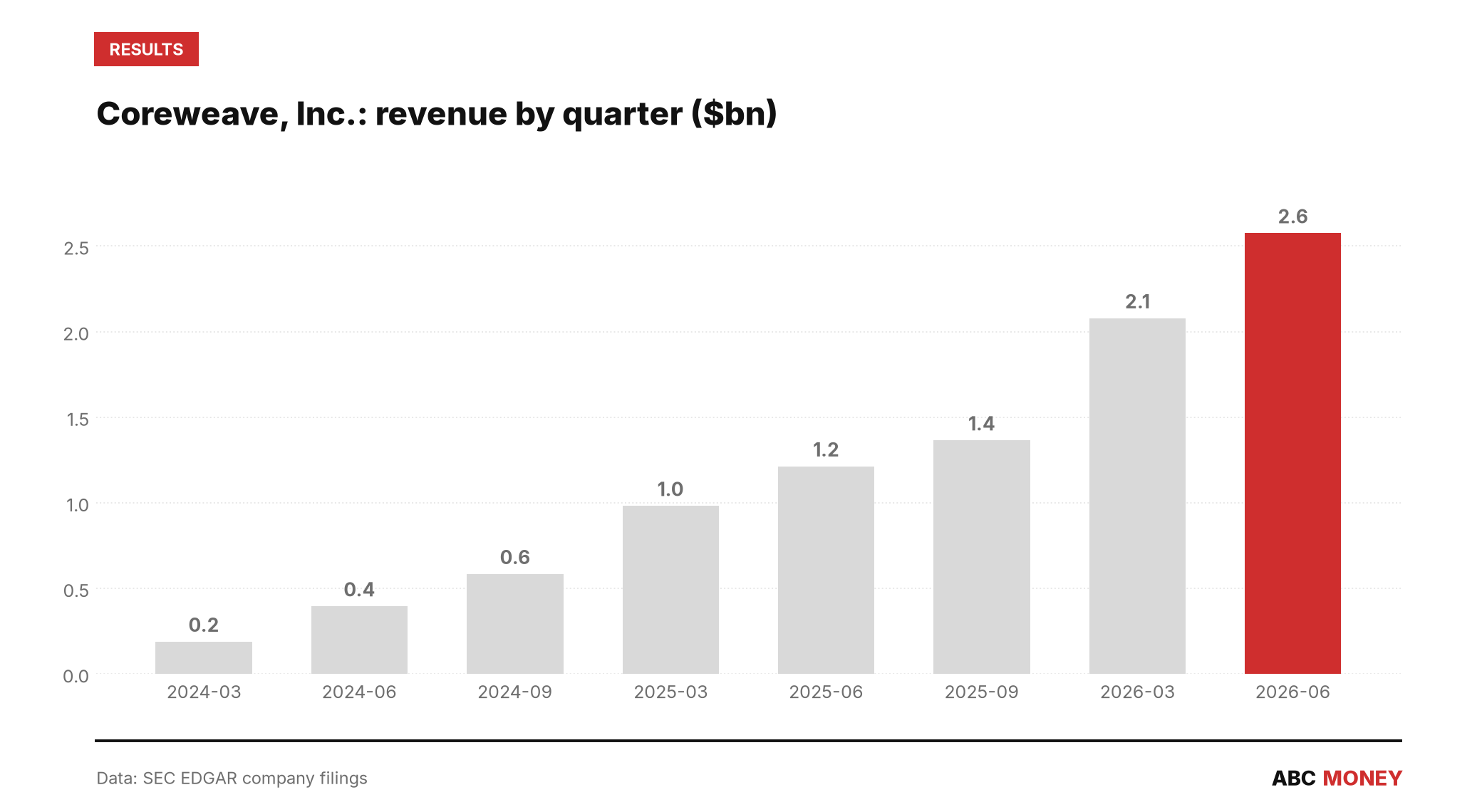
The numbers underpinning the rally were substantial. CoreWeave’s second-quarter revenue came in at $2.575bn for the three months to 30 June, according to its 10-Q filed with the SEC — up roughly 112% from $1.21bn in the same quarter last year. That beat Wall Street’s consensus estimate of around $2.56bn, and adjusted earnings per share came in at a loss of $1.03, ahead of the $1.20 loss analysts had pencilled in, according to CNBC.
Management also raised full-year revenue guidance to a range of $12.4bn to $13.2bn and disclosed a $104bn contracted backlog, which includes a $21bn commitment from Meta Platforms and a multi-year agreement with Anthropic, according to Seeking Alpha. For a company whose entire pitch to investors rests on being the infrastructure layer beneath the AI build-out, a backlog of that size — locked in by two of the sector’s most closely watched buyers — is the kind of forward visibility that tends to move a stock more than the quarter just gone.
Wall Street’s response was swift. Deutsche Bank lifted its price target to $150 from $135 while maintaining a Buy rating, according to Investing.com, one of roughly a dozen brokers to revise their targets upward on Wednesday.
The losses the CoreWeave stock surge is looking past
None of this changes the fact that CoreWeave remains deeply unprofitable on a GAAP (Generally Accepted Accounting Principles — the standard US accounting rules companies must follow in official filings) basis. The company reported a GAAP diluted loss per share of $1.14 and a net loss of $626m for the quarter, according to CNBC‘s reporting on the release. That follows a full-year net loss of $1.167bn on revenue of $5.131bn for 2025, per the company’s annual report filed with the SEC.
The gap between that GAAP reality and Wednesday’s share-price reaction is really the story here. Investors are not pricing CoreWeave on what it earned last quarter; they are pricing it on what its backlog implies about demand for AI computing capacity over the next several years, and on management’s own guidance that this demand is accelerating rather than plateauing. That is a defensible bet, but it is a bet on trajectory, not on current profitability — and it leaves the stock more exposed than most to any sign that hyperscaler capital spending on AI infrastructure is cooling.
Not every analyst is convinced
Morgan Stanley was the outlier among Wednesday’s dozen target revisions, keeping a Hold rating and a $99 price target — below where the stock was already trading, according to Finbold. It is a useful reminder that the earnings beat, however large, has not produced unanimous conviction on the sell side.
There was also a filing on Tuesday that some readers might mistake for a signal: CoreWeave’s chief operating officer, Sachin Jain, reported a $1.25m sale of 13,608 shares at $92.09 in a Form 4 filed with the SEC. But the sale was dated 10 August, the day before the earnings release, and reflects a routine restricted-stock-unit vest and tax-withholding transaction rather than a bet against the results, according to Investing.com‘s reporting on the filing.
Positioning data offers another angle on how the market was set up ahead of the print. FINRA’s daily short-sale volume ratio for CRWV ranged between 0.53 and 0.68 in the two weeks before earnings, according to FINRA data — a level consistent with normal trading activity rather than the kind of heavy short-covering (buying back borrowed shares to close a bet that the price would fall) that can exaggerate a post-earnings squeeze. That matters for how the rally should be read: this looks like a genuine repricing of CoreWeave’s growth prospects, not a short squeeze dressed up as one.
What happens next
The rally has also come against a slightly less accommodating rates backdrop. The 10-year US Treasury yield stood at 4.72% on 10 August, up from 4.65% previously, according to data from the Federal Reserve Bank of St Louis. Higher long-term borrowing costs typically weigh hardest on capital-intensive growth companies — a category CoreWeave firmly belongs to, given its business of leasing and operating data centre infrastructure — which makes the scale of Wednesday’s move more notable rather than less.
From here, the market’s attention shifts to execution: whether CoreWeave can convert its $104bn backlog into billed revenue at the pace implied by its raised guidance, and whether the capital spending that AI infrastructure demands keeps pace with the contracted demand. The next data points worth watching are CoreWeave’s progress against its active power capacity targets disclosed alongside the guidance raise, and whether the current run of upward analyst revisions continues or, as Morgan Stanley’s holdout suggests, starts to divide the sell side more evenly.
This article is for information only and is not investment advice or a recommendation to buy or sell any asset. Markets move quickly; figures are correct as sourced at the time of writing. Always do your own research before making financial decisions.


 Bitcoin
  Ethereum
  Tether
  BNB
BNB  USDC
USDC  XRP
XRP  Solana
  TRON
TRON  Lido Staked Ether
  Cardano
  Gram (prev. Toncoin)
  Avalanche