
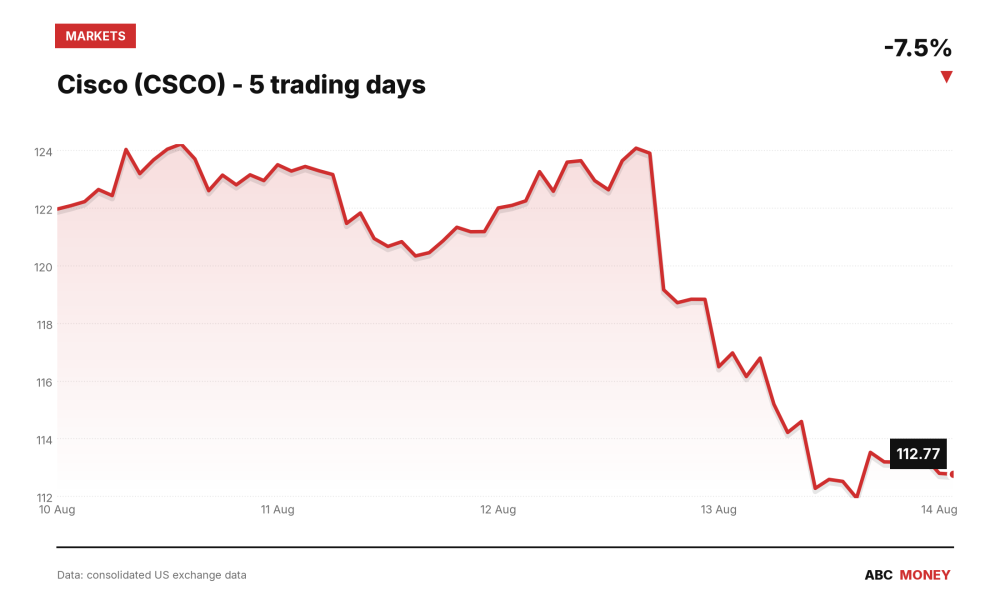
Cisco Systems (NASDAQ: CSCO) beat fiscal fourth-quarter estimates on Wednesday, but Cisco earnings after hours told two different stories, and same-day coverage never quite settled which one was right. That mismatch, more than any single number, is the real lesson from a busy session that also featured a newly public AI-chip maker sliding 16% and a smaller quantum-computing firm’s results getting lost in the noise.
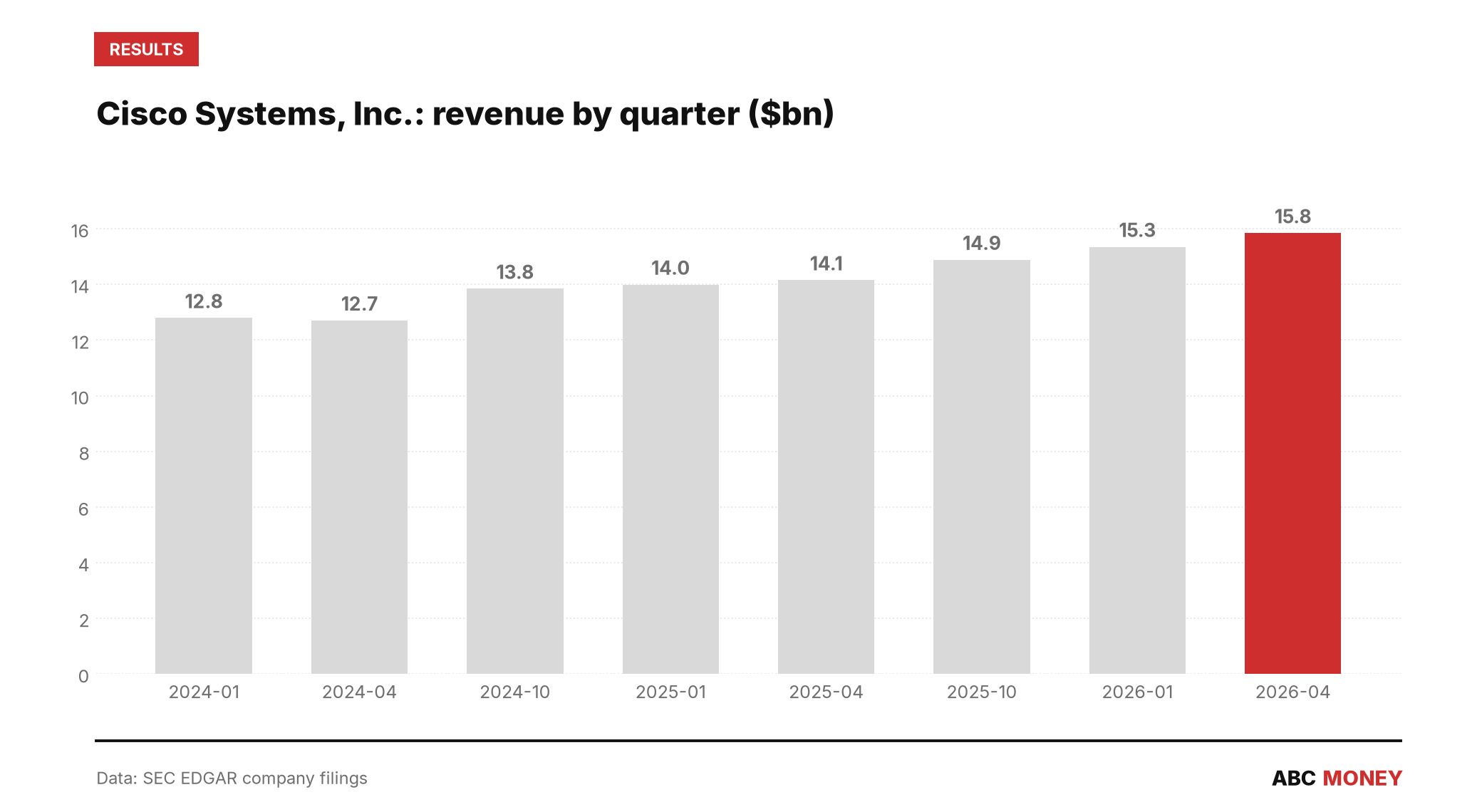
Cisco shares closed up 2.86% at $123.88 during the regular session, having traded as high as $124.45, after the company reported fourth-quarter revenue of $17.25bn, close to the $17.3bn the company itself announced, alongside GAAP net income of $3.9bn and non-GAAP net income of $4.9bn. Options markets had priced an 8.21% swing in either direction going into the print, according to Vantage Markets – one of the widest earnings-implied moves for the stock this year, and a sign traders expected fireworks.
A Cisco print, two contradictory tapes
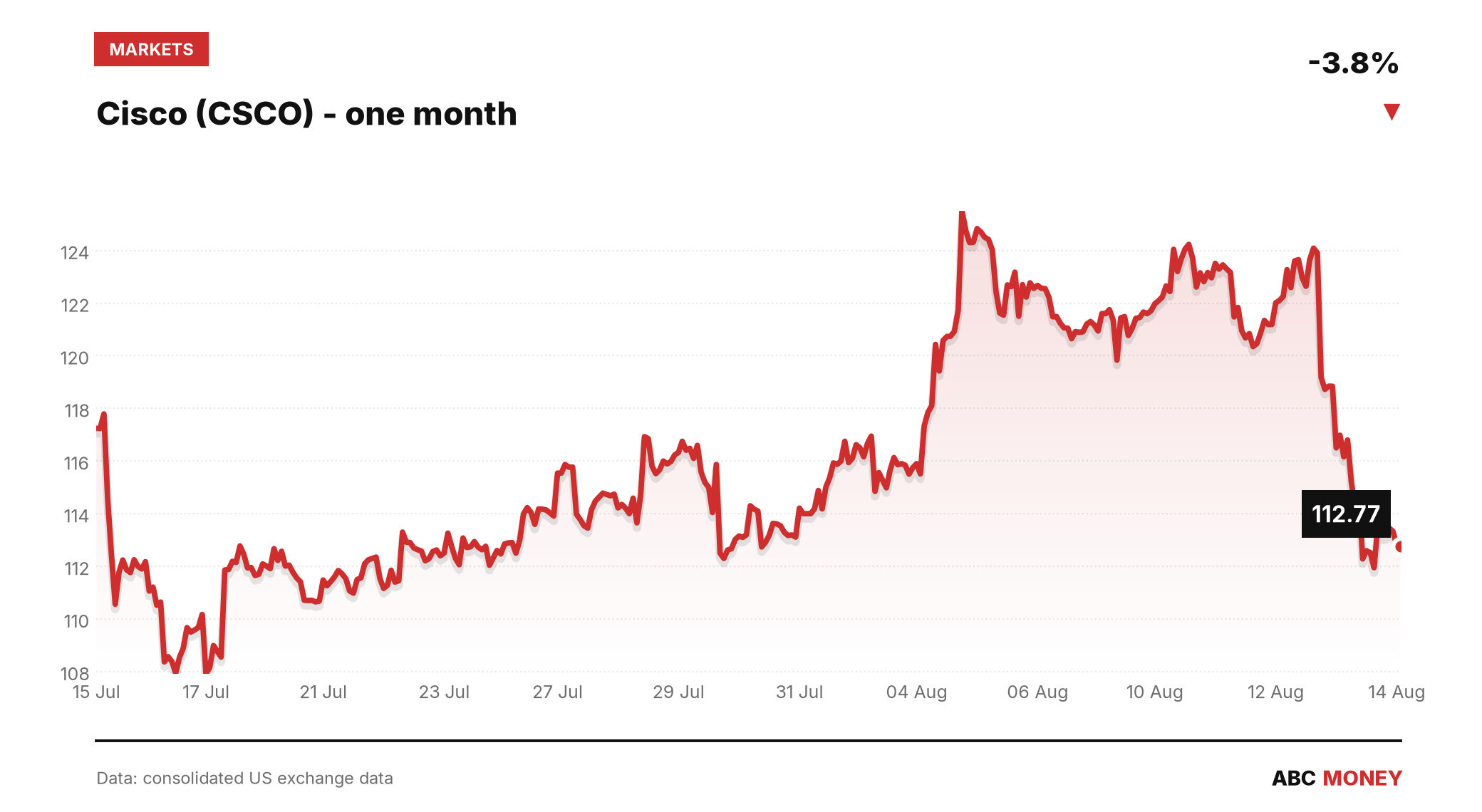
Here is where the story splits. The Benzinga roundup that sparked this piece put Cisco’s after-hours move at a 4.07% fall, to $118.84. But Robinhood’s market page, citing same-day coverage from 24/7 Wall St. and TipRanks, describes shares rising roughly 2.5% to 3% in extended trading on the back of the same results. Both cannot be correct, and nothing in the public record resolves which snapshot came first or which was simply stale by the time it published. For readers using these roundups to gauge sentiment in real time, it is a useful reminder that after-hours prices are moving targets, and a headline percentage from any single tracker deserves a second look before it shapes a view.
Underneath the price noise, Cisco’s own paperwork was busier than usual. Seven insiders, including chief executive Charles Robbins, filed Form 4s – the SEC disclosure insiders must submit within two business days of a trade in company stock – on the evening of the earnings release, a routine but closely watched cluster given the timing. Cisco also declared a quarterly dividend of $0.42 per share, payable 21 October 2026, a detail the original roundup omitted but one income-focused shareholders will want on record.
Cerebras: from IPO pop to a 16% slide
Cerebras Systems (CBRS), described by Yahoo Finance as the biggest initial public offering of 2026, surged nearly 70% on its debut before giving much of that back. By the most recent session in the pack, shares had fallen 16% over 24 hours to $218.53, even as the stock remained up 1.2% over the trailing 20 trading days – a swing consistent with the outsized first-week volatility that has become something of a pattern for AI-chip-adjacent listings this year. Volume ran at 2.79 times the 20-day average, and the stock’s 20-day range spans $168.60 to $263.06, underlining how unsettled the trading has been.
The company’s most recent 10-Q, filed with the SEC on 12 August 2026, showed second-quarter revenue of $180.1m for the three months to 30 June 2026, up from $103.3m in the same quarter a year earlier – both figures drawn from the same filing’s comparative period disclosure. FINRA’s daily short-sale data shows the short volume ratio – roughly, the share of daily trading volume attributable to short sellers, who profit if the price falls – drifting between 0.57 and 0.74 through late July and into mid-August, not an extreme reading but one worth watching as the post-IPO lock-up period unfolds.
Coherent’s cited move, and Infleqtion’s quiet report
Coherent (COHR) is credited in the roundup’s own scoring notes with a 7.0% move over 24 hours, the kind of jump that reliably puts a stock on retail traders’ radars. That figure, however, appears only in the original Benzinga piece itself; no separate market-data source in the available record independently confirms it, so it should be read as reported rather than verified. Infleqtion (INFQ) fares better on the paper trail: the company confirmed via Barchart that it reported second-quarter 2026 results on 12 August 2026, the same day as Cisco and Cerebras, which explains its inclusion in a roundup built around same-day catalysts even if the detail of those results sits outside this evidence set.
SpaceX doesn’t belong on a stock list
The original piece grouped SpaceX alongside four publicly traded names, but SpaceX has no listed ticker and isn’t included among the tradable symbols in the underlying data set. It is a privately held company; whatever news attached to it that day may be genuine, but it isn’t a stock story in the way Cisco, Cerebras, Coherent and Infleqtion are, and treating it as a fifth equity on investors’ radars overstates what retail traders can actually buy or sell.
The macro backdrop gave all four listed names something to react to. July’s consumer price index rose 3.4% year on year, easing from June, while the 10-year Treasury yield sat at 4.70% on 11 August and the 2-year at 4.22%, both little changed on the week, per FRED data from the Federal Reserve Bank of St. Louis. Market-implied odds of a September rate cut eased to 43% from 54.4%, a shift that tends to matter more for richly valued, high-growth names like Cerebras than for a cash-generative incumbent like Cisco. What to watch next: Cisco’s dividend payment date of 21 October, any follow-up filings from Cerebras as its post-IPO volatility settles, and whether a second earnings cycle brings Coherent’s cited move into sharper, independently verifiable focus.
This article is for information only and is not investment advice or a recommendation to buy or sell any asset. Markets move quickly; figures are correct as sourced at the time of writing. Always do your own research before making financial decisions.


 Bitcoin
  Ethereum
  Tether
  BNB
BNB  USDC
USDC  XRP
XRP  Solana
  TRON
TRON  Lido Staked Ether
  Cardano
  Gram (prev. Toncoin)
  Avalanche