
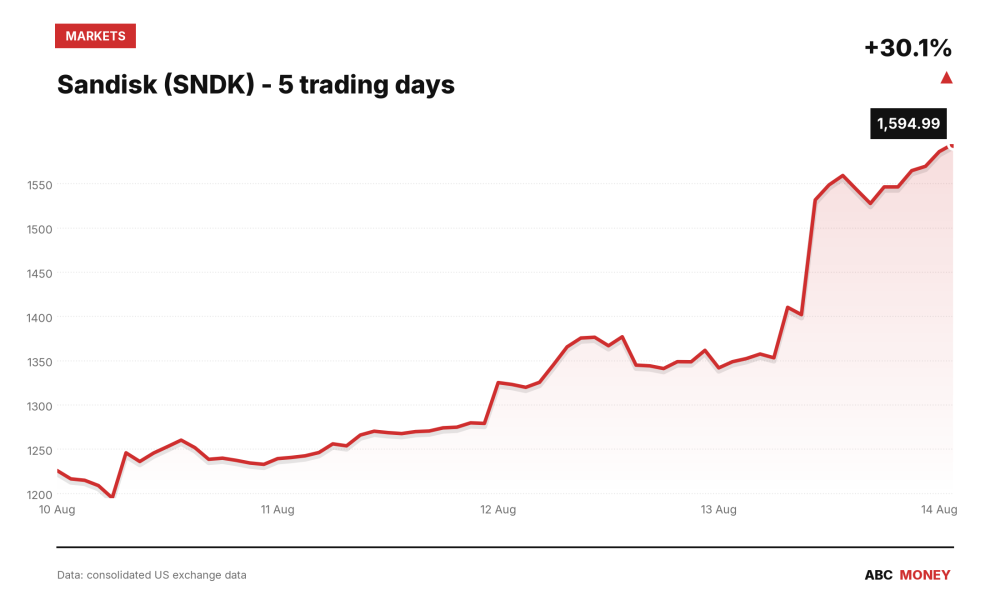
Sandisk’s investor day on 13 August 2026 did something a lot of corporate presentations promise and few deliver: it moved the share price by double digits within hours. Sandisk (Nasdaq: SNDK) climbed as much as 16.7% in morning trading, and closed the session at $1,554.44, up 15.23% on the day, as management laid out a new multi-year financial model that investors judged considerably stronger than they’d been braced for, as Yahoo Finance reported.
The event, branded “Sandisk In Focus,” was the company’s set-piece for explaining how it plans to grow now that memory pricing and AI-driven data-centre demand have become the central story in flash storage. Chief financial officer Luis Visoso used it to put numbers on that story for the first time, according to the company’s release.
The Sandisk investor day numbers that moved the stock
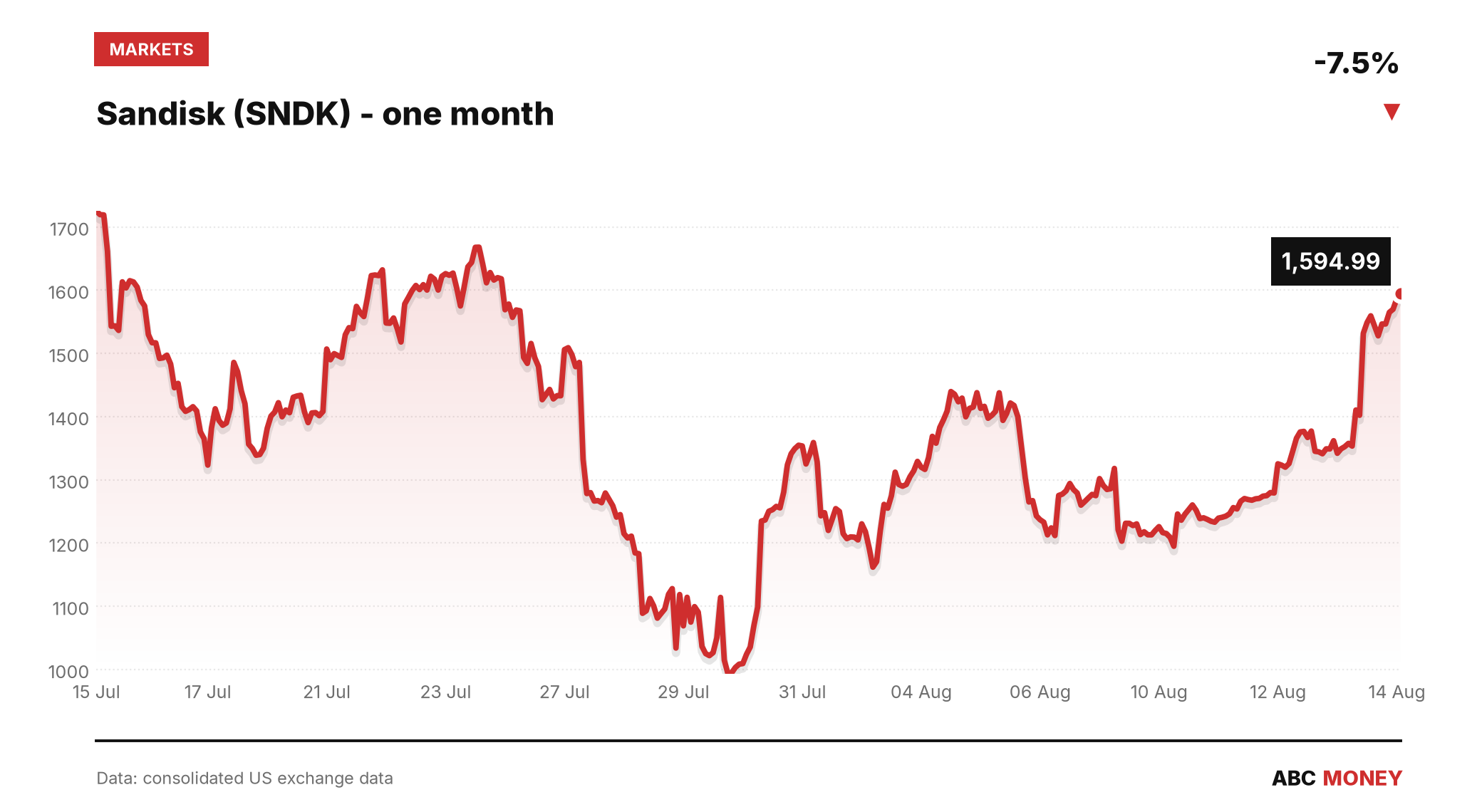
The targets themselves were the trigger. For fiscal 2028 through 2030, Sandisk guided to revenue growth in the mid-to-high teens percentage range, a non-GAAP gross margin of roughly 80% and a non-GAAP operating margin of about 75% – extraordinarily rich margins for a business that has spent much of the past two years grinding through a brutal NAND flash pricing cycle. Management also pointed to an adjusted free cash flow margin near 50%, with a plan to return all of the excess cash generated above reinvestment needs back to shareholders, according to detail reported by Investing.com.
The credibility for those margins rests on what Sandisk calls its New Business Model agreements – multi-year supply contracts that lock in pricing and volume with customers rather than leaving revenue exposed to spot NAND prices. The company said it has now signed such deals with eight customers, covering roughly half its bit shipments in fiscal 2027 and about two-thirds by fiscal 2028. Layered on top is a demand forecast: Sandisk expects the total addressable market for enterprise data-centre flash to reach 1.2 zettabytes by 2030, underpinning the AI-storage growth case that has become the industry’s dominant narrative.
A rally built on a steep prior slide
What made the reaction so sharp was the starting point. Sandisk shares had fallen roughly 30% from a 52-week intraday high of $2,354.39 set on 22 June 2026, a retreat that had erased much of the gain since the stock began trading at $52 following its spin-off from Western Digital in February 2025, as Forbes noted. Even the day before the investor day, the stock had already jumped 8.3% on news that Sandisk and Kioxia had launched a ninth-generation 2-terabit QLC NAND flash chip with a 33% faster interface – a sign that sentiment was already turning before management said a word about margins.
Positioning data suggests plenty of investors were leaning the wrong way into the event. FINRA’s daily short sale volume ratio for SNDK – the share of daily trading volume attributable to short sellers, who borrow and sell stock betting the price will fall – had risen from around 0.21 to 0.31 in late July to a range of 0.41 to 0.46 by early August, according to FINRA data. That build-up of bearish bets, combined with trading volume running 1.64 times its 20-day average on the day, points to a classic short squeeze dynamic: sellers caught offside by news that reset the market’s view of durable margins.
Evercore ISI reiterated an outperform rating on the stock that same morning, part of what the Motley Fool described as a fourth consecutive day of gains heading into the event. The enthusiasm spilled well beyond Sandisk itself: SK Hynix rose 8% to $166.26, Western Digital gained 8% to $490.10 and Micron Technology added 6% to $963.28, as the market treated Sandisk’s data-centre flash forecasts as a read-through for the whole memory sector, per Yahoo Finance’s reporting.
What the underlying filings actually show
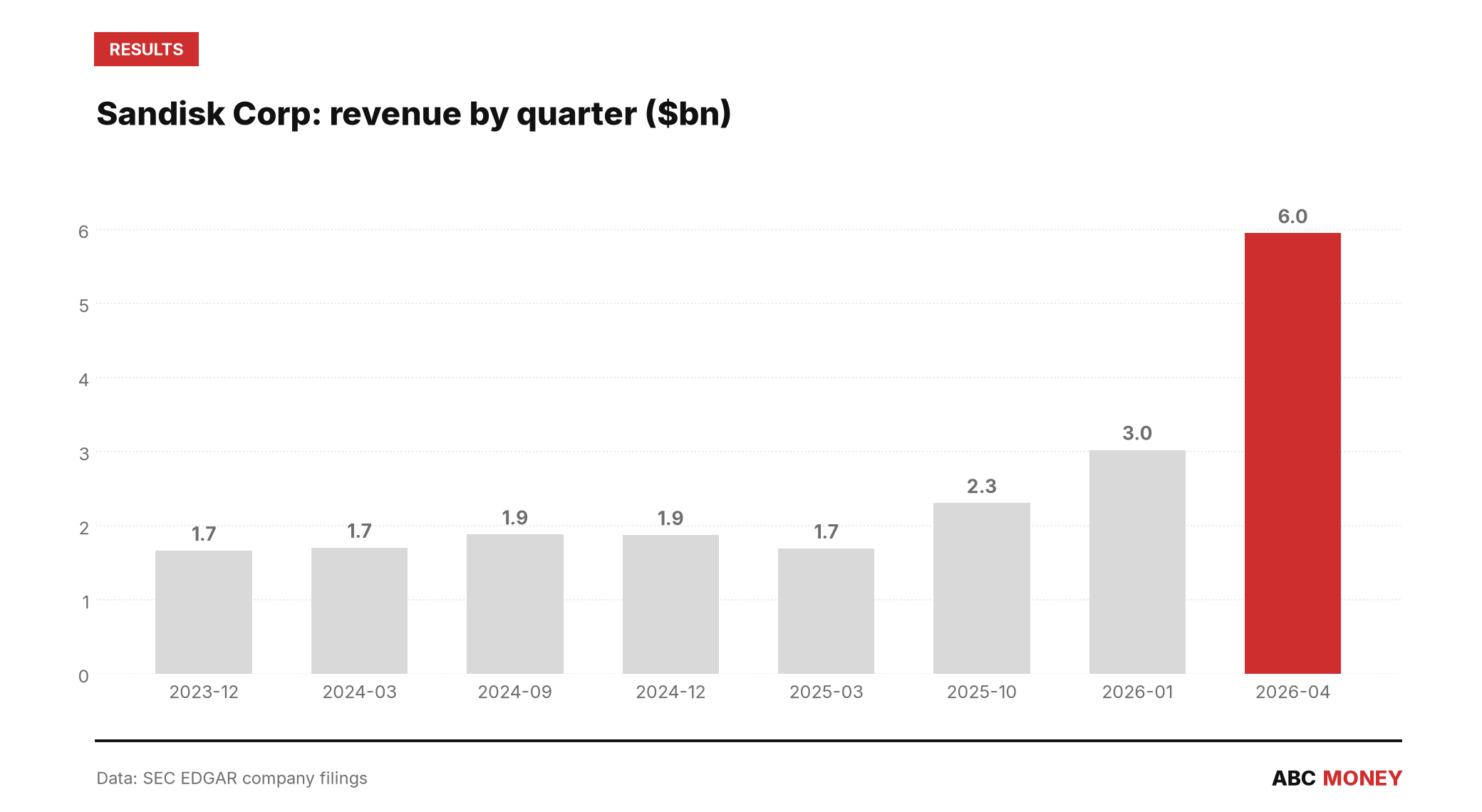
Strip away the investor day theatre and Sandisk’s own quarterly filings tell a consistent growth story. Revenue climbed from $2.308bn in the first quarter of fiscal 2026 to $3.025bn in the second quarter, then to $5.95bn in the third quarter ended 3 April 2026 – a trajectory that helps explain why the market was willing to extrapolate mid-to-high-teens growth out to 2030, based on figures in the company’s 10-Q filed with the SEC. That acceleration follows a rough fiscal 2025, when Sandisk posted a full-year net loss of $1.641bn and diluted losses per share of $11.32, underlining just how far the business has swung since the spin-off from Western Digital.
Macro conditions were unusually quiet that week, which likely let the company-specific story dominate trading. The 10-year US Treasury yield sat at 4.70% on 11 August, barely moved from 4.72% the previous reading, while the 2-year yield held near 4.22%, according to Federal Reserve data. With no rates shock competing for attention, Sandisk’s numbers had the market’s undivided focus.
What happens next
A replay of the presentation is available on Sandisk’s investor relations website for those wanting the full detail behind the targets. The more interesting test comes over the following quarters: whether the New Business Model contracts actually hold pricing steady as NAND supply expands, and whether the eight customers signed so far grow into the broader base needed to sustain an 80% gross margin through a full memory cycle. Analysts will also be watching FINRA’s short-interest data for signs of whether Tuesday’s squeeze fully unwound or whether bearish positioning simply resets at a lower level, and whether Micron, SK Hynix and Western Digital can each independently justify the sympathy moves that followed Sandisk’s forecast.
This article is for information only and is not investment advice or a recommendation to buy or sell any asset. Markets move quickly; figures are correct as sourced at the time of writing. Always do your own research before making financial decisions.


 Bitcoin
  Ethereum
  Tether
  BNB
BNB  USDC
USDC  XRP
XRP  Solana
  TRON
TRON  Lido Staked Ether
  Cardano
  Gram (prev. Toncoin)
  Avalanche