
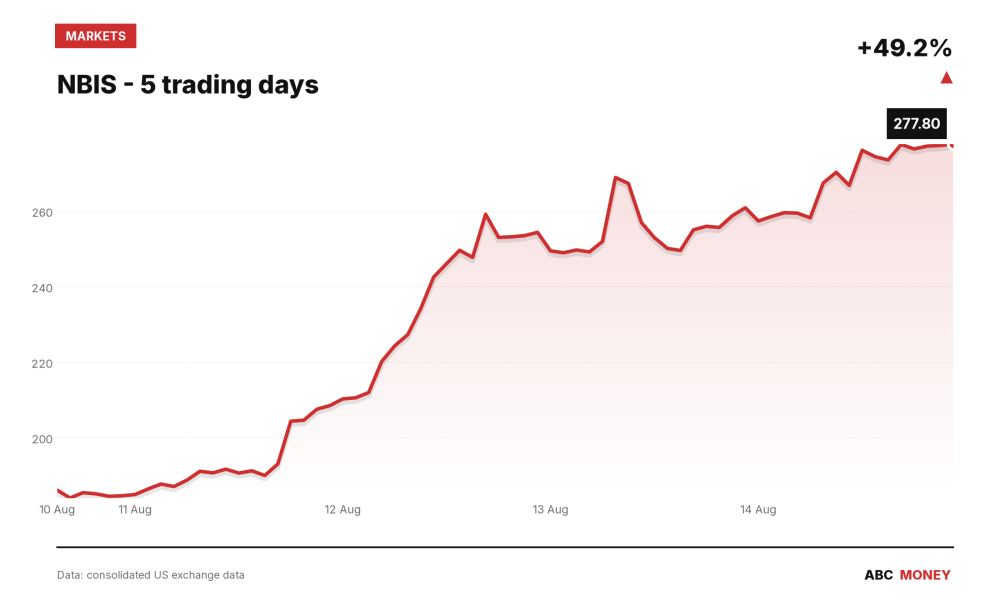
Nebius Group N.V. (NBIS) has raised its contracted power guidance for a third time this year, telling investors alongside second-quarter results on 12 August 2026 that it now expects 5 gigawatts of contracted power capacity by the end of the year – up from 4 gigawatts in May and 3 gigawatts in February, according to reporting on the company’s guidance trajectory. For a business that measures its future revenue in gigawatts of data-centre power it has locked down for artificial intelligence customers, that is a striking rate of upward revision, and the stock has moved accordingly.
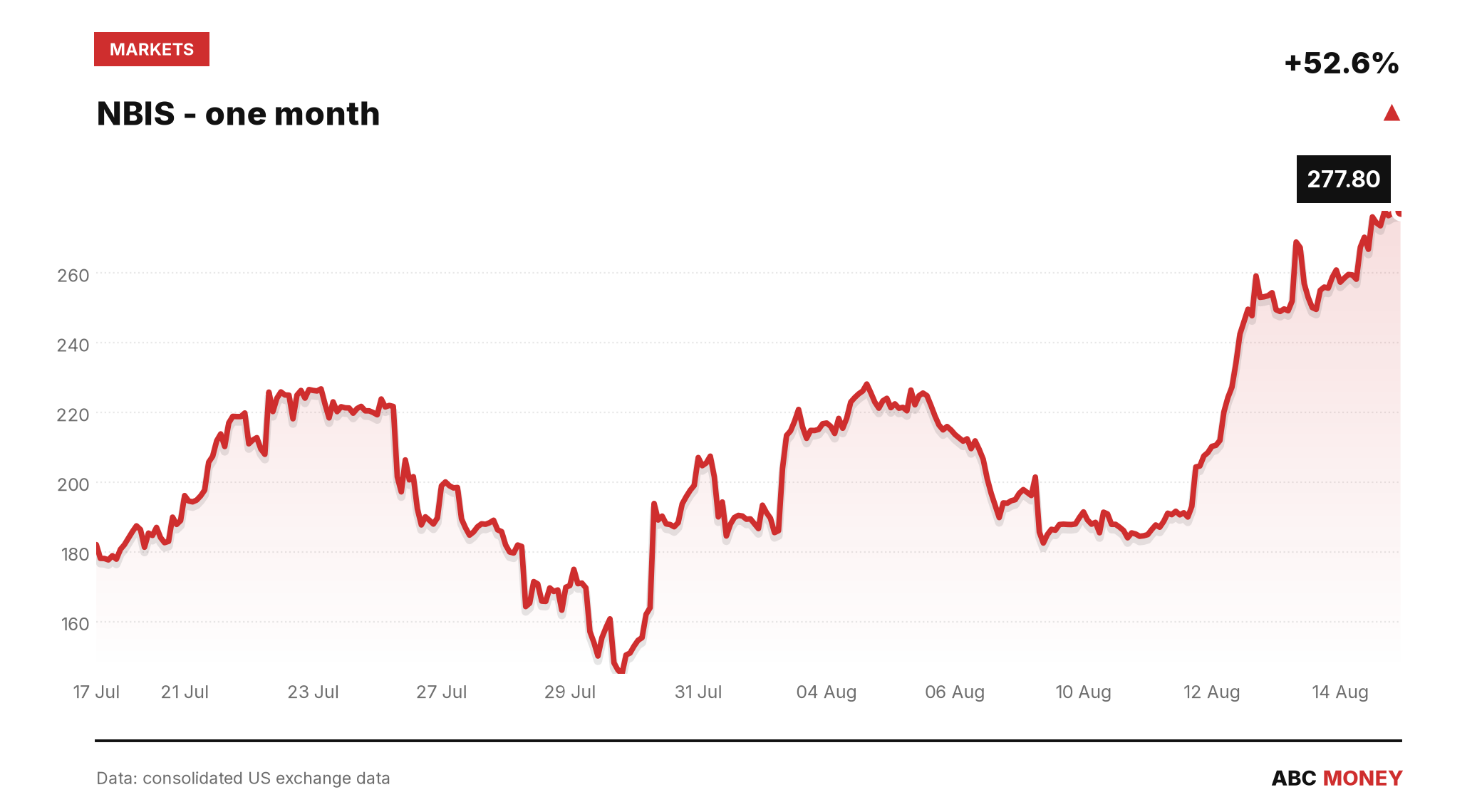
Shares closed at $277.80 on 14 August 2026, up 39.6% over the prior 20 trading days and within sight of a 20-day high struck that same session, against a 20-day low of $145.00, per consolidated exchange data. That is a rally built on more than sentiment: Nebius’s second-quarter revenue came in at $582.3 million, up 454% year-on-year and 46% on the prior quarter, according to the company’s earnings call – a single quarter that now exceeds the $529.8 million Nebius booked for the whole of 2025, and dwarfs the $117.5 million it generated in 2024, both figures drawn from its annual report filed with the SEC.
Why the contracted power guidance keeps climbing
The immediate catalyst is a long-term infrastructure supply agreement with Meta Platforms worth up to $27 billion – a five-year, $12 billion dedicated deal plus up to $15 billion in additional compute purchases – which Data Center Knowledge reported underpins deployments of Nvidia’s forthcoming Vera Rubin chip architecture. Moor Insights & Strategy analyst Matt Kimball framed the agreement as a significant validation for Nebius in a crowded field of so-called neocloud providers competing to rent out AI computing capacity, the outlet noted.
Management’s own language suggests demand is running ahead of even the raised targets. In its Q2 shareholder letter, the company said: “We could sell our entire 2027 capacity on these terms today. We are deliberately not doing so because we see higher value in retaining some capacity for immediate customer needs,” according to the letter to shareholders. Nebius also disclosed a $775 million asset-backed debt facility secured against a contracted backlog it now puts at $40 billion, and reaffirmed 2026 targets of $7-9 billion in annualised run-rate revenue, group revenue of $3-3.4 billion, an adjusted profit margin of roughly 40%, and capital spending of $20-25 billion, per figures compiled by investor-relations materials.
The gap between backlog and delivery
That last figure is worth sitting with. A $40 billion backlog is an order book, not cash in hand, and Nebius is guiding to spend $20-25 billion building the capacity to fulfil it – a scale of investment that dwarfs the company’s current annual revenue base. Nebius only turned its first full-year profit in 2025, posting net income of $82.5 million and diluted earnings per share of $0.33, a sharp reversal from the $641.4 million net loss and -$2.28 per share it reported for 2024, per its EDGAR filings. The company is, in effect, racing to build out physical infrastructure fast enough to convert a rapidly growing contracted book into delivered, billable capacity – and 2027 execution, not this month’s gigawatt number, is likely to be the harder test.
Not every part of that buildout is running smoothly. A public hearing tied to Nebius’s data-centre site in Vineland, New Jersey was adjourned without a vote, a permitting delay that executives flagged on the earnings call as a risk to the construction timeline, according to the same call. Planning and grid-connection friction of this kind is a familiar hazard for the whole AI infrastructure sector, and it is the sort of thing that can slow a gigawatt target even when customer demand is not in doubt.
What positioning data show
For a stock that has rallied nearly 40% in a month, there is little sign of crowded bearish positioning. FINRA’s daily short-sale volume ratio – the share of trading volume attributable to short sales, where a higher number signals heavier bearish activity – for Nebius ranged between roughly 0.38 and 0.64 through late July and mid-August, according to FINRA data, a range that suggests the move has been driven by buyers rather than a short squeeze unwinding. Trading volume in mid-August ran only modestly above its 20-day average, consistent with steady demand rather than a speculative spike.
The next test of the contracted power guidance comes with Nebius’s next scheduled update, when investors will be watching whether the 5-gigawatt figure holds, whether the Vineland permitting question resolves, and whether the gap between backlog and delivered, revenue-generating capacity starts to close. Given how far guidance has moved in six months, the market has learned not to assume this is the last revision.
This article is for information only and is not investment advice or a recommendation to buy or sell any asset. Markets move quickly; figures are correct as sourced at the time of writing. Always do your own research before making financial decisions.



 Bitcoin
  Ethereum
  Tether
  BNB
BNB  USDC
USDC  XRP
XRP  Solana
  TRON
TRON  Lido Staked Ether
  Cardano
  Gram (prev. Toncoin)
  Avalanche