
CoreWeave (NASDAQ: CRWV) has confirmed a multibillion-dollar Hudson River Trading deal, agreeing to supply the quantitative trading firm with cloud access to Nvidia’s (NASDAQ: NVDA) newest chips under a multi-year agreement announced on 20 August 2026. It is the third marquee tie-up CoreWeave has struck with a Wall Street quant shop inside a matter of months, and it lands just as the company’s own quarterly losses continue to widen alongside its revenue.
Under the agreement announced from Livingston, New Jersey, Hudson River Trading will run AI research and model-training workloads on CoreWeave’s platform using Nvidia’s Vera Rubin NVL72 and HGX B200 GPU systems, connected via Spectrum-X Ethernet networking, according to Investing.com. Hudson River’s head of research and development, Kevin Lee, said the firm chose CoreWeave because of its track record running AI systems in demanding production environments, tying the tie-up to the trading firm’s push to scale machine-learning-driven research.
What the Hudson River Trading deal actually discloses
CoreWeave’s chief revenue officer, Jon Jones, told Bloomberg that “This is a material expansion” of an existing partnership between the two firms, but declined to put a number on it. That matters, because “multibillion-dollar” is CoreWeave’s own characterisation rather than a disclosed figure – no filing or interview, including CoreWeave’s, attaches an exact contract value, as Data Center Dynamics also noted. Readers should treat the headline number as directional rather than precise.
What is disclosed is the pattern building around it. The Hudson River agreement follows Jane Street’s earlier commitment of a $6bn cloud-services contract with CoreWeave alongside a separate $1bn equity investment, struck at $109.00 a share, according to an exhibit CoreWeave filed with the SEC. An expanded agreement with quant trading firm IMC earlier in August rounds out what one trade outlet, CryptoBriefing, has framed as a broader trend of high-frequency and quantitative trading houses buying up scarce Nvidia-based compute capacity wherever they can find it.
Growth outpaces the losses, for now
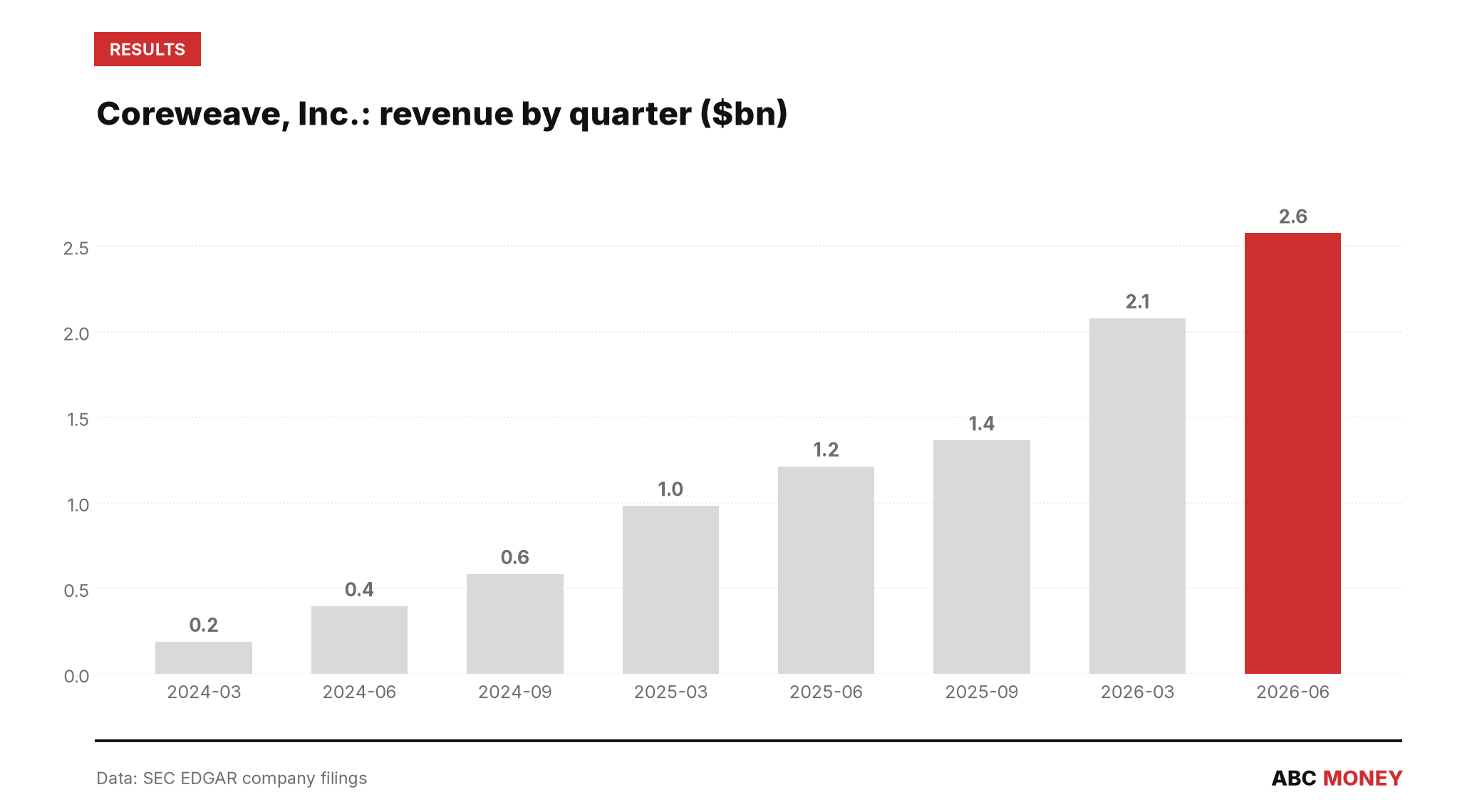
CoreWeave’s underlying numbers show why that scarce capacity keeps finding buyers – and why the losses that come with building it out keep growing too. Revenue rose to $2.575bn in the quarter to 30 June 2026 from $2.078bn in the prior quarter, per the company’s second-quarter 10-Q filing – growth of roughly 24% in three months. Yet the net loss for that same quarter came in at $626m, an improvement on the $740m lost in the first quarter (diluted loss per share of $1.14 versus $1.40, per the same and the prior 10-Q), but still a substantial cash burn for a company signing ever-larger infrastructure commitments. The bet, in effect, is that today’s losses buy tomorrow’s capacity lock-in with customers like Hudson River and Jane Street – a wager that only pays off if utilisation and pricing hold up once the current Nvidia hardware cycle matures.
A muted market reaction
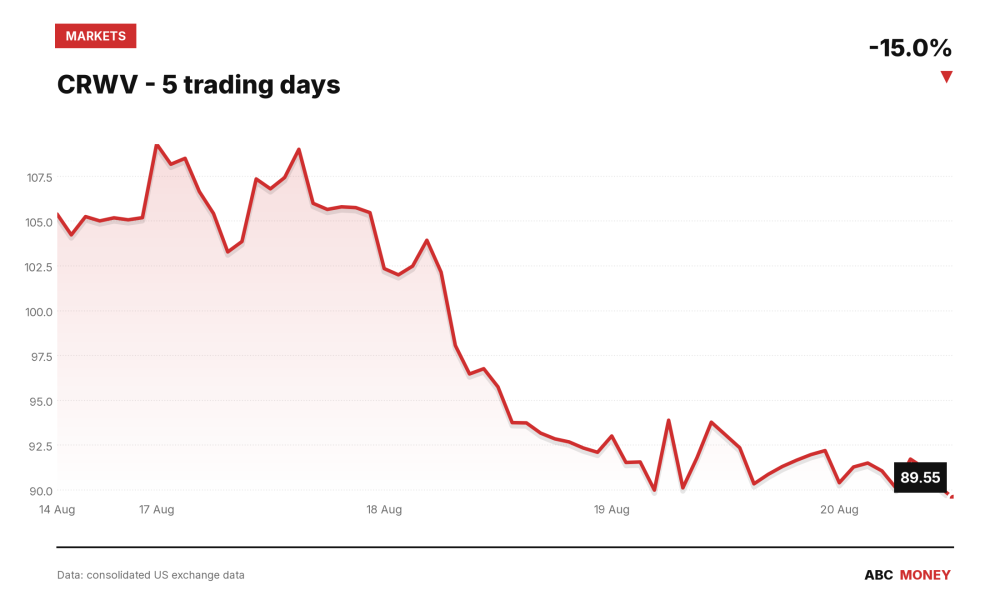
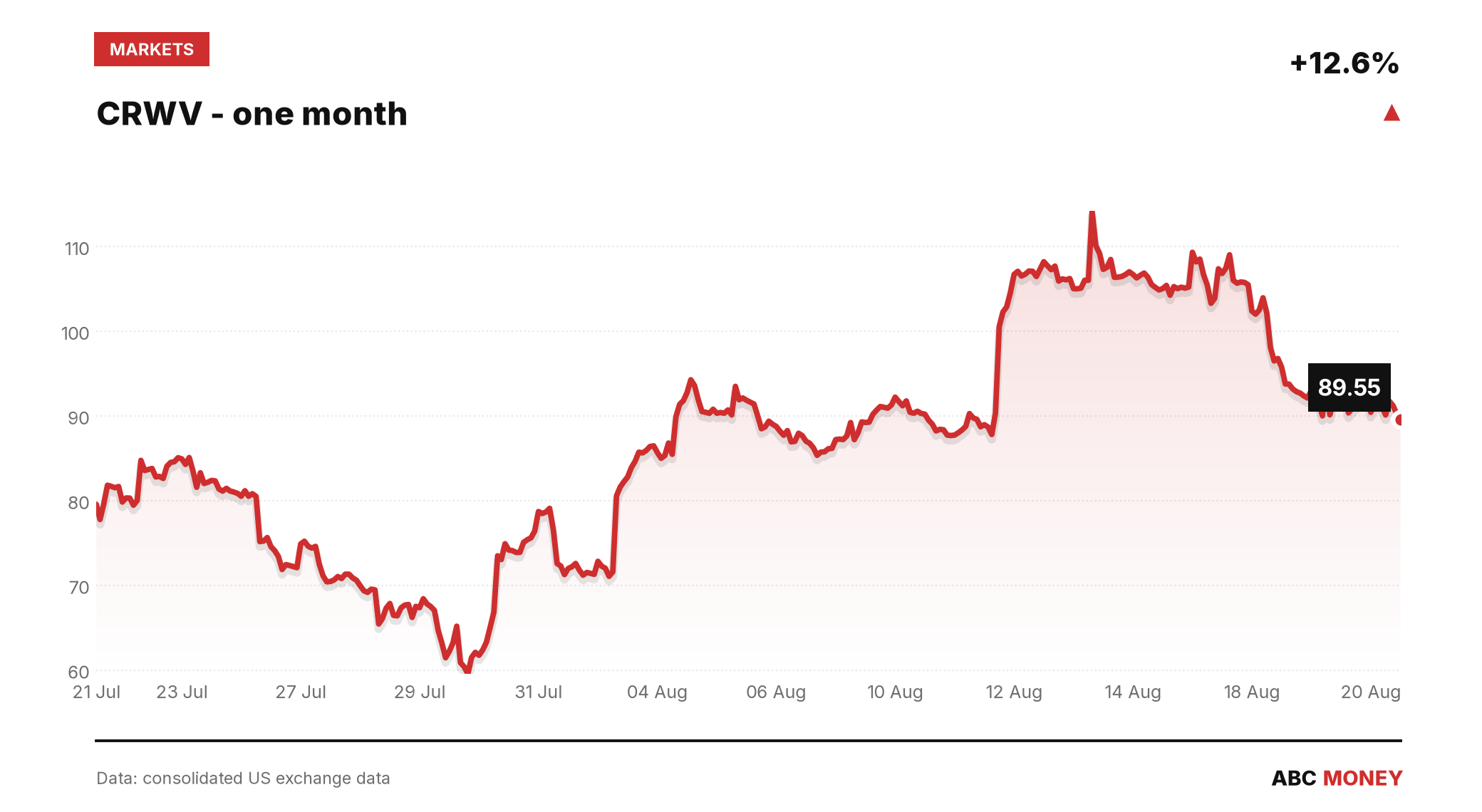
Investors treated the news calmly rather than euphorically. CRWV shares were changing hands at $89.46 as of 20 August, down 1.99% on the day, though still up 20.76% over the preceding 20 trading sessions – a range that has run from a low of $71.05 to a high of $114.16 in that window. Trading volume around the announcement ran at roughly half its 20-day average, hardly the signature of a market caught off guard. Short-sale activity told a similarly unremarkable story: FINRA’s daily short-sale ratio for CRWV – the proportion of trading volume attributable to short sales, where traders borrow and sell shares betting on a price fall – stood at 0.51 on 19 August, squarely within its recent range of roughly 0.45 to 0.57 and showing no spike in bearish positioning ahead of the deal.
Several CoreWeave insiders, including chief executive Michael Intrator, filed Form 4 disclosures with the SEC in the days immediately before the Hudson River announcement, though the filing index does not itself specify share counts or transaction values. Taken together, the picture is of a company whose commercial pipeline keeps deepening even as Wall Street watches its balance sheet just as closely – the next test being whether the November quarterly filing shows the loss trend continuing to narrow as this latest wave of quant-fund contracts starts contributing revenue.
This article is for information only and is not investment advice or a recommendation to buy or sell any asset. Markets move quickly; figures are correct as sourced at the time of writing. Always do your own research before making financial decisions.


 Bitcoin
  Ethereum
  Tether
  BNB
BNB  USDC
USDC  XRP
XRP  Solana
  TRON
TRON  Lido Staked Ether
  Cardano
  Gram (prev. Toncoin)
  Avalanche